

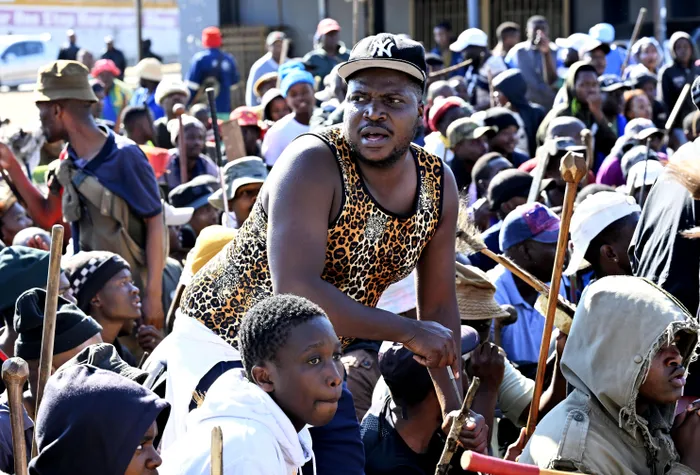
Soweto residents have joined calls for illegal immigrants to leave South Africa as deadline for self-deportation looms.
Image: Itumeleng English/Independent Newspapers
South Africa is bracing itself for widespread disruption and potential volatility tomorrow as a highly coordinated national demonstration against illegal immigration reaches its climax.
Triggered by a rigid 30 June deadline issued by the March and March movement for all undocumented migrants to leave the country, the looming protests have exposed deep societal fractures, forcing political leaders, academics, and traditional monarchs to make urgent appeals for calm.
The planned demonstrations have mobilised thousands of self-described frustrated patriots demanding more stringent border control and immediate deportations. However, beneath the patriotic rhetoric lies a toxic undercurrent of escalating social unrest, with experts warning that ordinary migrants are increasingly being transformed into scapegoats for systemic failures of the state.
The sheer scale of public anxiety has prompted a massive state security response, with the South African Police Service finalising nationwide deployment plans backed by an allocation of over 600 million rand to maintain public order. In the Western Cape, Premier Alan Winde convened an urgent Joint Operations Centre meeting involving municipalities, police, and the South African National Defence Force to establish comprehensive contingency plans.
While affirming that the provincial government fully respects every resident's constitutional right to protest, Winde issued a stern warning to organisers and participants alike.
"Anyone acting outside of the law must be arrested and prosecuted," Winde stressed, adding an impassioned plea to the national conscience: "I call on all residents to reject violence in all its forms. There is no justification for violence under any circumstances. This is not who we are as South Africans."
The anxiety gripping the nation is underscored by alarming data from the African Centre for Migration and Society, which recorded 406 verified incidents of xenophobic discrimination and 75 related deaths between 2022 and 2025. the trajectory has worsened, with a sharp spike of 151 incidents in 2025 alone, followed by dozens more in the opening months of this year, many of which directly followed anti-migrant demonstrations.
Critics and researchers argue that previous high-level government meetings with movement leaders have inadvertently emboldened vigilante groups, allowing township protection rackets to bypass the rule of law. Jacinta Ngobese-Zuma, the former radio personality who founded March and March, has repeatedly characterised the influx of undocumented foreign nationals as a war, demanding an immediate freeze on refugee applications.
While she maintains her campaign is strictly non-violent, the movement's rhetoric has created a highly combustible atmosphere, prompting foreign missions from nations such as Malawi, Ghana, and Nigeria to arrange voluntary repatriation processes for citizens eager to escape potential harm.
The debate has also exposed a profound ideological divide regarding national security and the economy. Proponents of the protests point to admissions by the Department of Home Affairs that the state cannot quantify the millions of undocumented migrants residing within porous borders, raising valid concerns over strained public infrastructure and foreign criminal syndicates using the country as a operational base.
Conversely, humanists and academic leaders argue that the public narrative has become dangerously distorted. Professor Bismark Tyobeka, Principal and Vice-Chancellor of North-West University, noted with immense concern that the vital distinction between lawful refugees, international students, and criminal syndicates is disappearing entirely in the public eye.
Citing independent economic data showing that foreign-born residents comprise just five per cent of the population and act as net job creators, Tyobeka warned against forcing citizens to choose between tolerating xenophobia or ignoring illegal immigration. Arguing that openness and order are complementary ideals rather than opposing ones, he observed that South Africa does not have to choose between the two, noting that when governments fail to manage immigration properly, ordinary migrants invariably bear the brunt of state administrative failures.
As the deadline arrives, the ultimate test will be whether the state can successfully maintain the rule of law while protecting peaceful protestors and vulnerable migrant communities from vigilante overreach. President Cyril Ramaphosa recently took the unprecedented step of appealing directly to the country's traditional monarchs, urging kings and queens to use their deep moral authority and the spirit of Ubuntu to defuse community tensions.
Emphasising that the sole responsibility for enforcing immigration laws rests entirely with the state and never with private citizens, the President warned that lawlessness and intimidation threaten to irreparably tear the social fabric of the nation and damage its international standing.
With global eyes fixed on South Africa, tomorrow's demonstrations will determine whether the country can constructively channel its profound socio-economic frustrations through peaceful civic activism, or whether the fading colours of the historic Rainbow Nation will be further tarnished by a new wave of fragmentation and violence.