

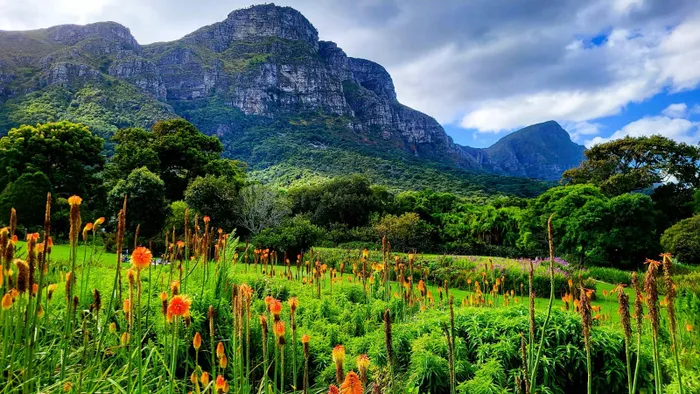
Kirstenbosch Botanical Gardens.
Image: File
A high-profile ministerial walkthrough of Kirstenbosch National Botanical Garden has thrust the world-famous heritage site into the center of a fierce public dispute involving allegations of institutional neglect, political point-scoring, and systemic decay.
Nestled on the slopes of Cape Town’s Table Mountain, the globally renowned garden was subjected to an urgent inspection by the Minister of Forestry, Fisheries and the Environment, Willie Aucamp, following a viral social media campaign that painted a devastating picture of collapsing conservation capacity and vanishing plant collections.
Before the minister’s visit on Wednesday intended to assess the grounds and reassure the public that Kirstenbosch remains a world-class scientific institution, opposition parties seize on the crisis to challenge the governance credentials of the leadership overseeing the national asset.
The controversy was ignited by James Deacon, an environmentalist and long-time contributor to Kirstenbosch, who went public with a series of alarming observations from the facility's nurseries. According to Deacon, plant collections built carefully over decades are actively dying due to sheer institutional neglect.
He claimed that the iconic Protea collection has dwindled to less than a third of its historical size, that only a fraction of the Ericas remain, and that at least one rare species has been allowed to slide from being extinct in the wild to completely extinct. Deacon further alleged that Kirstenbosch has lacked dedicated Protea or Erica specialists for years, leaving production facilities overrun with weeds, and that procurement dysfunction has forced the South African National Biodiversity Institute (SANBI) to divert donor funds meant for education to cover staff salaries.
In a swift bid to manage the damage, Minister Aucamp was accompanied during his inspection by SANBI Chief Executive Shonisani Munzhedzi and Professor Eugene Moll, a widely respected former University of Cape Town plant ecologist who had previously voiced concerns during a television interview.
Providing first-hand insight into the scientific work being undertaken, the delegation audited the garden's seed banks, nurseries, and succulent collections. Following the walkthrough, Professor Moll offered a striking reassessment, admitting he had not realised the facilities were of such a high standard and confirming that previous challenges facing the delicate succulent collections had already been successfully resolved.
Welcoming the candid appraisal, Minister Aucamp declared that while operational challenges certainly exist, the claims of widespread mismanagement and systemic decline are inaccurate and do not reflect the overall state of the garden.
Earlier the GOOD Party launched a scathing attack on the Democratic Alliance (DA), pointing out that Kirstenbosch falls under a DA-led national ministry, a DA-run province, and a DA-governed municipality. The party argued that if the hollowing out of South Africa’s ecological identity is happening under the DA's watch, the party's core political promise of exceptional administrative governance has fundamentally failed. Demanding immediate parliamentary oversight and full transparency regarding SANBI’s finances, the party insisted that Kirstenbosch belongs to the people of South Africa rather than bureaucrats, and must be protected before irreversible damage is done.
As SANBI moves forward with ministerial directives to rebuild its volunteer programmes, strengthen staff mentorship, and partner with international experts to plug skills gaps, the true condition of the garden remains fiercely contested.
Deacon maintains his campaign is a non-political effort driven entirely by a desire to fix deep-seated institutional decay, while the ministry views the panic as an unconstructive distortion of reality.