

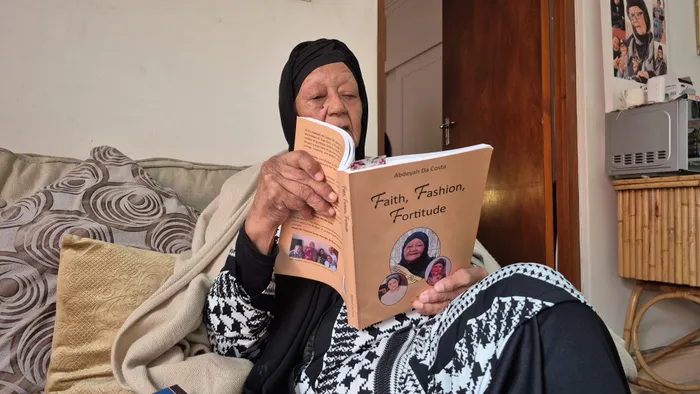
Abdeyah da Costa with her book Faith, Fashion, Fortitude
Image: Tracy-Lynn Ruiters
When you step into the home of 100-year-old Abdeyah da Costa, affectionately known to many as “Aunty A”, you are immediately met with a sense of warmth, tradition and the overwhelming feeling that you are in the presence of someone who has lived through an entire century of South African history.
Aunty A, at first glance, appears serious, composed and dignified. But the moment she begins speaking, that perception softens instantly, replaced by the warmth and love so vividly spoken about in the recently released book, Abdeyah da Costa: Faith, Fashion, Fortitude, written collaboratively by her nephews and relatives Salie Manie, Ashiek Manie, Tughfa Hamdulay and Faseeg Manie.
The biography paints an intimate portrait of a woman whose life became intertwined with the social and cultural history of the Bo-Kaap community.
She greets me by reciting one of her favourite poems before asking about me first.
“How would you describe yourself?” she asks gently, seated comfortably in the home she has occupied for her entire life.
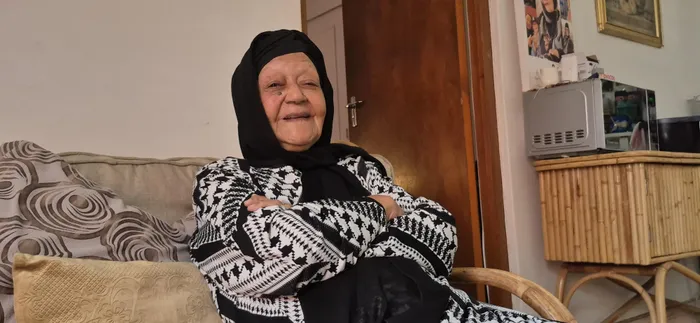
Aunty A is 100 years old
Image: Tracy-Lynn Ruiters
Born in 1925, Abdeyah da Costa has spent all 100 years in the same house at 49 Dorp Street in the Bo-Kaap, watching generations come and go while the neighbourhood transformed around her.
Her hearing remains remarkably sharp, her wit quick and playful.
“The eyesight… dit raak lam,” she laughs softly, motioning for me to sit closer.
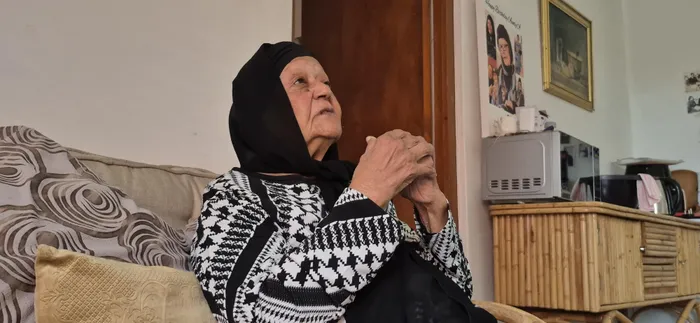
Aunty A is known as the mother of Bo-Kaap
Image: Tracy-Lynn Ruiters
Despite her age, Aunty A does not seem 100, neither in appearance nor spirit.
Speaking about the secret to a long and fulfilled life, she shrugs modestly.
“There is no secret recipe. It’s natural. Success comes naturally as long as you search for it and want it.”
As she pages through old family photo albums stacked neatly beside her couch, she pauses at one particular image.
“That’s me,” she exclaims proudly, pointing at a glamorous younger version of herself wearing bright red lipstick.
“That was the in thing.”
The photographs capture a stylish and confident woman who, despite growing up under apartheid restrictions, built a successful life for herself through determination and resilience.
The book details how financial hardship forced her to leave school after Standard Six, before eventually entering the garment industry in the 1940s.
But Aunty A’s ambitions stretched far beyond factory floors.
She recalled how she eventually opened not one, but several boutiques and Parlour Salons across Cape Town during apartheid, at a time when opportunities for women of colour were severely restricted.
“You learn to respect people, you learn to respect your growth and when you learn all these things and skills, you want to share it,” she said.
The biography describes how, in 1972, she courageously opened the Parlour Salon in Claremont, a so-called “white area” under apartheid laws, even being forced to use a white nominee in aspects of the business due to racist legislation.
What followed was extraordinary. Over time, she expanded the business into five Parlour Salons across the Peninsula.
But while business success formed a major chapter of her life, it is when speaking about her late husband, Sulaiman da Costa, that her eyes light up most.
“He was my life… my everything,” she says softly.
The couple never had children of their own, but she says everyone around her naturally became her child.
“He held me up high. He supported my dreams. And I dreamt a lot. I had big dreams and when I could envision it, I would tell him and he would support me.”
Aunty A also travelled extensively, something rare for many South Africans, particularly people of colour, during apartheid. The book recounts her travels through Africa and Western Europe, including a memorable voyage aboard the QE2 in 1982.
Sitting elegantly on her couch, she carries herself with a timeless grace.
“You look a bit like the Mona Lisa,” I tell her.
“You are not the first person to tell me this,” she laughs. “And I actually saw the Mona Lisa.”
Though she mastered business, fashion and poetry, there is one thing she openly admits she never perfected.
“Cooking,” she said, bursting into laughter.
Her upbringing, she explains, was rooted deeply in discipline and faith.
“My father was very strict. He was the Moulana. My mother taught the girls. So we were taught discipline and to grow in our faith daily.”
She fondly recalled her childhood days reciting nasheeds and growing up in the tightly knit Bo-Kaap community where religion, family and resilience shaped everyday life.
Faith became the anchor of her existence, something repeatedly reflected throughout the biography.
The book also reveals another lesser-known side of Aunty A — her love for poetry. Despite limited formal education, she eventually published her own poetry collection, revealing a deeply reflective and creative inner life.
Today, after a century of life, Aunty A remains a symbol of perseverance, dignity and quiet strength in the Bo-Kaap community...the true mother of Bo-Kaap.