

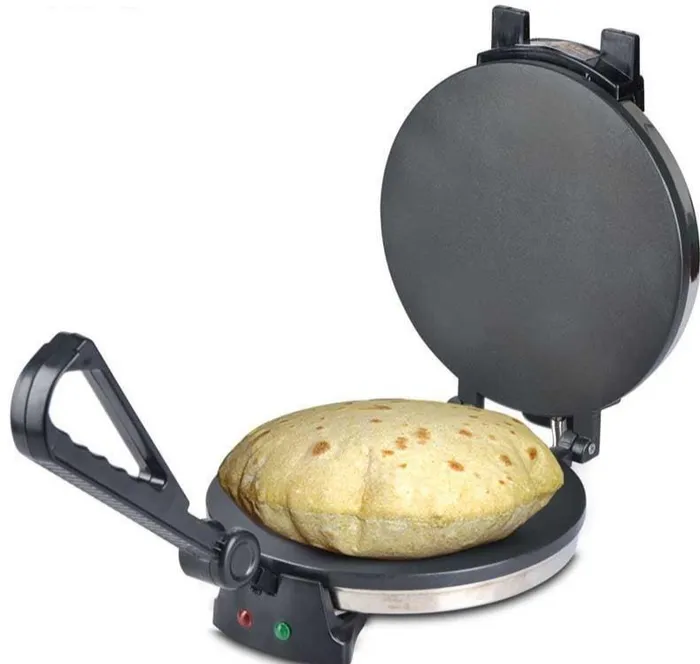
The roti maker machine will never beat the taste of handmade rotis says the writer.
Image: Supplied
PUNTED into kitchens as a shortcut and a promise to ease chores, the roti-maker machine can flatten dough into flawless circles, each roti identical in shape, and cooked on heated electric plates.
But the rotis, puris and parathas flattened and shaped with a rolling pin held with flour-covered hands, and cooked on a ghee-smeared tawa, carry something no algorithm can replicate.
For the new cook, hand-rolled rotis emerge with uneven edges, jagged outlines like the crumbling, winding sections of the Great Wall of China; for the experienced, the pressure of fingers create near perfect circles. But the taste and aroma born of the warmth of human touch cannot be matched by any machine.
This is the difference between artificial intelligence (AI) and natural intelligence.
AI excels at precision, repetition, and scale. It can mimic patterns, predict outcomes, and deliver uniform perfection. Yet, it lacks the subtlety of human intuition – the ability to bend rules, to improvise, to infuse creation with emotion, thereby ensuring that even irregular shaped, buttery rotis taste divine.
AI may have democratised creativity, but human imagination, judgement, and lived experience remain irreplaceable. AI is breaking down the traditional barriers to artistic expression, making it possible for anyone to create high-quality art, music, or literature, regardless of their technical skills, formal training, or financial resources. Before AI arrived, if you had the outline for a newspaper article, a concept for a novel, a brilliant idea for a graphic or inkling for a song, your creative journey stopped there because the tools did not exist to create artificial – or false creativity.
And I dare say “false” because AI is not creativity; it is mimicry dressed up as genius. Creativity is born only of human struggle and natural spark. It cannot be reproduced. What machines churn out is polished plagiarism, while true imagination remains the exclusive province of the human mind.
Today, those who once couldn’t string two sentences together, have turned into fluent essayists, thanks to AI which can stitch words with mechanical ease within a split second. Never mind that any discerning reader can instantly spot the tell-tale fingerprints of ChatGPT, Grammarly, Jasper, or one of the countless other AI crutches propping up these instant writers.
AI now makes it possible for anyone to take a photograph, run it through a digital brush, and parade the result as a painting of their own. And the worse part of it, and which irks me, is that people are paying huge sums for what they believe is an original masterpiece, yet its true author was a camera lens, not a human hand. The machine becomes the unseen artist, while the buyer mistakes imitation for creation.
Even professionals, like lawyers, are being duped by AI. A Pietermaritzburg law firm, Surendra Singh and Associates, landed in serious trouble after citing AI-generated case studies that turned out to be fictitious. In January 2025, High Court Judge Elsje-Marie Bezuidenhout found that only two of nine cases cited actually existed, calling the conduct “irresponsible and downright unprofessional”. The firm was ordered to pay costs, and the matter was referred to the Legal Practice Council for investigation. And that, bluntly, is the price you pay for being lazy – trying to save time with a laptop instead of poring through voluminous law books where real precedent lives.
AI masquerades as if it is good at smoothing rough edges and filling gaps in human effort. Yet beneath this glittering surface lies a quiet erosion: the fading of independent thought, the weakening of natural creativity, the laziness of minds lulled into outsourcing imagination and painstaking research.
We see it everywhere, all the time. Videos of little cherub-cheeked children suddenly speaking in beautiful Tamil, like seasoned adults, their words too polished to be their own. Clips of toddlers who cannot yet walk, yet dancing intricate Bharatha Natyam or Kathak moves choreographed by algorithms. Images of faces that never existed, photographs of places that were never visited, voices that belong to no one.
AI can take the existing lyrics of golden oldie songs, tweak the tune just enough to sound “new”, layer in a cloned voice and then re-stage the whole performance with fresh scenery or digital backdrops. But no amount of effort in the digital studio can take away the beauty of the original rendering by Lata Mangeshkar or TM Sounderarajan, the magic that once spun at 78 or 33 RPM on scratchy records, carried by yesterday’s musical instruments and framed in black-and-white backdrops. Those imperfect grooves held more soul than any algorithm ever will.
In the workplace, AI drafts reports, analyses data, manages schedules, and even conducts job interviews. Efficiency has become the new deity, and the human spark is relegated to the margins.
Now let’s fast-forward a few decades, to around 2070 or so. The world will have grown weary of the machine’s perfection. The sheen of AI-generated prose will feel sterile, its polished grammar lifeless, its flawless photographs soulless. People will begin to yearn for poor syntax, the misspelled word, the raw brushstroke, the unfiltered photograph.
Fifty years from now, our brethren will crave the spark of human imperfection, the very flaws that make art alive. Just as raw silk carries its rough stitches and uneven weave, yet glows with a beauty no machine can replicate, so too will the crooked sentence, the trembling note, and the jagged brushstroke be treasured. AI may polish and smooth, but it cannot give us the texture of life, the imperfections that make creation authentic.
I foresee a time when AI must step aside for the living grace of human touch, perhaps not so much in the relentless and profit-driven world of industry and agriculture, but certainly wherever creativity is the true currency, especially in writing and the arts.
When I glance through newspaper pages today, I can so easily spot the journalists who ride piggyback on AI yet shamelessly claim the byline. Their prose has the sterile shine of machine polish, but they parade it as original thought; as if Ctrl+C and Ctrl+V were acts of genius which few know about.
I am thankful that when I started as a rookie journalist on clickety-clackety typewriters, the keys only had alphabets, numbers, and punctuation. No keys for copying and pasting – just sweat, ink ribbons, and the grind of real craft which called for thorough research through bound back-copies of newspapers and the weighty volumes of Encyclopaedia Britannica.
And hell hath no fury like lanky, bespectacled, chain-smoking Barbara Strachan, the librarian at Independent Newspapers, if borrowed old newspapers were not returned in good condition – and soon. That was journalism forged in dust, discipline, and the wrath of librarians, not in shortcuts and silicon.
AI can compose symphonies that echo Mozart, but it cannot replicate the trembling improvisation of a singer finding her note in the moment. Decades from now, audiences will flock to hear voices untrained by machines, songs sung with breath and error, melodies shaped by instinct rather than code. To sing again will be an act of rebellion against the machine’s dominance. Much like the timeless grace of hand-carved woodwork compared to machine-cut furniture: one is flawless, the other is alive.
Painting, too, will reclaim its place. AI can generate canvases in the style of Van Gogh or Picasso, but the brush dipped by a human hand carries the tremor of emotion. The uneven stroke, the accidental smudge, the pause of hesitation – these are the fingerprints of natural intelligence. In a future saturated with flawless digital art, the handmade will be treasured.
Photography will undergo a similar revival. Today, images are doctored, filtered, photoshopped into perfection. Tomorrow, people will yearn for the unedited shot: the blur of motion, the tilted necktie, the shadow across a face – reminding me how our trusted GSD Balu photo-bombs all family pictures.
And beyond art, even some sections of industry will rediscover the handmade. Cars assembled by hand, furniture carved by artisans, bread kneaded by bakers – these will be prized not for efficiency, but for essence. AI will have lost its attraction, and humanity will reclaim the dignity of creation.
This renaissance of natural intelligence will not come easily. Generations accustomed to machine assistance will have to relearn the art of thinking, the discipline of writing, the patience of painting, the courage of singing. But necessity will drive them. As AI saturates every corner of life, originality will become scarce, and scarcity will breed demand.
AI dazzles us daily. But let’s not be fooled into thinking the machine has surpassed the mind. Every brushstroke it imitates, every chord progression it recombines, every theorem it calculates, every newspaper article it puts together, was first conceived by natural intelligence. The human mind imagined the raga before the algorithm, wrote the sonnet before the chatbot, proved the equation before the processor.
AI does not invent from nothing; it accumulates, digests, and rearranges the vast archive of human achievement. AI’s every dazzling output is stitched from the threads of human thought; every algorithm is an echo of a mind that once dared to dream. AI is the echo; humanity is the voice.
** The views expressed do not necessarily reflect the views of IOL or Independent Media.