

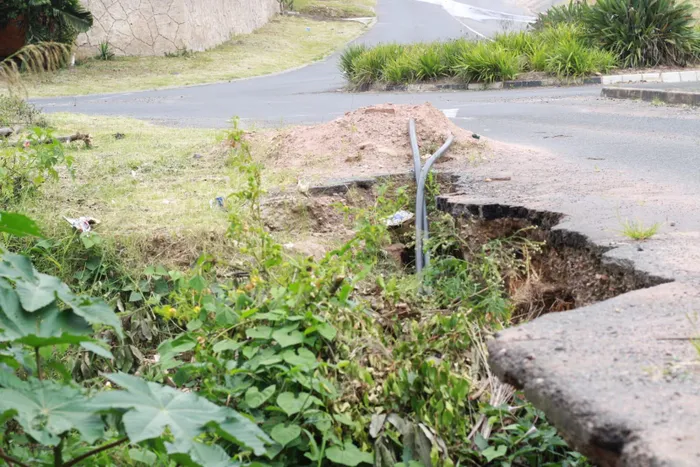
A road in Trenance Park - New Phase, which has not been repaired after workmanship to fix a water pipe.
Image: Chumani Mazwi
RESIDENTS and civic leaders in eThekwini expressed outrage over the municipality's ongoing financial mismanagement, as a recent audit revealed alarming irregular expenditure and service delivery failures
The 2024/2025 Consolidated General Report on Local Government Audit Outcomes, presented by Auditor-General Tsakani Maluleke, highlighted that only 39 out of 257 municipalities across the country achieved a clean audit.
It revealed a precedent of deep-rooted mismanagement and systematic failures.
According to the report, despite handling an expenditure budget of R71,02 billion - equivalent to 57% of KwaZulu-Natal’s total municipal budget - the eThekwini Municipality failed to attain a clean audit for more than a decade.
The report further indicated that irregular expenditure surged from R3,41 billion in 2020/2021 to R7,80 billion in 2024/25, with eThekwini contributing R4,48 billion, or 57% of this total.
According to the report, 98% of the main infrastructure-related conditional grant of R7,5 billion received in 2024/25 was used.
The grant was intended for infrastructure development and maintenance.
The report stated that severely deteriorated roads, poor drainage and sewage spillages in eThekwini and Msunduzi (Pietermaritzburg) highlighted inadequate routine maintenance and delayed responses to defects.
In addition, the report stated wastewater treatment works in eThekwini and the City of uMhlathuze (Richards Bay) continued to discharge non-compliant wastewater and this issue was not being addressed.
The eThekwini, Msunduzi and Endumeni (Dundee) municipalities also failed to manage landfill site compliance, illegal dumping and environmental risks.
According to the report, project management weaknesses further hindered service delivery to communities.
It read, for example, the Etafuleni housing project in eThekwini was due for completion in 2014 but remained significantly delayed 12 years later.
The report stated that some beneficiaries are occupying incomplete homes without basic services. This was due to poor planning and weak coordination to connect basic services, resulting in illegal electricity connections and inadequate access to water, creating health and safety risks.
Abdool Valodia, chairperson of the Overport Ratepayers Association, said the report painted a troubling picture of the eThekwini Municipality's persistent failure to achieve a clean audit over the past decade.
“This is unacceptable for a metro of eThekwini’s size and strategic importance.”
He said the failures directly affected the daily lives of eThekwini residents.
“Ratepayers in areas like Overport continue to pay high rates and taxes yet endure potholed roads, frequent sewer blockages, unreliable water supply, and mounting service delivery protests.
“Vulnerable communities suffer most. Children and the elderly are exposed to environmental hazards, while delayed housing projects perpetuate informal settlement conditions and undermine dignity and safety,” he said.
Valodia called on the municipality to treat the findings as a “wake-up call”.
“Immediate and decisive action is required such as strengthening financial controls and rooting out irregular, fruitless and wasteful expenditure through transparent procurement processes and consequence management for officials who fail to comply.
“The municipality needs to fix basic infrastructure maintenance by prioritising routine road repairs, drainage upgrades, and wastewater treatment compliance to prevent further environmental damage.
“Residents have waited long enough. Ratepayers demand better value for their hard-earned money. We urge the mayor, city manager, and council to present a credible turnaround plan with clear timelines and measurable targets within the next quarter,” he said.
Rachael Naidoo, secretary of the Tongaat Civic Association, said the irregular and wasteful expenditure were unacceptable.
“The municipality must transition from merely identifying and writing off irregular expenditure to enforcing robust consequence management. Officials responsible for persistent Supply Chain Management breaches and financial misconduct must face swift and visible disciplinary action.
“We urge the city to rigorously overhaul its supply chain processes. The recurring irregular spending tied to expired contracts and non-compliance indicates a systemic failure in internal controls that must be corrected at the administrative level. The leadership of the city must set the 'tone at the top' to shift the municipality's culture toward proactive compliance,” she said.
Naidoo said communities could not continue to suffer.
“This money could have been used to improve key infrastructure like water and sanitation. In Tongaat, we are faced with regular water disruptions and sewer flowing into the streets and rivers due to poor maintenance. Our community facilities are in a state of disrepair. It is unacceptable.”
Pooh Govender, chairperson of the Shallcross Civic and Ratepayers Association, said while the report was deeply concerning, it came as no surprise.
“Unfortunately, communities have been living with the consequences of municipal failure for years. For the association, the report simply gives official recognition to what residents experience every day - taps running dry, sewage flowing into our rivers and neighbourhoods, roads crumbling, illegal dumping becoming commonplace, housing projects left incomplete for years, and critical infrastructure deteriorating through neglect rather than being maintained through proper planning. These are not isolated service delivery failures. They point to a systemic breakdown in governance, financial management, project execution and accountability.”
Govender said the municipality must move beyond crisis management.
“It requires a comprehensive infrastructure renewal strategy, preventative maintenance instead of reactive repairs, competent project management, accurate revenue collection systems, transparent procurement, and firm consequence management where negligence, waste or maladministration occur.
“If this report does not trigger meaningful reform, eThekwini risks becoming a municipality trapped in a cycle of declining infrastructure, weakening finances and diminishing public confidence. The people of eThekwini deserve better. They deserve a municipality that is accountable, responsive and capable of delivering the basic services that every resident has a constitutional right to expect,” he said.
Yogesh Naidoo, chairperson of the Reservoir Hills Ratepayers Association, said the findings lay bare the serious failures of governance and accountability.
“The report highlights chronic weaknesses in financial management, including poor budgeting practices, weak revenue and cash-flow management, and massive water and electricity losses.
“For communities, this translates into burst pipes left unattended, deteriorating roads, sewage spillages, and housing projects delayed for over a decade. Families are left in incomplete homes without basic services, while ratepayers continue to shoulder the cost of mismanagement,” he said.
Naidoo said the association called for stricter measures and stronger accountability mechanisms to be enforced against the municipality.
“Ratepayers cannot continue to subsidise inefficiency and corruption. Unless stricter measures are implemented, communities will remain trapped in a cycle of poor service delivery and financial mismanagement.”