

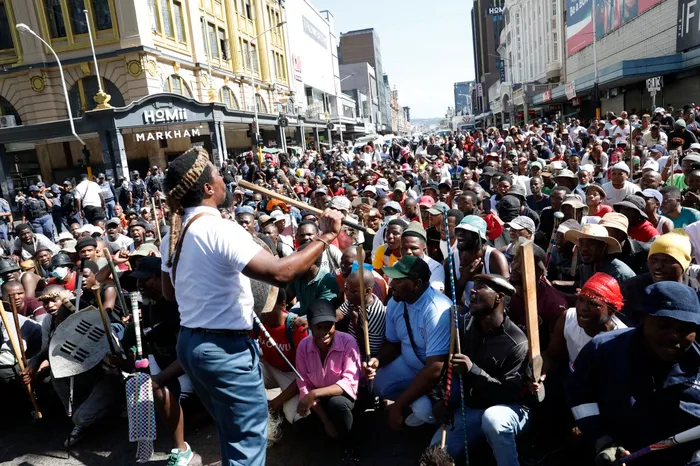
WITH the June 30 deadline for undocumented immigrants approaching, KZN police have identified eThekwini and uMgungundlovu as key hotspots for anticipated marches. March and March protestors seen in the Durban CBD as police monitor the the scene.
Image: Doctor Ngcobo / Independent Newspapers
WITH the June 30 deadline for undocumented immigrants approaching, KZN police have identified eThekwini and uMgungundlovu as key hotspots for anticipated marches.
Acting Police Commissioner Major General Phumelele Makoba outlined the police's preparations and the importance of maintaining order during these demonstrations, during a media briefing.
“eThekwini district is one of our hotspots. uMgungundlovu is one of our hotspots. And then the rest of our hotspots,” Makoba said.
Reflecting on the recent wave of marches calling for undocumented immigrants to leave the country, Makoba said marches are expected to be heightened on June 30, with fears of instability and chaos.

Acting KwaZulu-Natal Provincial Commissioner Major General Phumelele Makoba said that law enforcement is ready to maintain peace and order during the planned truck protests and anti-foreigner marches.
Image: SAPS
Makoba said that based on the information they have, the June 30 marches will be different due to the number and locations of the marches.
“They will overstretch our resources. That is what we are preparing for so that when they march, both those marching and those not marching will be safe. It is the sheer number of these marches.
“We also know that we have seen in other places that when there is a peaceful march, there is a group that goes out and commits a crime. One of the examples is the one in Pietermaritzburg on Friday. The march was peaceful, it ended peacefully, and then there was a group that took an opportunity and committed a crime.”
She said police have been monitoring the marches and are aware that there were people who were conducting searches on civilians and demanding proof of identification.
“We are reminding those who will be engaged in marches that no civilian is allowed to search a fellow civilian, and no civilian has the right to demand any form of identification from another person. That is the duty of law enforcement officers. It is a crime to be in South Africa without proper documentation; however, it is the duty of police and other law enforcement agencies to arrest undocumented foreign nationals,” Makoba said.
“Police will enforce the law without fear or favour on anyone who is found to be breaking the law. We have a duty to educate the public about what is permissible and what is not, so that they do not claim innocence when police enforce the law.”
Makoba highlighted that police have held a series of meetings at various levels with march organisers.
“The word is that the marches will be peaceful demonstrations,” Makoba said. “Police have a duty to ensure stability, peace, and order, and as such, we shall deploy accordingly. It is the responsibility of the organiser of the march to appoint marshals to control the crowd.”
Makoba said planning for marches is under way, and areas of interest have been identified.
Working together with other law enforcement agencies, sister departments, Business against Crime, and private security companies (E2 partners), the Provincial Joint Operational and Intelligence Structure (PROVJOINTS) has developed a comprehensive operational plan to ensure that there is peace, order, and stability in KZN, days leading to June 30, on the day and beyond, she said.
“Our intelligence officers are on the ground collecting valuable information that operatives will use to maintain order and stability,” Makoba said.
“Acts of intimidation, public violence, blockading of roads, and incitement of violence will be dealt with in accordance with the law. It is a constitutional right to march, as much as it is a constitutional right not to march.”
Makoba said that police will ensure workers going to work on June 30 will go on without fear of intimidation.
“Those who are planning to take advantage of peaceful marches to commit crimes will face the wrath of the law,” Makoba warned.
“Police resources such as drones will come in handy in identifying those who want to test the capacity of the police.”
Makoba added that engagements with march organisers will continue so the relationship between the police and community members remains intact.
“We are appealing to all those who will be marching to respect the police and adhere to the routes as directed by the police,” Makoba said.