

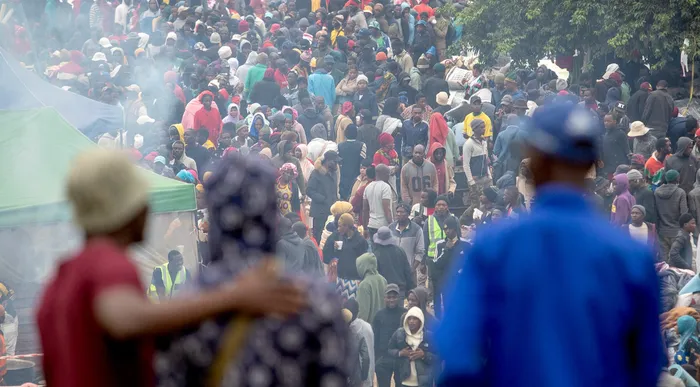
Hundreds of documented and undocumented foreign nationals are currently displaced across eThekwini (Durban) following threats and protests from armed local groups demanding they leave the country. Thousands of individuals—primarily from Malawi and Mozambique, along with other African nations—are sheltering in makeshift camps and open fields.
Image: Leon Lestrade / Independent Newspapers.
THE temporary accommodation of thousands of Malawians at the Sherwood Hall grounds has ignited a fierce political debate, with parties calling for urgent government action.
They have urged authorities to balance compassion for vulnerable migrants with the concerns of local communities already grappling with unemployment, poverty and strained public services.
uMkhonto weSizwe Party (MKP) eThekwini region spokesperson, Mkhanka Nunu Zuma, said: “We are surprised by the speed with which government institutions have responded to this situation. This raises serious concerns about consistency in the application of the law."
He argued that authorities had historically taken a far more aggressive stance against unauthorised gatherings involving local residents.
"Under South African legislation, gatherings of more than 15 people are required to follow the necessary legal procedures, including obtaining the relevant authorisation. We have, on numerous occasions, witnessed workers, students and ordinary South Africans being dispersed by force for participating in unauthorised gatherings."
Zuma questioned why authorities appeared willing to tolerate the occupation of a public facility when homeless South Africans have often faced eviction from public land.
"We have also seen our homeless attempting to erect shelters on open land being removed by the same authorities. It is therefore reasonable to ask why the government has not acted with the same urgency and firmness in addressing the occupation of Sherwood Park, which has prevented members of the local community from using the park as intended."
He said reports of voluntary repatriation and deportation efforts involving Malawian nationals highlighted broader immigration challenges facing South Africa.
"These developments suggest that South Africa is facing a serious challenge relating to undocumented migration," Zuma said.
He maintained that the government should prioritise South African citizens facing socio-economic hardships.
The DA eThekwini caucus leader, councillor Thabani Mthethwa, said eThekwini like many other cities was a victim of uncontrolled immigration.
"The situation with foreign nationals gathered in Sherwood is unfortunately becoming a humanitarian crisis. We urge all state stakeholders working with their foreign counterparts to expedite the processing of these displaced persons in line with immigration laws of the country to avoid further crisis."
Mthethwa called on government agencies to accelerate processing procedures to prevent further deterioration of conditions at the site.
The IFP councillor, Dr Jonathan Annipen emphasised the need for a balanced approach that respected both humanitarian obligations and community concerns.
"As public representatives, we must recognise that every person, regardless of nationality, deserves to be treated with dignity and respect, particularly where humanitarian considerations are involved."
However, Annipen said government departments needed to provide greater transparency regarding the circumstances surrounding the accommodation arrangement.
He noted that local residents had legitimate concerns about public facilities, safety and service delivery.
Minority Front leader Shameen Thakur-Rajbansi said the Sherwood situation ignited strong public debate across South Africa.
"At the centre of this debate are two competing realities that cannot be ignored. On the one hand, are vulnerable human beings who require temporary shelter, protection and humane treatment. On the other hand, we have South African communities who are increasingly frustrated by rising unemployment, weak border control, illegal migration and growing competition for scarce economic opportunities."
Thakur-Rajbansi stressed that humanitarian assistance must not be confused with long-term immigration policy.
"While the Department of International Relations and Co-operation engages the Malawian government regarding arrangements for the possible repatriation of its citizens, the individuals currently housed at Sherwood must be treated humanely and provided with basic necessities such as shelter, sanitation, health care and security. That is the mark of a civilised society.
"Similarly, humanitarian assistance cannot be mistaken for a long-term immigration policy."
She argued that the incident exposed the absence of a comprehensive national migration framework and warned that unresolved tensions could deepen social divisions.