

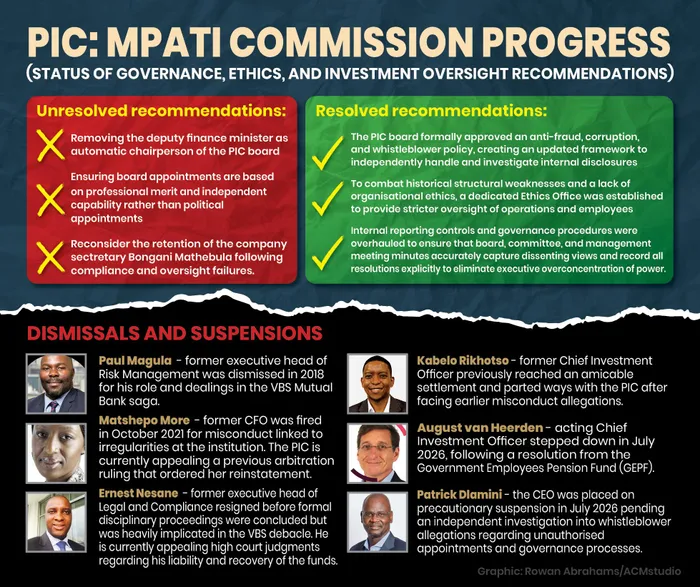
The Public Investment Corporation (PIC) is suffering from a severe governance crisis driven by ongoing internal power struggles despite despite key recommendations from the Mpati Commission of Inquiry.
Image: Rowan Abrahams/ACMstudio
As internal power struggles continue to threaten the state asset manager, the Public Investment Corporation (PIC is experiencing a worsening governance crisis.
This is according to the Association for the Monitoring and Advocacy of Government Pensions (AMAGP), which said the PIC has been in the news for many years for the wrong reasons, despite key recommendations from the Mpati Commission of Inquiry.
The advocacy group said this is because two key recommendations with political ramifications have not been implemented.
This follows news that the PIC board placed CEO Patrick Dlamini on precautionary suspension amid whistleblower allegations of corruption, mismanagement, and executive overreach.
The turmoil has exposed that critical reforms from the 2020 Mpati Commission of Inquiry remain unresolved, despite the PIC’s executive leadership previously assuring Parliament that all recommendations had been fully implemented.
The Mpati Commission was established in October 2018 to look into allegations of impropriety at the PIC. The commission was tasked with investigating corruption, governance failures and improper investment decisions at Africa’s largest asset manager.
The commission produced a landmark report containing 276 recommendations targeting systemic corruption and governance failures.
The commission concluded that having the deputy minister automatically chair the board exposed the PIC to severe political interference and institutional instability. It recommended appointing an independent, non-executive chairperson with specialised expertise in finance, pension funds, and corporate governance.
The report explicitly stated that board appointments must be based strictly on professional merit and independent capability rather than political deployment or patronage.
The commission also directed the PIC board to formally reconsider the compliance, oversight, and governance structures surrounding the reinstatement of Company Secretary Bongani Mathebula.
Following the report, the former executive head of Risk Management was dismissed in 2018 for his role and dealings in the VBS Mutual Bank saga. Matshepo More, the former CFO, was also fired in October 2021 for misconduct linked to irregularities at the institution. The PIC is currently appealing a previous arbitration ruling that ordered her to be reinstated.
Ernest Nesane, the former executive head of Legal and Compliance, resigned before formal disciplinary proceedings were concluded but was heavily implicated in the VBS debacle, and Kabelo Rikhotso, the former Chief Investment Officer, previously reached an amicable settlement and parted ways with the PIC after facing earlier misconduct allegations.
However, Nesane is currently reviewing the court’s judgment regarding his liability and recovery of the funds.
The PIC, meanwhile, approved a revised anti-fraud and corruption framework ensuring internal disclosures are investigated independently from executive management.
A dedicated Ethics Office was also established to monitor organisational ethics, enforce consequence management, and provide tighter control over day-to-day operations and employee conduct.
Despite the recommendations, the PIC is currently embroiled in severe internal fighting, culminating in the precautionary suspension of Dlamini and the removal of acting Chief Investment Officer August van Heerden.
The infighting has coincided with heightened public scrutiny over the PIC's unlisted investment portfolio, where roughly R67 billion has been committed to unlisted entities with significant financial losses recorded.
At the root of the boardroom war is a deeply contested, is a multi-million rand investment transaction involving Lanseria Airport, which reportedly incurred a 400% overvaluation error.
AMAGP chairman Zirk Gous said the current boardroom conflict provides clear insight into how the company is being led.
Gous said this perpetuates the belief that the PIC operates under questionable motives, compromising institutional trust in the organisation’ governance and its fiduciary management of state pension funds.
“It is for the Standing Committee on Finance (SCOF) to demand full disclosure of hidden documents. We can recommend that the very first document on that list for full disclosure should be the investment mandate of the GEPF to the PIC, especially on unlisted investments,” said Gous.
Gous added that the commission recommended that the board chairperson should be independent with a specific term of office plus expertise in pension funds.
He said the state asset manager claims that the recommendations were fully implemented in its report to SCOF in December 2025, 'was dishonest, which has destroyed trust by its actions'.
He said the removal of the political influence and control over the PIC and the appointment of a board based on merit will be the first steps to ensure management integrity.
Both the PIC and Deputy Finance Minister David Masondo, who serves as the board chairperson of the PIC, did not respond to the request for comment.
Masondo’s spokesperson, Sipho Mofokeng, said the deputy minister will not be responding to media queries relating to the PIC while the investigation process by the Financial Sector Conduct Authority (FSCA) is under way.
The FSCA’s regulatory intervention under Section 135 of the Financial Sector Regulation Act follows severe concerns regarding governance, transparency, and leadership stability at PIC.
In a statement issued on Wednesday morning, Finance Minister Enoch Godongwana insisted that the PIC has completed the implementation of the Mpati Commission recommendations.
Godongwana added that while challenges remain, the PIC has made significant progress in strengthening the corporation's governance framework and oversight processes.
Meanwhile, the Public Servants Association (PSA), which represents more than 240,000 public-sector employees, said it remains deeply concerned about developments at the PIC.
“While the GEPF remains a financially sound and well-funded pension fund, recurring governance concerns at the PIC inevitably undermine the confidence of public servants whose retirement savings are entrusted to the institution. The greatest immediate impact is the erosion of trust. Members need assurance that investment decisions are made solely in their best interests and are free from political or improper influence.”