

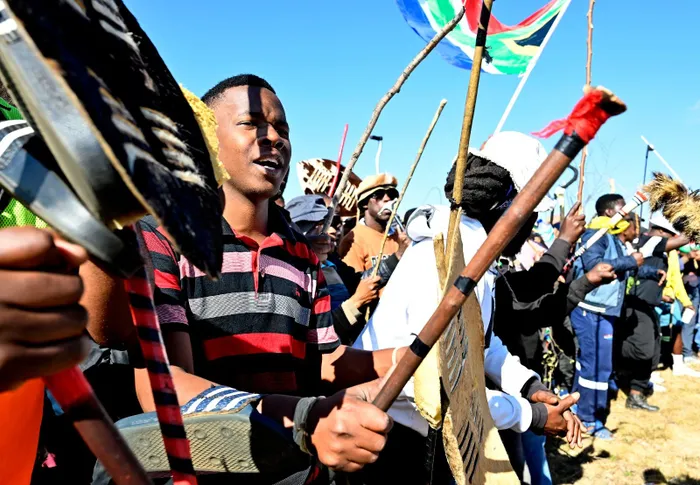
Ahead of a self-imposed deadline, Soweto residents take to the streets demanding action against undocumented foreign nationals.
Image: Itumeleng English/Independent Newspapers
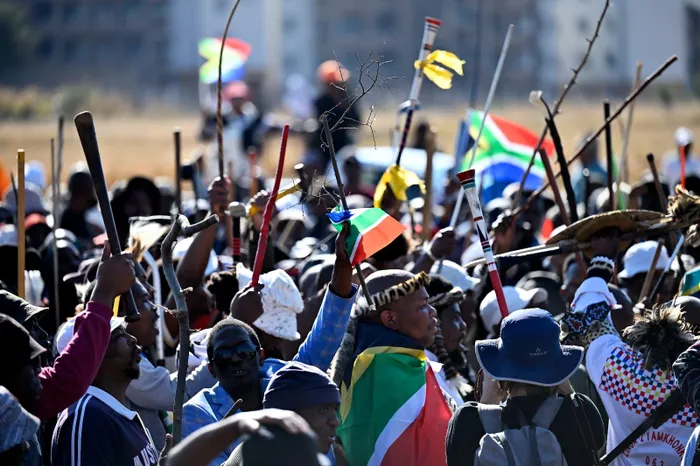
Ahead of a self-imposed deadline, Soweto residents take to the streets demanding action against undocumented foreign nationals.
Image: Itumeleng English/Independent Newspapers
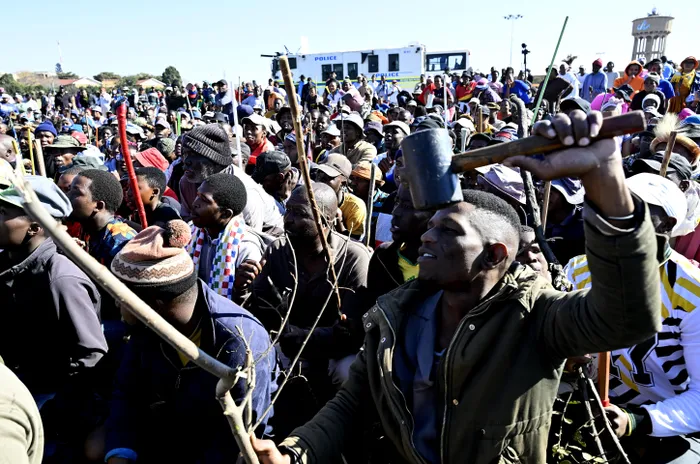
Residents of Soweto took to the streets on Monday, wielding traditional weapons including shields and sticks, to protest against illegal immigrants amid growing socio-economic tensions.
Image: Itumeleng English/Independent Newspapers
On Monday, just before the self-imposed June 30 deadline, many hostel residents, including Izindunas and Amabutho, participated in the final Soweto protest to demand the removal of undocumented foreign nationals from South Africa.
This occurred as Parliament called on small business owners, informal traders, and street vendors to take additional safety measures.
The march concluded at Protea Police Station after beginning at Jabulani Amphitheatre.
Protesters, wielding traditional weapons such as shields and sticks, said they were dissatisfied with the current immigration crisis.
"Our children can't build homes and families on R350. We are losing our children to nyaope and unemployment while the government fails to protect us from illegal immigrants. All we want is for the future of our children to be secured," said Anna Dhlomo, a resident of Jabulani Hostel.
Aaron Xaba, an induna from the Nancefield hostel, passionately advocated for the prioritisation of South African citizens in employment and education opportunities, lamenting the challenges faced by local children.
"Things have become hard for our children who are not working while non-South Africans are everywhere and benefiting from jobs and education opportunities that should be reserved for our children," Xaba stated.
Xaba assured that the protest would remain peaceful, despite some confusion surrounding the legality of carrying traditional weapons.
"We have heard talk that we are not allowed to carry our traditional weapons. However, our weapons carry significant traditional meaning and are not used just anyhow, he explained. The march intended to convey their grievances to the Protea Police station, echoing a collective call from residents," he said.
Echoing Xaba's sentiments, Khanyisani Ngidi, a Dube Hostel dweller, said: "It is true that they must go. They have brought us nothing but a lot of problems, including drugs and crime that we see in our communities.”
Ngidi emphasised that the local population has long welcomed foreigners, but the strain on resources has prompted a desire for change. “We have welcomed them into our homes for a long time, but it is our government that has made things very difficult for Africans," he remarked.
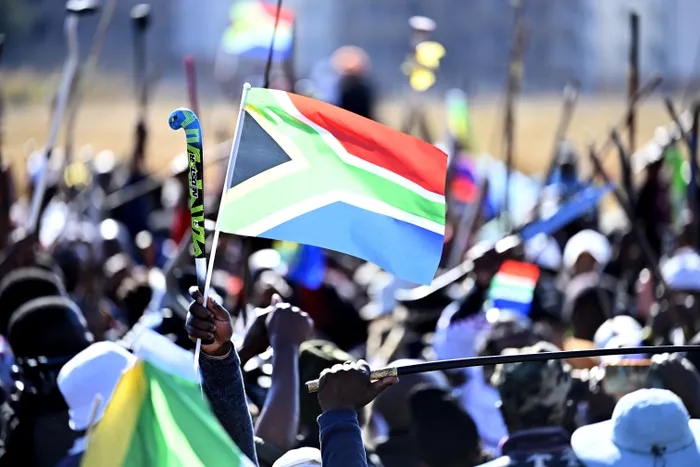
Scores of Soweto residents joined the last march against illegal immigration before the Tuesday, June 30 deadline.
Image: Itumeleng English/Independent Newspapers
Major General Fred Kekana, Deputy Provincial Commissioner for the Police in Gauteng, addressed journalists, affirming that while the protests were peaceful, it remains the police's duty to protect the rights of both protesters and those affected by the demonstrations.
“I’m here on the ground, and as far as I can tell, the situation, as you can see, is under control. The people are marching, and of course, it’s their right to march," Kekana said, highlighting the normal operational state of local businesses amid the protests.
As police continue to monitor the situation closely, Kekana confirmed that operations would persist beyond the deadline, promising safety for both the demonstrators and civilians.
"Our operations are ongoing. We are also controlled by the situation. And even if after tomorrow, we are not going to stop operating and ensuring that the community is safe," he explained.
As protestors arrived outside Protea Glen police station to deliver a memorandum calling for crime-prevention strategies and an end to youth unemployment, Nkosikhona "Phakelumthakathi" Ndabandaba urged the government to ensure the safety of marchers and ordinary South Africans as the countrywide protests intensify.
"We encourage all the shops to open, and we just went to Jabulani Mall, and everyone was happy to see us," he said.
Meanwhile, as the country prepares for nationwide anti-illegal immigration protests, Parliament has urged street vendors, informal traders, and small business operators to take extra precautions and avoid exposing themselves to unnecessary danger.
The warning comes from the chairperson of Parliament’s Select Committee on Economic Development and Trade, Sonja Boshoff, as concerns grow about the potential for unrest linked to the self-imposed June 30 deadline announced by anti-illegal-immigration activists.
The protest campaign has gathered momentum over recent weeks, with demonstrations taking place in several communities since late April. Organisers have indicated they intend to escalate their campaign unless the government demonstrates stronger enforcement of immigration laws.
While acknowledging that many South Africans have legitimate concerns about illegal immigration, Boshoff stressed that such frustrations must never be allowed to descend into violence.
“The concerns many South Africans have regarding the impact of illegal immigration are genuine and deserve to be heard. These concerns point to systemic failures that require decisive and lawful action by government. However, no grievance can ever justify vandalism, intimidation, assault or any other form of criminal conduct,” Boshoff said.
Her remarks come as foreign national traders, particularly those operating in busy commercial districts in Gauteng, the Western Cape and KwaZulu-Natal, are expected to be among the most vulnerable should protests turn violent. Community organisations and business groups have advised traders in high-risk areas to consider temporarily suspending operations or relocating until tensions ease.