

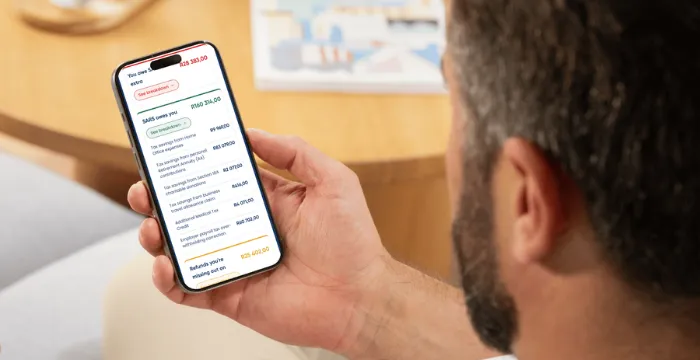
A South African taxpayer utilising TaxClaw.AI to maximise their tax refund this season.
Image: Supplied
The 2026 tax season has officially opened, bringing with it a familiar wave of financial anxiety for millions of South Africans. For many, the questions begin with a simple SMS or email from SARS.
Between July 1 and July 12, SARS issued its automated assessments. While the system is designed to simplify the filing season, it often inadvertently creates confusion: some taxpayers receive an SMS stating they have been auto-assessed and discover a few thousand Rands deposited into their bank accounts, yet they are left wondering if they are legally owed more. Others are hit with auto-assessments claiming they owe SARS money, leaving them baffled. Meanwhile, a third group receives notifications stating their tax affairs are too complex for auto-assessment, forcing them to navigate the realm of manual eFiling.
Enter TaxClaw.AI, a locally developed platform aiming to provide clarity. The platform allows taxpayers to independently validate their SARS auto-assessments before making them legally binding.
The platform, launched 3 weeks ago, is spearheaded by technology experts Ben Chaud and Meraj Chhaya, alongside Marius Higgs, a registered tax practitioner with 15 years of industry experience. Interestingly, TaxClaw wasn’t originally meant for the public: “This started as a highly specialized tool used internally by our tax specialists to stress-test internal filing data,” Ben Chaud explains. “But when we saw the sheer volume of ordinary South Africans wondering about auto-assessments, we decided to democratize the technology and make AI analysis completely free for everyone.”
What distinguishes TaxClaw.AI from the current influx of AI tools is its underlying architecture. The platform is not a standard language model connected to ChatGPT or Claude, but rather a purpose-built Machine Learning model that was trained on thousands of anonymized tax returns and complex tax simulations. The model's outputs are then strictly verified by a custom arithmetic engine to ensure compliance.
The practical application of this technology is significant. According to TaxClaw, during this current tax season, a taxpayer received an auto-assessment calculating a refund of R4,325. Upon running his details through TaxClaw’s AI, the system revealed they were actually entitled to a refund of R13,525. SARS’s automated system, which relies solely on third-party data, was unaware that the taxpayer was entitled to a home office deduction and had made substantial Section 18A charitable donations throughout the year. The tool flagged these missing elements, highlighting a missed R9,200 refund.
TaxClaw.AI operates on a strict privacy model, requiring no identifying information to generate a report. Users do not need to provide their name, ID number, or phone number. The AI analysis is completely free, and the company only monetizes its services if a user explicitly chooses to have TaxClaw’s registered practitioners handle their final eFiling.
The tax window closes in October - taxpayers have until then to use TaxClaw's AI, which is clearly a no-brainer approach to increasing their tax refunds - or potentially reduce the amount owed to SARS.