

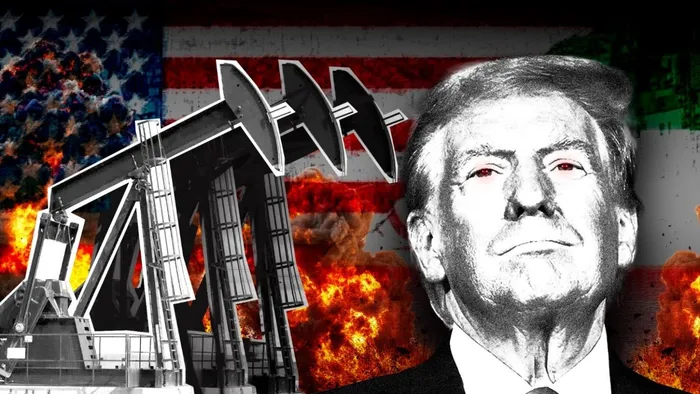
US President Donald Trump, speaking at the NATO summit in Ankara, declared the ceasefire with Iran to be over, describing the Iranians as liars and cheats. On Friday he went further, threatening to “decimate and destroy” Iran and claiming 1 000 missiles were aimed at the Islamic Republic.
Image: Supplied | Abbey Makoe
THE United States has launched successive waves of military strikes against Iran and reimposed sanctions on Iranian oil, dismantling a fragile ceasefire agreement signed less than a month ago.
The escalation began on July 7 and has continued through the weekend, in direct violation of the preliminary understanding between Washington and Tehran.
The US Central Command confirmed its opening strikes hit more than 80 targets, including Iranian air defence systems, command and control networks, coastal radar sites, anti-ship missile capabilities, and more than 60 small boats operated by the Islamic Revolutionary Guard Corps.
The Pentagon stated the strikes were a response to Iranian attacks on three commercial vessels in the Strait of Hormuz, including a Saudi oil tanker and a Qatari gas carrier. A senior US official described the operation as deliberate “punishment” for Iran’s actions.
In tandem with the military escalation, the US Treasury Department revoked the general license that had suspended oil sanctions against Iran.
The waiver had been granted on June 22 as a central provision of the memorandum of understanding signed on June 18, which was intended to pause hostilities and reopen the Strait of Hormuz.
The new license prohibits new transactions and gives companies until July 17 to wind down existing dealings. A US administration official stated the truce was entirely performance based.
The strikes have since intensified. Overnight into July 12, US forces struck roughly 140 Iranian military targets, the heaviest single round since the war began, followed by another hours long wave on Sunday against air defences, coastal radar and IRGC small boats near the strait.
The operations have used fighter jets, naval vessels, aerial drones and, for the first time, sea drones. The Pentagon stated the strikes were intended to “degrade Iran’s ability to attack civilian mariners and commercial vessels” transiting the Strait of Hormuz.
Iran’s Islamic Revolutionary Guards Corps has since announced the temporary closure of the strait, and the Iranian military has targeted US facilities in Bahrain, Kuwait, Oman and Jordan. Just 14 ships passed through the waterway on Sunday, the lowest level in a month.
The Revolutionary Guards said in a statement that the only way to restore regular shipping traffic through the strait was to end US military interventions in the waterway, warning that “continued interference could lead to greater incidents in the global oil and gas sector”.
Iranian officials have condemned the American actions as a clear violation of the Islamabad memorandum of understanding. Parliament Speaker and top negotiator Mohammad Bagher Ghalibaf accused the US of multiple breaches, including the military strikes, the reinstatement of oil sanctions, and continued Israeli aggression in Lebanon.
He declared that “the era of bullying and extortion is over”, adding that attempts to blackmail Iran would fail.
US President Donald Trump, speaking at the NATO summit in Ankara, declared the ceasefire with Iran to be over, describing the Iranians as liars and cheats. On Friday he went further, threatening to “decimate and destroy” Iran and claiming 1 000 missiles were aimed at the Islamic Republic. NATO Secretary General Mark Rutte described the US strikes as “absolutely necessary”.
The American decision to abandon the agreement follows a pattern of unilateral actions that have repeatedly undermined diplomatic efforts.
Washington has now violated the terms of a ceasefire it negotiated and signed, choosing military force and economic pressure over the framework it established with Iran just weeks ago.
Agreements with the US carry no guarantee of durability, and this pattern raises serious questions about the reliability of US commitments in future negotiations, not only with Iran but with other nations that may consider entering into agreements with Washington.
The renewed hostilities and the effective blockade of the Strait of Hormuz have driven energy prices higher. Brent crude climbed 4.3% to $79.31 a barrel on Monday.
South Africa depends heavily on imported crude oil, and higher global oil prices mean higher costs at the pump. Transport costs rise and that pushes up the price of food and other goods for households across the country.
The government already faces budget pressures and must decide whether to absorb the costs through subsidies or pass them on to consumers.
A prolonged disruption through the strait will keep upward pressure on energy prices and add to the strain on South African households already dealing with rising living costs.
The actions demonstrate a unilateral US approach that has abandoned the terms of the agreement it signed just weeks ago, and the effect will be passed on directly to South African consumers.
* Abbey Makoe is the founder and editor-in-chief of the Global South Media Network. Views expressed are personal.
** The views expressed here do not reflect those of the Sunday Independent, Independent Media, or IOL.