

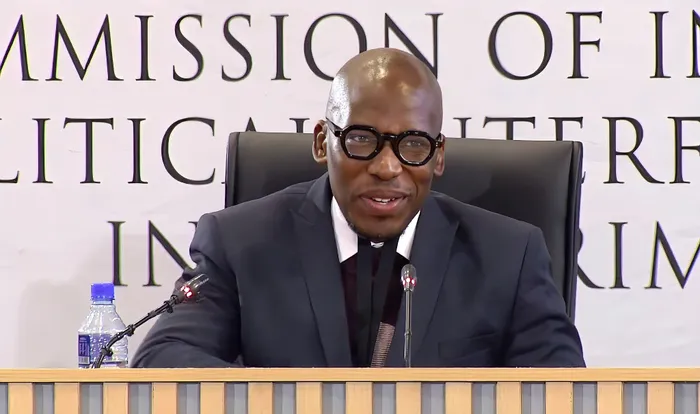
Businessman Tumelo Nku referred to R60 000 as “petty cash”.
Image: Social media
THERE are moments in the life of a nation when history is not written through explosive revelations or dramatic confrontations, but through a single sentence that unintentionally exposes the culture of an institution.
Such moments matter because language is never merely descriptive. It shapes perception, reflects values, and often reveals how those entrusted with public power understand the world around them.
One such moment occurred during the Madlanga Commission when Mr Nku referred to R60 000 as “petty cash”. It may have been an offhand remark, perhaps even devoid of any intention to provoke debate, yet it immediately raised a far more important question than the amount itself.
What does it say about an institution when R60 000 is considered “petty”? More importantly, what does it reveal about the gradual psychological distance that can emerge between those who administer public resources and the ordinary citizens whose taxes make those resources possible?
South Africans have become accustomed to hearing staggering financial figures. Over the past decade, allegations involving millions and billions of rand have become so frequent that they no longer generate the same shock they once did.
We have become desensitised to extraordinary numbers. In that context, perhaps R60 000 appears relatively insignificant to someone accustomed to managing large budgets or dealing with multimillion rand procurement contracts.
But relative to whom?
Certainly not to the millions of South Africans who wake up every morning wondering how they will pay school fees, afford transport to work, settle a month’s rent, or simply put food on the table. For them, R60 000 is not petty.
It represents opportunity, security, and, in many instances, hope. It could fund a university education, launch a small business, settle crippling debt, or provide a financial cushion that many households have never experienced.
That is why the statement resonated so strongly. It was never really about R60 000. It was about perspective.
Admittedly, there is something almost comical about the phrase. One could imagine families across South Africa immediately searching every corner of their homes in the hope of discovering this elusive creature called “petty cash”.
Perhaps it is hiding beneath the couch. Perhaps it is tucked away inside the old biscuit tin where important documents mysteriously disappear. Perhaps it has been sitting quietly in the wardrobe all along.
After hours of searching, however, most households would probably recover R23.50, two foreign coins from a long-forgotten holiday, an expired supermarket voucher, and enough dust to qualify for archaeological preservation.
That, for most South Africans, is petty cash.
Humour, however, often serves as society’s way of confronting uncomfortable truths. Beneath the laughter lies a serious governance concern that deserves careful reflection.
Every institution develops its own internal language. Over time, that language begins to redefine what is considered normal. Large amounts become ordinary. Exceptional circumstances become routine.
Behaviours that once attracted scrutiny gradually become accepted simply because they occur frequently enough. Eventually, institutions begin speaking a financial language that ordinary citizens no longer recognise.
This phenomenon is far more dangerous than it first appears.
Behavioural scientists have long argued that people assess value comparatively rather than absolutely. Someone who regularly works with billion rand budgets may genuinely perceive R60 000 as relatively insignificant.
Psychologically, this is understandable. From a governance perspective, however, it is deeply problematic because public institutions are not expected to measure money according to internal benchmarks. They are expected to measure it according to the public trust placed in them.
Every rand held by the state carries a story. It represents hours worked by teachers, nurses, police officers, factory workers, entrepreneurs, and countless taxpayers who contribute to the public purse.
Public money is therefore not simply currency. It is accumulated human effort. When institutions begin losing sight of that reality, they risk losing something far more valuable than money.
They risk losing legitimacy.
History teaches us that institutions rarely collapse overnight. Their decline is usually gradual and almost imperceptible. It begins with small shifts in thinking. Language changes first. Perception follows.
Behaviour adapts. Eventually, culture is transformed. By the time the warning signs become obvious, abnormal conduct has already become institutional routine.
That is why governance is never only about laws, policies, or compliance frameworks. It is equally about organisational culture. Policies may define acceptable conduct, but culture determines what people actually regard as acceptable.
When culture changes, even the strongest governance frameworks begin to weaken because people stop questioning behaviours that would once have seemed extraordinary.
The Madlanga Commission may therefore have revealed more than evidence. It may have exposed an institutional mindset.
Mindsets cannot be audited. They cannot be regulated through legislation. Yet they influence every decision an institution makes.
This is precisely why seemingly minor statements often generate such significant public reactions. Citizens are not reacting merely to words. They are reacting to what those words appear to symbolise.
They hear a widening gap between institutional reality and everyday lived experience. They hear confirmation that those operating within positions of authority may no longer appreciate the financial pressures confronting ordinary people.
Perhaps the greatest irony is that R60 000 can simultaneously be viewed as insignificant and life-changing, depending entirely upon where one stands. For a large organisation, it may represent a routine operational expense.
For a struggling entrepreneur, it may determine whether a business survives. For an unemployed graduate, it could finance further education. For a pensioner, it could provide years of financial stability.
Good governance requires the ability to appreciate all these perspectives simultaneously. It demands humility.
Leaders who remain connected to the realities of ordinary citizens seldom trivialise public resources because they instinctively understand that every budget allocation carries human consequences. They recognise that behind every financial figure is someone’s sacrifice, someone’s tax contribution, and someone’s hope for a better future.
There is an old saying that culture eats strategy for breakfast. Perhaps governance scholars should add another. Language eats accountability for lunch.
The words institutions repeatedly use eventually shape how they think, how they act, and ultimately how they govern. When financial language becomes detached from social reality, public confidence begins to erode long before any official finding of wrongdoing is made.
The real lesson from the “R60 000 petty cash” remark is therefore not about accounting. It is about culture. It reminds us that governance failures often begin long before corruption is uncovered. They begin when institutions gradually lose their sensitivity to value, when extraordinary amounts become ordinary, and when language quietly normalises what society still regards as exceptional.
The most troubling question arising from this episode is not whether R60 000 should be described as petty cash. It is whether South Africa’s institutions are slowly developing a vocabulary that ordinary citizens no longer recognise.
Because when institutions begin speaking a financial language that no longer reflects the lived realities of the people they serve, the greatest loss is not measured in rands and cents.
It is measured in public trust, and that is a currency no institution can afford to squander.
* Abbey Makoe is the founder and editor-in-chief of the Global South Media Network. Views expressed are personal.
** The views expressed here do not reflect those of the Sunday Independent, Independent Media, or IOL.