

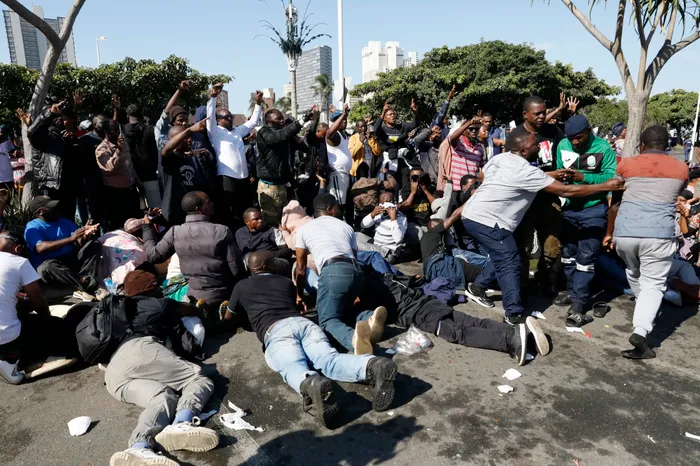
Supporters of the anti-illegal immigration organisation March and March and foreign nationals in a confrontation outside Durban’s Diakonia Centre on May 21. Some might say that the terribly destructive violence of the past few weeks shows that the chickens have come home to roost.
Image: Doctor Ngcobo | Independent Newspapers
DEEP down in our crisis-ridden society the political forces behind the unprecedented violent anti-immigrant national protests have been steadily germinating over a long period.
It is the socio-material context of arguably the worst Black poverty, unemployment and social inequalities in the post-apartheid period which was the catalyst that ignited those combustible protests across the length and breadth of South Africa.
It is this context which many commentators and analysts in the media have unfortunately not paid sufficient attention to in dealing with the migrant worker crisis. But it is only through such an approach that we can understand the conditions which gave rise to the unprecedented destructive violence, which often descended into sheer mob hysteria, with the terrible opportunistic looting of shops owned by foreigners.
This widespread orgy of wanton violence, the intensity of which has never been seen before since our watershed 1994 Uhuru nonracial and democratic elections, is the most poignant reminder that we are in fact facing a mortal and multifaceted crisis now fiercely demanding immediate government action and answers.
Naturally, if the Black working-class majority is now facing the worst poverty, joblessness and social inequalities crisis since 1994, competition with immigrant workers for jobs and various social services would be much greater.
Add to that the impacts of the neoliberal austerity budgets we have had for several years — which have further deepened poverty and available resources for various public services, such as health and education — and we have a generalised situation which will polarise relations between them.
In such a situation, the accumulated frustrations of struggling Black communities, with already high rates of unemployment and poverty, will cause them to hit out at migrant workers and small business traders, such as spaza shop operators.
But the overall situation has never been as bad as it is now. We also have the worst cost of living crisis in the post-apartheid period. Mass black hunger, malnutrition and the related stunted development of children are rampant across our society.
Levels of black poverty, unemployment and social inequalities are, in fact, worse today than they were under apartheid, as a direct result of the distinctly neoliberal policies which the African National Congress (ANC) has pursued since taking office in 1994. That is precisely why the ANC declined in the 2024 elections from 57% in 2019 to around 40% of the vote, and for the first time lost a national election.
For too long did the ANC allow the undocumented crisis to fester without a comprehensive programme of action to systematically and consistently root out the inefficiencies and corruption in the Home Affairs Department, arguably the biggest underlying causal factor.
It is clearly very complex, besides the fact that it coincided with the most intense and devastating socioeconomic crisis we have had since 1994. In fact, the existing socioeconomic crisis runs so deep and wide that the current waves of violence sweeping the country will be long discussed and debated.
There are several factors that have over a long period contributed to the outbreak of this tortuous crisis, which limited space does not allow me to fully unravel. But it strikes at the heart of the ‘miracle transition’ some mistakenly referred to in the 1990s.
Some might say that the terribly destructive violence of the past few weeks shows that the chickens have come home to roost. But nobody can be satisfied with the mob hysteria and mindless violence we have seen recently.
However, the biggest tragedy is the fact that different sections of the Black working class are at war with each other. It is very unlikely that spaza shops make a lot of money, with those operators probably living from hand to mouth.
Come to think of it, we are all in this country to a greater or lesser extent immigrants. All, I repeat. Slavery, colonisation and the settlers who came from various parts of the world since diamonds and gold were discovered in the 19th century are all immigrants. There are probably people from every part of the world whose ancestors have been living in this country for very long.
But the South African people who have been very unhappy with undocumented immigrants who are either employed or operate spaza shops certainly have legitimate grievances, as they do with the selling of foodstuffs which have expired.
The serious problems which undocumented immigrants present to both the government and to ordinary South African citizens in several respects are indeed legitimate and urgently need to be addressed.
Capacity and resource constraints, especially within neoliberal austerity budgets, are another very big problem we face. For that tragic situation the ANC must take primary responsibility, which is probably partly why it lost power in the 2024 elections. But this crisis is unlike the earlier moments of anti-immigrant, xenophobic and Afrophobic violent eruptions, which first began in 2007/8.
The resurrection of this crisis is today taking place and is in fact intensified by the biggest socioeconomic, unemployment and political crisis we have had since 1994, which has resulted in utter desperation for jobs and income. That is the real context within which the current immigration crisis is unfolding.
It is a daily battle for survival in highly impoverished Black townships and a brutal dog-eat-dog situation for both South African Blacks and African migrants. It is this worsening crisis which has produced Operation Dudula and March. They did not emerge in a vacuum.
It is crucially important to secure this understanding of the material forces which have produced the anti-immigrant mayhem and hysteria recently in Black townships and towns. But it is going to be extremely difficult, if not impossible, to find answers to this terrible, very complex and convoluted crisis without addressing the largely neoliberal capitalist economic and social policies the ANC has been wedded to since 1994.
Don’t forget that SA has had the most powerful economy in Africa and has been the minerals powerhouse of the world since the 19th century, thanks to the diamonds and gold that were then discovered. And don’t forget, too, that the backbone of that economy for a long time was Black migrant labour from neighbouring Southern African countries.
But who among the protesters against immigrant workers knows and understands that history? Most probably very few, if any. Yet, it is profoundly important to understand if we are to make progress in finding solutions to the crisis.
However, even if this knowledge and understanding are secured, it will not automatically lead to constructive and progressive solutions to a very deep and complex crisis. But without it, finding solutions will be much more difficult.
It is also much easier said than done to assert that the alternative is for the local and immigrant workers to unite against the employers and the capitalist class. For someone who is a former trade unionist, I can assure you that calling for such a unity, while objectively and politically correct, avoids the really hard, difficult, complex and even contradictory questions which concern the concrete conditions on the ground.
However, it is the current leaders in government and civil society that we must turn to for working constructively towards finding solutions. But for that purpose, we all need to be mature enough to acknowledge that it is impossible to have ready-made answers to this deepening and very complex immigrant crisis, as it is very unwise to only blame the ANC or the current Government of National Unity.
However, there are also several peculiarities about those marches and protests across SA over the past few weeks. The first thing that struck me from the outset was that it was only Black African migrants from other Southern African countries which were targeted in the orgy of violence and mob hysteria we were inundated with on our TV screens and social media.
Why? Why were only the poorest Black people from those countries targeted? Why not a single word from the protesters and rioters about white and European immigrants and their ancestors who have been in SA from 1652? Why is there the presumption that it is only black African immigrants who are undocumented?
This omission of whites and Europeans is more ironical and contradictory because there is an avalanche of evidence to show that it is indeed ‘white monopoly capital’ which bears a much greater responsibility for the current devastating crisis of Black poverty, unemployment and social inequalities than does the ANC.
The other and related problem is to assume that it is only SA that has serious immigration problems. All other African countries, and in fact, the entire world, have ongoing immigration problems.
It is very serious in Southern European countries, where desperate African immigrants from Northern African countries have tried to cross over to seek greener pastures and escape from grinding poverty and hopelessness. Many, including children, have drowned.
And while the ANC bears overwhelming responsibility for the current immigrant crisis in SA, they are not the only factor at play in producing the multidimensional complexity we have today. To presume that we must only focus on the ANC is gross opportunism and highly simplistic, which will get us nowhere.
Finding constructive solutions to this very complex and multifaceted immigration crisis in SA requires a much wider appraisal of all the factors which produced it. But it should be now absolutely necessary that all immigrants in South Africa be required to be duly documented and that all small businesses, such as spaza shops, must be regulated.
Very important progressive civil society voices directed against Operation Dudula and March must be noted, for largely scapegoating migrants, but they must also seriously consider the wide range of problems created by those who are undocumented.
But valid cases of administrative delays in processing migrant applications at Home Affairs must be noted. The lack of capacity at Home Affairs is vividly clear. There are even many South Africans who have been negatively affected by this situation and have been waiting for a long time for their documents.
However, the irrefutable fact is that the ANC bears probably the greatest responsibility for the current immigration crisis. One must stress this fact at this moment because this year is also the 50th anniversary of the 1976 Soweto black student uprisings and the 30th anniversary of the 1996 Constitution, which we are repeatedly told is the most progressive constitution in the world.
But how can a country with purportedly the best and most progressive constitution in the world also have among the highest levels of unemployment and the worst social inequalities in the world, especially when the constitution is the highest law in the land?
I conclude with the earnest hope that we will not see more widespread mayhem, chaos, violence and vigilantism on 30 June, which is apparently the deadline for the onerous demands placed on the government.
To expect the demands to be met by that date, especially the mass deportation of all undocumented foreign nationals, given the immense complexity and confusion of the general situation on the ground, strongly appears unrealistic.
The lack of state resources and administrative capacity and the crisis in the police itself will probably be the biggest drawbacks in meeting that deadline.
* Dr Ebrahim Harvey is a political writer, analyst, and commentator.
** The views expressed here do not reflect those of the Sunday Independent, Independent Media, or IOL.