

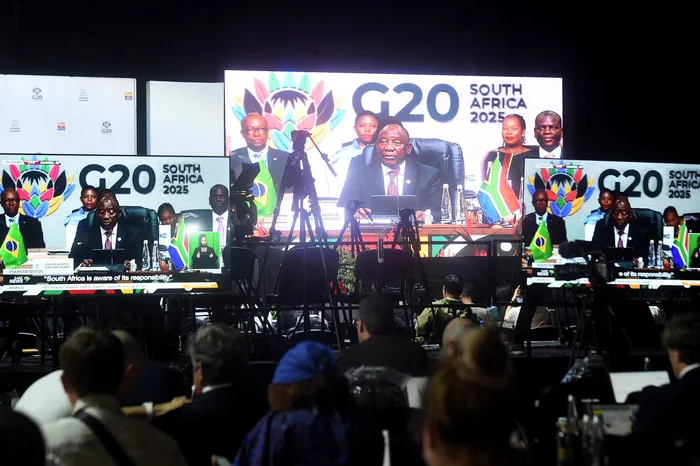
From debt reform to digital public infrastructure, many of the priorities championed at the Johannesburg meetings reflected continuity from India’s presidency in 2023 and signalled the rising weight of the Global South in shaping global governance.
Image: Itumeleng English / Independent Newspapers
AS the G20 Summit concluded in South Africa, the first held on African soil, analysts and delegates agreed that India’s imprint on the outcomes was unmistakable.
From debt reform to digital public infrastructure, many of the priorities championed at the Johannesburg meetings reflected continuity from India’s presidency in 2023 and signalled the rising weight of the Global South in shaping global governance.
India’s role was most visible in the expanded presence and confidence of African nations at the Summit. The African Union (AU) participated as a permanent member for the first time at a G20 hosted in Africa, a milestone that several leaders said would not have been possible without India’s decisive diplomatic push during its presidency in 2023.
The move has since reshaped negotiations and amplified Africa’s collective voice across issues of development, trade and industrialisation.
South Africa, hosting the Summit under the banner of inclusive growth and global reform, built directly on India’s agenda. Officials highlighted shared priorities, including food security, climate resilience, digital transformation, and fairness in the global financial architecture.
Working groups and ministerial discussions frequently drew on frameworks established under India’s leadership, particularly on disaster risk reduction and women-led development.
One of the clearest areas of policy alignment was digital public infrastructure. With similar challenges to Africa, India’s digital identity and real-time payments systems, now globally recognised as models for low-cost, inclusive technology, drew strong interest from African policymakers.
Several delegations discussed plans to collaborate with Indian institutions to scale digital public goods across the continent, especially after India’s establishment of an offshore Indian Institute of Technology (IIT) campus in Zanzibar. Leaders said such initiatives directly advance Africa’s Agenda 2063 goals in skills, education, and technology.
Debt sustainability, a pressing concern for many African economies, also took centre stage. India and South Africa jointly pushed for more transparent sovereign debt restructuring processes, fairer credit assessments, and reduced barriers for developing nations seeking long-term financing.
Delegates said the unified stance of the two countries helped mainstream Global South concerns and brought sharper focus to the constraints faced by developing nations trying to invest in energy, health, education, and infrastructure.
Trade reform and multilateral restructuring were also key themes. India’s call for changes within the World Trade Organisation (WTO) to ensure more equitable participation by developing economies found strong support from African members, who argued that outdated global rules limit their industrialisation and integration into international markets.
The IBSA (India-Brazil-South Africa) dialogue, held on the sidelines, underscored the emergence of coordinated South-South leadership. Officials emphasised their commitment to strengthening global governance, accelerating SDG progress, and expanding cooperation in technology, health, and climate adaptation.
While Brazil and South Africa have enhanced their diplomatic prowess through successful G20 presidencies, Brazil has achieved breakthroughs, such as the Global Alliance Against Hunger and Poverty, whereas South Africa remains mired in a geopolitical quagmire, hedging between competing global powers amid rising tensions, US boycotts, and overlapping economic crises.
In contrast, Indian Prime Minister Narendra Modi is also set to host the upcoming India-Russia summit on December 4-5, continuing India’s strategic engagements amid awareness of potential disapproval from the European Union and NATO.
As the Summit closed, observers noted that India’s role has shifted from supportive partner to structural force in Global South diplomacy. With India, Brazil, and South Africa leading the G20 in succession, many see this phase as a turning point, one where developing nations not only participate in global decision-making but help set its direction.
* Phapano Phasha is the chairperson of The Centre for Alternative Political and Economic Thought.
** The views expressed here do not reflect those of the Sunday Independent, IOL, or Independent Media.