

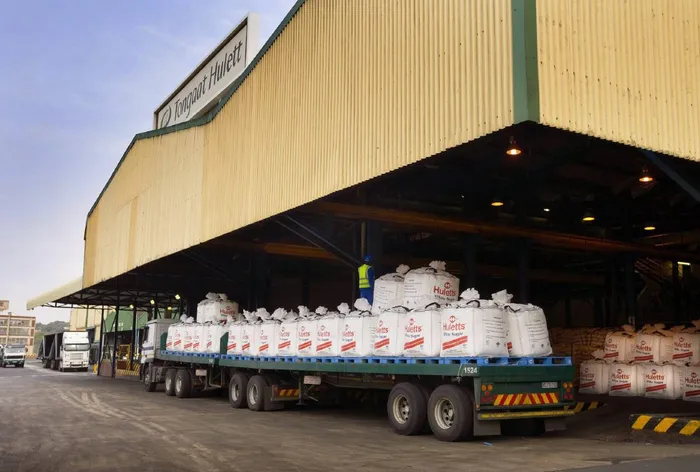
Arguments will be presented in the Durban High Court in the liquidation application involving Tongaat Hulett
Image: simphiwe mbokazi
SA Canegrowers and the South African Farmers Development Association (SAFDA) have expressed growing concern ahead of the KwaZulu-Natal High Court hearing on Wednesday, where arguments will be presented in the liquidation application involving Tongaat Hulett (THL).
The sugar producer previously entered provisional liquidation in June.
According to SA Canegrowers, the prospect of an unfunded liquidation poses a significant threat to rural communities across KwaZulu-Natal.
The organisation noted that approximately 60% of South Africa’s sugarcane growers supply Tongaat Hulett’s mills, meaning the collapse of the company would have far-reaching consequences beyond its own operations.
Economic activity in large areas of KwaZulu-Natal that rely on the company will also come to an immediate halt.”
SA Canegrowers added that sugarcane growers will have nowhere to supply their cane, potentially excluding as much as 4.6 million tons of raw sugarcane from the local value chain every year.
“Tens of thousands of workers on farms will become unemployed, and entire communities will lose the income that drives secondary businesses: transporters, fuel stations, restaurants, shops, and supermarkets. The government’s own industrial policy objectives underscore why intervention in the sugar industry, and particularly in the future of Tongaat Hulett, is both necessary and urgent.”
Higgins Mdluli, chairman of SA Canegrowers, said that saving Tongaat Hulett is not simply about preserving one company; it is about protecting a strategic industrial value chain that aligns directly with the government’s employment and industrialisation agenda.
“Without intervention, South Africa risks losing critical agricultural and industrial capacity, rural livelihoods, and a platform for future growth in renewable fuels.”
Dr Siyabonga Madlala, South African Farmers Development Association (SAFDA) executive chairman, said that Tongaat Hulett is a very important player in South Africa’s sugar industry.
“Beyond its role as a milling company, Tongaat Hulett supports thousands of jobs and rural economic activities across KwaZulu-Natal.”
Madlala added that the preservation of a stable and functional sugar milling sector is important to maintaining confidence in the industry, sustaining rural economies, and ensuring continuity for growers who depend on the company’s operations.
“While SAFDA respects the legal processes currently underway, we believe it is important that any outcome prioritises the long-term sustainability of the industry and the lives linked to it.”
Madlala said that more than 17,500 of South Africa’s 28,000 sugarcane growers supply Tongaat Hulett, the majority of whom are small-scale growers.
“The future of Tongaat Hulett is therefore critically important to the livelihoods of these small-scale growers and their families. For many rural communities, sugarcane farming is the primary source of income, supporting not only small-scale growers but also farm workers, local businesses, contractors, and broader rural economies.”
Harold Maistry, president of the Tongaat Civic Association, said that the Tongaat Hulett Group is deeply rooted in the KwaZulu-Natal North Coast and has historically functioned as the economic, social, and industrial backbone of the town of oThongathi.
“As an agricultural and agri-processing giant, the company has operated for over 130 years, deeply influencing the local community through employment, land development, rural and agricultural support. The Maidstone Mill in Tongaat is a major hub, with the Group employing thousands directly and supporting tens of thousands of jobs indirectly in the region.”
Maistry added that securing the livelihoods of the 15,000+ small-scale growers supplying the mills who face immediate non-payment and potential ruin, as emphasised by SA Canegrowers and SAFDA, should be an immediate priority.
“The employees who would be impacted by this liquidation should be protected. Tens of thousands of workers on farms will become unemployed, and entire communities will lose the income that drives secondary businesses.”
Dr Christiaan Mostert, a senior agricultural economist, said that THL is not only important as a company but as a systemically important sugar-industry platform in the SA sugar value chain. “Tongaat Hulett is significant for five reasons: significant milling capacity, small-grower market access, rural employment, regional economic activity, and downstream sugar supply.”
Mosetert added that a credible legal and funding basis will be needed to stop the liquidation of THL on Wednesday.
“The immediate issues are funding and governance. The April postponement was possible because the IDC facility provided liquidity for continued operations (until 30 June 2026). Tongaat appears profitable at the operating level but heavily loss-making before tax after finance costs. Cash flow is uncertain. It appears that the finance burden has overwhelmed its operating profit. Without further funding or a credible transaction to resolve the issues, another delay becomes harder to justify.”
Dranca Neo Phalatse, postgraduate coordinator at the faculty of natural and agricultural sciences at the University of Pretoria, said that Tongaat Hulett plays a significant role in the sugar industry value chain, particularly in supporting employment and agricultural supply networks.
“Its continued operation is therefore generally considered important from both an economic and sector stability perspective.”
The Department of Trade Industry and Competition was approached for comment but said they are unable to comment on a matter before court.