

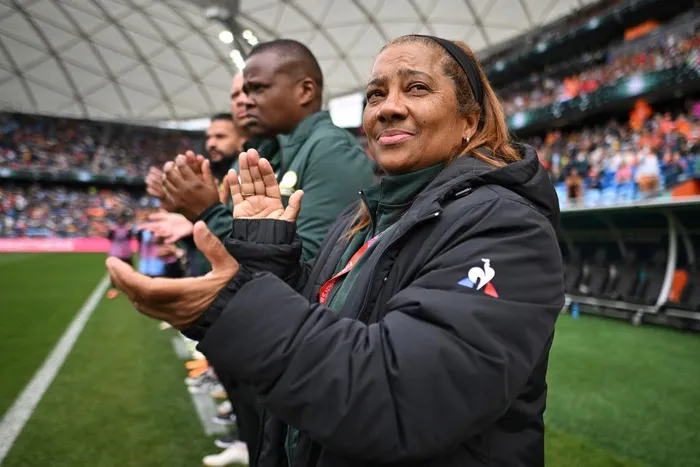
BANYANA Banyana coach Desiree Ellis. | Image: Getty Images.
Image: Getty Images.
The ol’ adage “a good dancer knows when to leave the stage” couldn’t have been more befitting for Banyana Banyana’s coach Desiree Ellis at the moment.
Ellis has given her all for the national team, transforming Banyana from being ‘the other team’ to becoming powerhouses of continental football.
Her journey has been fulfilling and rewarding in a personal and collective capacity as she defied the odds and led Banyana to improbable achievements.
Before she took over the reins, Banyana had never qualified for the World Cup - let alone win the Women’s Africa Cup of Nations.
So, enter Ellis. In a space of five years she changed all that - won Wafcon and qualified for back-to-back global showpieces in France and Australasia.
The success story of the national team made every ‘girl child’ to dare to dream, with the semi-pro Hollywoodbets Super League also becoming the springboard of women’s football.
People started to take interest in women’s football, while the number of exported players increased rapidly as well.
Ellis didn’t walk in the shadows during the transform - she basked in its glory as well, getting deserved recognition from all and sundry.
Apart from her four CAF Coach of the Year awards, she was conferred with Order of Ikhamanga and Honorary Doctorate by Cape Peninsula University of Technology.
These are things that the little girl who was born in Kuilsrivier more than six decades ago mustn’t have dreamt of when she started playing football with boys.
After all, her football career didn't tell that she’d gone on to get the highest recognition from the No 1 civilian, having earned 32 caps for Banyana. But she changed that.
So, such have been the change of fortunes in Ellis’ career, she’s now one of the most decorated coaches in continental football - male and female.
While her coaching prowess and abilities to overcome adversities are undisputed, Ellis’ team has lost bite in the last few years. And that’s worrisome - to say the least.
You see, I am not saying take your eyes off the inevitables such as squad revamps, injuries, form or external challenges caused by Safa, but the team itself doesn’t look the same.
And so, sadly for Ellis, since the buck stops with her in making sure that the team performs on the pitch, she has to shoulder the responsibility and blame.
We have to be honest that the game continues to evolve, and the majority of players who play abroad are exposed to the highest level of performance-based coaching.
And without criticising Ellis’ ability to blend the local-based and overseas-based players, but the gulf in quality, across board, will always be there.
Take for instance what happened at Wafcon - the absence of Thembi Kgatlana, who withdrew from the tournament due to personal reasons, was evident.
Kgatlana has been Banyana’s talisman for years - her international experience coming in handy for the national team especially in major tournaments.
Jermaine Seoposenwe, who also boasts international experience as she’s plying her trade in Mexico just like Kgatlana, seemed to be out of sorts.
Others that she had already checked out, having announced prior to the tournament that she’d be calling time on her international career. And they might be spot on!
So, should that have been the case, Ellis should have been able to manage the situation better - risk it by throwing the youngsters into the deep end and start the integration process.
After all, it is said that if they are ‘good enough, then they are old enough’. Ronnel Donnelly showed glimpses of brilliance when she made cameos, but she didn’t quite flourish.
So, the fact that it seems Ellis is over-reliant on her tried and tested is what could have have resulted in the stagnation of the team in recent years - hence the failure to defend Wafcon.
The team therefore needs someone who’ll not necessarily start afresh, but steer the ship towards a different direction - with fresh ideas, time and players. And that person is not Ellis!