

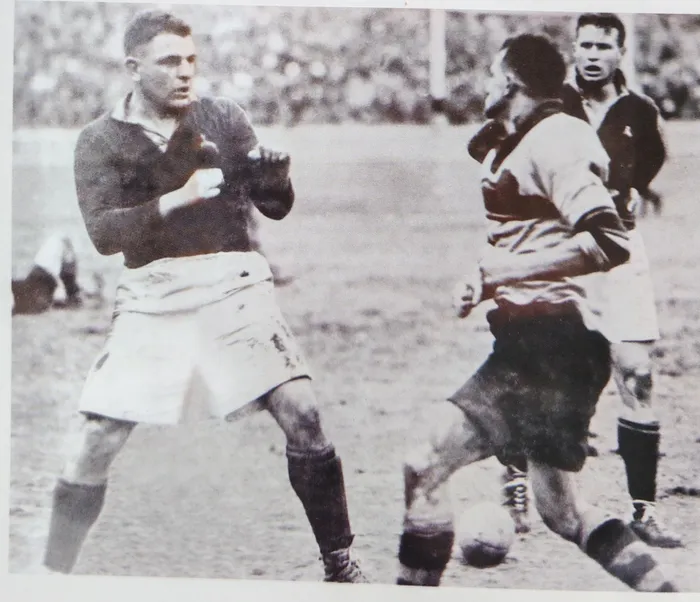
Bok prop Harry Martin squares up to Wallaby Aub Hodgson in a 1937 game regarded as the dirtiest Test. Freddie Turner is gaping in astonishment. Note the prone Aussie in the background.
Image: Supplied
As the rugby world looks forward to the mini-World Cup that is the looming series between the Springboks and All Blacks in New Zealand, it is perhaps a good omen that the only Bok team to win at Eden Park “warmed up” with two Tests against Australia.
We are talking about the 1937 Springboks, who were unquestionably the greatest Springbok side until Siya Kolisi’s double World Cup winners.
Philip Nel, the Martizburg College old boy, captained a side dubbed “The Greatest Team to leave New Zealand’s shores after winning 27 of 29 matches in Australia and New Zealand. Nel’s team lost their first match, to New South Wales, when they had yet to gain their “land legs” after over a month at sea.
The only other match they lost was the first Test against the All Blacks after getting their selection wrong. The Boks won the next two Tests to win the series. Nel’s team remain the only Springbok side to win a series in New Zealand.
And they did it in style, scoring five tries to nil in the decider at Eden Park. Kicker Gerry Brand could land only one of the five conversion attempts but the score of 17-6 was still a thrashing (tries were worth only three points). In today’s scoring, it would have been 27-6.
Nel, a Greytown farmer, said after the tour that a significant reason for their success in New Zealand was the lessons learned from a Test against the Wallabies that is regarded as rugby’s dirtiest international.
The Boks not only bonded in battle but never again lost their cool on that tour of Australasia.
The catalyst to what became a bar-room brawl was the Wallabies’ premeditated ambush of ace Bok scrumhalf Pierre de Villiers, the smallest player on the field at just 62kg.
De Villiers was found unconscious when a ruck broke up and had to be carried off by a seething Boy Louw, “like a father removing the body of a child from an accident,” as historian Chris Greyvenstein described it.
Prop forward Louw was the Boks’ no-nonsense sheriff on the field. Imagine a combination of Eben Etzebeth and Bakkies Botha in an era where fist and boots were stock in trade for the enforcers of the game. That was Louw.
One of the major culprits was Louw’s old friend from the ill-tempered 1933 series in South Africa, Aubrey Hodgson.
Australia’s Daily Mirror explains: “Awesome Aub Hodgson was chosen to play the leading role in nullifying De Villiers.
“Winning the ball in a lineout, Hodgson would draw the ball to his chest and run forward towards De Villiers and gently hand him the ball. The next instant the little scrumhalf would find himself in the centre of a ruck and at the Australians’ mercy.”
Springbok prop Harry “Kalfie” Martin, a lieutenant in the SA Air Force, described the state of De Villiers: “He was in a terrible way. His eyes were rolling and his tongue was hanging out. It really upset us.”
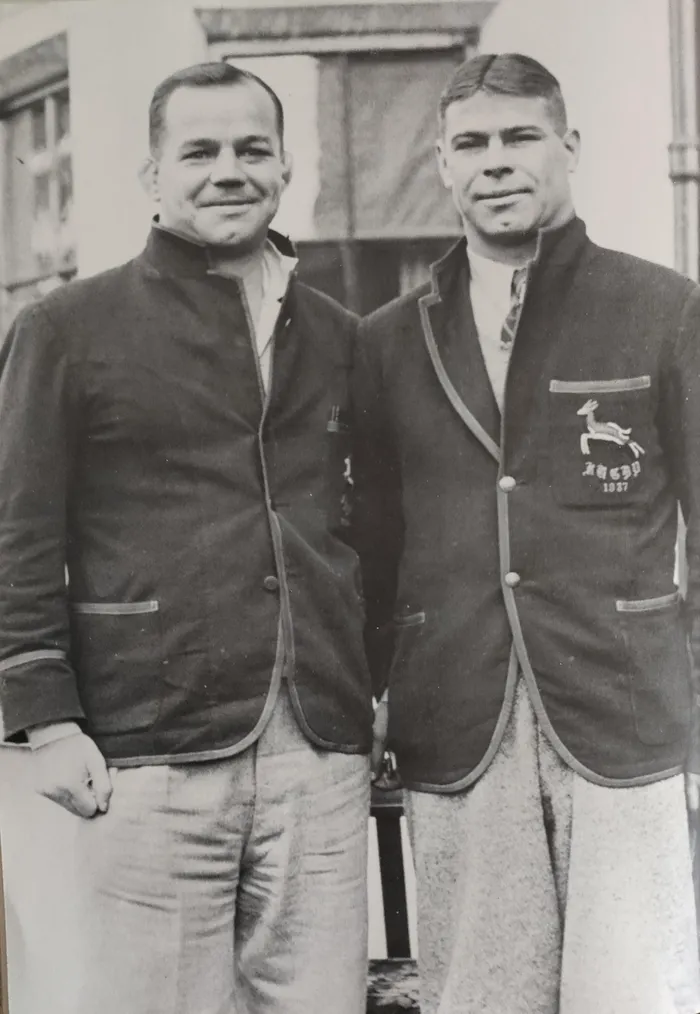
Boy Louw (left) and his brother Fanie were part of the formidable front row of the 1937 Springboks. Boy delivered retribution when tiny scrumhalf Pierre de Villiers was knocked unconscious. Supplied
Image: Supplied
The Mirror describes how the furious Martin took on Hodgson.
“Hodgson had been charging down the line with the ball when Martin hit him with a fearsome tackle. Hodgson, on the way to the ground, elbowed Martin in the face.
“As Hodgson scrambled to his feet, Martin hit him with an uppercut. The Australian shook his head and replied with a straight left and right.
“They treated 30 000 fans to an exhibition of moderately scientific boxing and the referee did not notice because he was breaking up the individual brawls that had erupted all over the field.”
The next day the newspapers were plastered with photos of the “Battle of Sydney Oval”. The Boks had won 26-17 on the scoreboard but the fight was honours even.
One photo showed Boy Louw with his right arm pulled back as if about to unleash a punch. But Louw, who was also a comedian of note, explained with tongue in cheek: “They are all wrong. I wasn’t about to punch. I had been flung out of a lineout and was trying to regain my balance.”
The next day the Boks left for New Zealand where they would win 16 of their 17 matches and return home as world champions.
* This story is an extract from Mike Greenaway’s best-selling book, The Fireside Springbok. He is also the author of Bok To Bok, the story of the Springboks’ 2023 World Cup triumph.