

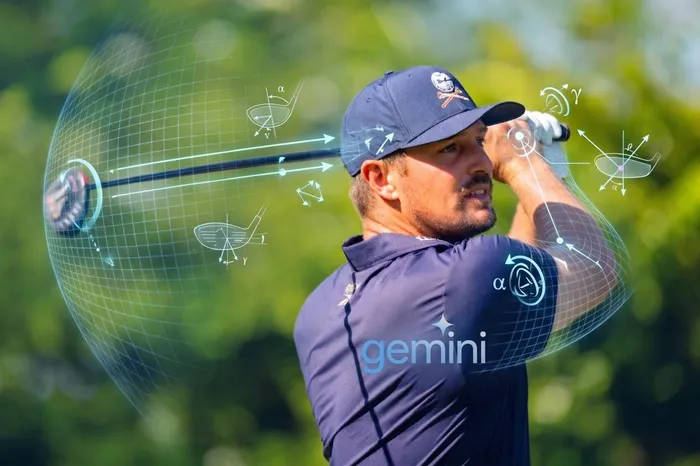
Bryson DeChambeau experimented with AI to improve his golf swing during the LIV Golf Korea event, finding some insights but ultimately realising AI can’t magically transform a player’s game. Picture: LIV Golf/Google Gemini
Image: LIV Golf/Google Gemini
It’s one thing to use AI for something quite specific, like deciding which car to buy, but when it comes to improving your golf game, can it actually be helpful?
The immediate thought is: not a chance. Swinging a golf club well is surely far too abstract and complicated a skill for AI to effectively tackle.
Last week, however, American Bryson DeChambeau was desperate enough to find out.
DeChambeau had been competing in the LIV Golf Korea event, where he scored well in the first two rounds, but a disappointing third round left him scratching his head and turning to Google Gemini for answers.
“I spent some long hours on the range trying to figure some stuff out and I was talking to AI quite a bit last night trying to go through some different physics principles that make the club turn over, having some alpha torque and gamma torque put in there,” DeChambeau said.
“I was like, ‘What makes that possibly do that?’ And was talking about just grip pressure and tension.”
DeChambeau certainly found something in the final round, as he matched his lowest score of the weekend on his way to a third-place finish.
“I was slamming the club in the ground trying to figure out what to do. I was frustrated. I didn’t actually figure it out on the range. I went back and started talking to Gemini and trying to figure out just what it could be to passively make the club turn over.
“I’m still working it out,” he said. “I don’t have the answer.”
It seems, then, that the idea of uploading a video of your golf swing and having AI magically transform your game remains firmly in the realm of science fiction.
If you want to ask AI some technical questions about the golf swing, go right ahead. Just don’t expect it to suddenly turn you into Rory McIlroy.