

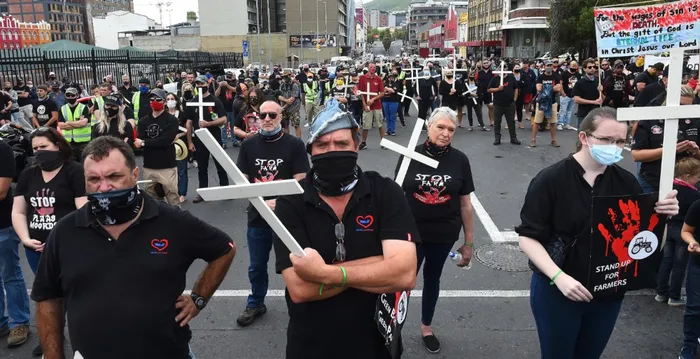
In 2020 farm owners and workers marched to the parliament where they prayed and handed over a memorandum to Members of Parliament demanding an end to farm attacks and murders. They were joined by bikers who carried flags and white crosses.
Image: Phando Jikelo, African News Agency (ANA) archives
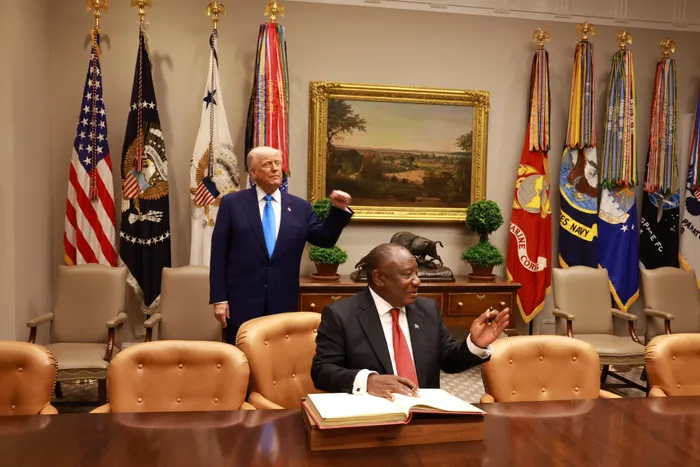
President Cyril Ramaphosa met with US President Donald Trump at the White House.
Image: GCIS
Three thousand white crosses will be planted on Washington's National Mall in September as South African lobby group Lex Libertas launches an international campaign highlighting farm murders and what it describes as the victimisation of minorities under the ANC government.
The display, which will stand within sight of the US Capitol, forms part of a conference the organisation will host with American political figures in Washington. The campaign has already drawn criticism from the South African government and the ANC, both of which reject claims that minorities are being systematically targeted, saying official crime statistics do not support that narrative.
Lex Libertas founder Dr Ernst Roets said the organisation decided to take its campaign abroad after years of unsuccessful attempts to engage the South African government.
"We've actually learned this lesson from the ANC themselves, that when they concluded during the 1980s, and late 70s, that the National Party government is not interested in engaging with them about the real problems that they are trying to present and to solve, that the way to find a solution is to get more international pressure.
"So the point for us is international awareness, and then to channel that awareness towards growing support for particular solutions within South Africa."
Roets said invitations would be sent to the White House, the National Security Council, the US State Department, media organisations and think tanks. Similar campaigns were also planned in Europe and elsewhere in Africa.
The organisation's campaign is being organised with the New York Young Republican Club, whose representatives visited South Africa earlier this year.
Central to the campaign will be the installation of 3,000 white crosses on the National Mall. Roets said each cross would represent a victim killed in a farm attack since 1990, with volunteers verifying every name before it is added to the display.
"The reason why we chose the crosses and the colour is because it became an issue during the White House meeting when protest actions against farm murders were pointed out in the video clips, which was then denied."
The issue attracted international attention earlier this year when US President Donald Trump raised farm murders during President Cyril Ramaphosa's visit to the White House, prompting a public exchange over crime in South Africa. The US later introduced a refugee programme for Afrikaners, although some of those who relocated have since returned.
The project has, however, drawn criticism for focusing only on one group of victims. Critics argue that the display makes no reference to the hundreds of Black South African farmers and farmworkers who have also been killed over the years, and therefore does not present the full picture. Available crime statistics and research indicate that farm killings, regardless of the victims' race, account for a small fraction of South Africa's overall violent crime and most occur during armed robberies rather than being racially motivated.
Roets rejected suggestions that Lex Libertas was seeking preferential treatment.
"We don't want special treatment. We want equal treatment for farmers and for people in rural communities."
He also denied that the campaign would damage South Africa's international reputation.
"We're just lifting up the mirror showing people what's happening in South Africa. We are interested in pointing out the damage that has been done by those in power in South Africa who have not responded to these issues the way they ought to have."
The Department of International Relations and Cooperation dismissed claims that Afrikaners are being systematically persecuted.
Spokesperson Chrispin Phiri said the government's position was based on official evidence and SAPS crime statistics.
"Accusations of systemic persecution of Afrikaners are unfounded," he said.
Phiri said crime statistics showed violence in South Africa was a broader criminal problem rather than one directed at any particular racial group.
During the fourth quarter of the 2025/26 financial year, from January to March this year, nine people were murdered in farm-related incidents. Five were farm dwellers, predominantly black, while four were white. He added that perpetrators were not exclusively black South Africans.
Phiri said government was strengthening policing through improved intelligence, investigations, procurement reforms and community policing, while prioritising the country's 50 highest-crime police stations.
The ANC also rejected comparisons between Lex Libertas' campaign and the party's own international mobilisation against apartheid.
Acting national spokesperson Nonceba Mhlauli said apartheid was "a legally enforced system of racial oppression that denied the majority of South Africans fundamental human rights", while democratic South Africa provided constitutional institutions and legal mechanisms through which grievances could be addressed.
"We reject narratives that portray South Africa as a country where minorities are systematically targeted or persecuted," she said, adding that previous campaigns built around claims of "white genocide" had failed because they were "not supported by facts or evidence".
Political analyst Zakhele Ndlovu of the University of KwaZulu-Natal said the campaign reflected growing frustration over government's inability to deal with violent crime.
"The main takeaway here is that this is an attempt to embarrass the ANC government for failing to protect its citizens," he said.
"It's easy to dismiss Lex Libertas and the New York Young Republicans Club as racist organisations but the truth is that the ANC government has failed in its fundamental duty to protect its citizens."
Unisa political analyst Dr Lulu Magagula-Chaka said farm attacks remained a serious crime deserving public attention, but warned there was no credible evidence that they formed part of a campaign targeting white South Africans.
"Farm attacks in South Africa remain an undeniably serious crime. It deserves public attention and effective state intervention."
"Farm murders occur, but they are not evidence of a state-sponsored programme to exterminate white South Africans."
Economist Dawie Roodt said the campaign could once again place South Africa under the international spotlight and potentially attract renewed attention from the US administration.
"Donald Trump's big attention is not here at the moment... But the moment the Middle East is resolved, then he will start looking at somebody else to bully. It might be South Africa or Cuba."
Roodt warned that while the campaign could increase pressure on government to address domestic concerns, any deterioration in relations with the United States could also have economic consequences, including the possibility of financial sanctions.