

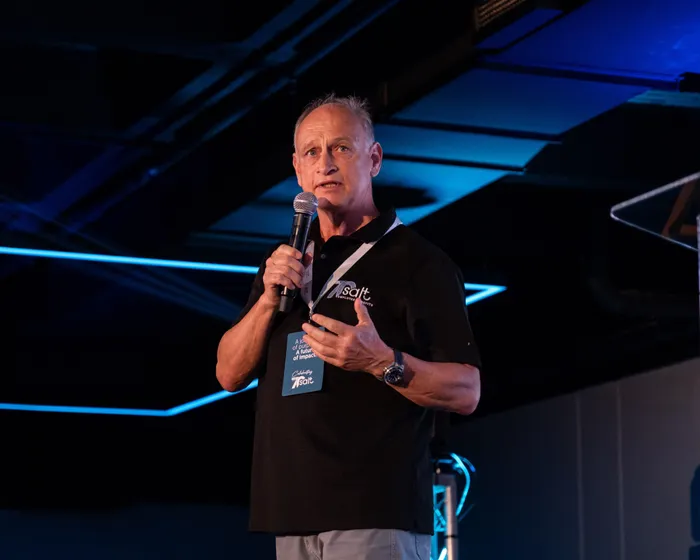
During Salt Employee Benefits' 70th anniversary, chairman Eddie Strydom emphasises the need for structural reform in South Africa's employee benefits industry to improve retirement outcomes for members. He discusses the challenges of compliance, administration, and the importance of member representation.
Image: Supplied
South Africa's employee benefits industry needs fundamental structural reform if it is to improve outcomes for retirement fund members, according to Salt Employee Benefits chairman Eddie Strydom.
Speaking to Personal Finance during Salt Employee Benefits' 70th anniversary event, Strydom said the sector has become increasingly burdened by compliance requirements and administration while failing to address the underlying problems affecting members.
"The industry has evolved, but it has evolved with a lot of red tape, compliance and administration. If you don't get to the root cause of the problem, you can do a hundred different things, but you still won't solve it. You've got to fix the root of the problem first," he says.
Salt Employee Benefits recently marked its 70th anniversary by hosting industry leaders, trustees, labour representatives and governance experts to discuss the future of employee benefits, retirement fund governance and member outcomes.
Strydom said his vision for the business has always been centred on serving people who have traditionally been overlooked by the financial services industry.
"I wanted to serve the unserved," he says.
He said his background in financial services ultimately led him to acquire Salt Employee Benefits in 2010.
"I was looking for a company that provides a service because I come from the financial industry. I was at PSG before, and I was always looking at databases. That's how I ended up buying Salt Employee Benefits back in 2010," he says.
According to Strydom, meaningful reform requires more than stricter regulation.
He believes the industry's biggest weakness lies in its structure and administration.
"We don't do anything if it's not in the best interests of the member. We'd rather walk away. People talk about central systems, payroll and non-compliance, but we all know those issues exist. You have to fundamentally restructure and change the processes," he says.
Strydom also threw his support behind stronger member representation on retirement fund boards through elected trustees but stressed that representatives must receive the necessary training to perform their duties effectively.
Referring to remarks made by Congress of South African Trade Unions (Cosatu) representative Jan Mahlangu during the opening session, Strydom said:
"Jan Mahlangu said Cosatu fought for at least 50% of trustees to be member representatives. I agree 100%. But you can't simply appoint people without equipping them. You have to make sure they are properly prepared. Otherwise, you're setting people up to fail. That's what's happening in our country, in the world and in this industry. That's what we want to change."
He said responsibility for many of the industry's shortcomings does not rest solely with administrators.
"The challenges are the employers and the unions. We can sit on stages and talk about what needs to be done, but then benefits are reduced from 7.5% to 5.5%. You can't say one thing and do another. The member is not always the priority," he says.
Strydom also highlighted the lack of business capability among some employers, saying weak systems and poor governance contribute significantly to non-compliance.
"There are thousands of non-compliant companies. Yes, some struggle because of cash flow, but it also comes back to structure. You've got people running companies who have absolutely no idea how to run a business. They don't have payroll systems or the right processes. We need to educate and train those people. Technology can help, but you can only lead a horse to water. When things go wrong, the administrator always gets the blame because that's the easiest way out," he says.
Salt Employee Benefits chief experience officer Nazlie Seegers said the industry is gradually returning to a stronger member-first approach, driven by regulatory reforms and changing expectations.
"We're seeing a broader push to force the industry into a position where we're refocusing on the member. You'll see that through treating customers fairly and the regulatory reforms that are coming. All of that is aimed at putting the member back at the centre," she says.
Seegers said Salt deliberately chose not to script speakers during the anniversary event to encourage honest and open discussions.
"I said to somebody this morning that I'm not sure whether we're brave or stupid because we didn't script any of the speakers. That's a risk, but for us it's about having honest conversations. Both our chairperson and I believe in serving the member. We don't always get it 100% right, but it's a journey of progress," she says.
She added that the event was designed as an opportunity to listen to stakeholders and identify practical solutions to improve the industry.
"Today is a listening session for us. Tell us where you think the issues are, whether we agree or not. We want to understand where people's minds are and how we bring the conversation back to the member. If employees don't have the tools they need, we must come to the table with solutions. If members don't understand their benefits, we must help them understand. The question is how we restructure and fix what's broken at a foundational level so we can build for the future," she says.
South African Transport and Allied Workers Union National Industrial Council member and Passenger Rail Agency of South Africa Second Defined Benefit Fund trustee Paul Nephane highlighted another persistent challenge facing the industry: employers deducting retirement fund contributions from workers' salaries without paying those funds over to administrators.
"Security companies deduct the money from members' salaries, and members can prove it because it appears on their payslips. But when they go to the administrator, they discover the contributions haven't been paid over for three or four months," he says.
According to Nephane, the problem often only comes to light when members attempt to claim benefits.
"When a member is dismissed or a family member passes away and they need to claim a benefit, that's when the problem is discovered. The employer hasn't been paying the contributions despite deducting the money. I'm calling on our colleagues and government to assist because this is happening across the industry," he says.
The discussions throughout Salt Employee Benefits' 70th anniversary event reflected a shared view among speakers that while regulation and compliance remain important, improving outcomes for retirement fund members will require structural reform, stronger governance, better employer capability and a renewed commitment to placing members at the centre of the industry.
PERSONAL FINANCE