Run on numbers: South African consumers caught between rate cuts and Eskom's burden
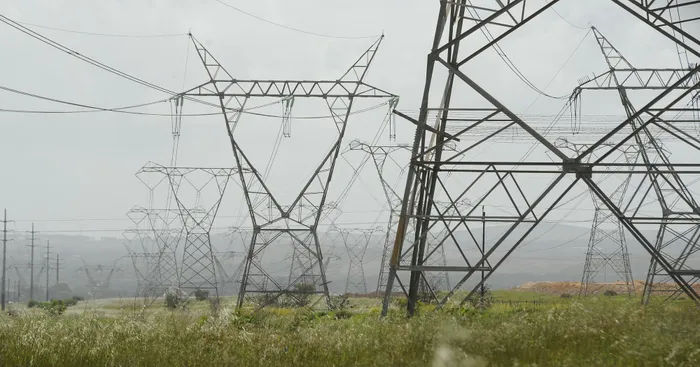
South Africans are experiencing economic relief through interest rate cuts and fuel price decreases, potentially adding R54.7 billion in consumer spending power. However, these gains are effectively neutralised by Eskom's spiralling costs and controversial pricing structure, raising serious questions about Nersa's regulatory effectiveness and the sustainability of the current energy model.
Image: Henk Kruger / Independent Newspapers
As of 2025/26, the gross South African government debt was R6.09 trillion ($412.04 billion), with a debt-to-GDP ratio of 77.4%. The national government’s gross loan debt increased by 8.5% year on year to R5 817 billion (78.1% of GDP) as of 30 June 2025.
The private sector debt linked to a variable rate is:
Home loans (mortgages): ~R1.1 trillion outstanding (largest category of household debt).
Vehicle finance: ~R500 billion outstanding.
Personal loans: ~R170 billion outstanding.
Credit card debt: ~R183 billion outstanding
Total variable rate debt R1,953 billion.
For every half a percent reduction in the short-term interest rates, the private sector has an additional R 9 760 000 000 per annum, or R 813 333 333 per month, discretionary spending. Total liquid fuel consumption: Around 27–30 billion Liters annually (varies slightly year to year depending on economic activity and imports). Breakdown by type (approximate share):
- Diesel: ~50% of total consumption
- Petrol (gasoline): ~30%
- Jet fuel, LPG, paraffin, furnace oil, aviation gasoline: ~20% combined.
As of the current year, consumers will see a reduction in price of R1,5 per Liter. This translates to an enormous boost of R 45,000,000,000 saving. Add the savings in interest rate payments, and we are up to a total saving of R54,760,000,000. There ought to be further spin-offs in lower prices that would work through the system as retailers pass on cost savings to consumers. On the other hand, in 2025, Eskom’s approved revenue requirement was R384.6 billion.
For 2026, the National Energy Regulator of South Africa (Nersa) initially approved R409.5 billion, but later adjustments and disputes suggest Eskom could collect R76 billion more, pushing the effective payments closer to R485 billion. This means Eskom alone doubles the good with bad news for consumers. There are many incompetent government departments, but Nersa is competing for top spot.
The formula used by Nersa to determine prices cannot survive scrutiny.
Core formula
NERSA uses the following principle for Eskom’s allowable revenue: AR=(WACC×RAB) + E +D + RCA.
Where:
- AR = Allowable Revenue
- WACC × RAB = Return on assets (Weighted Average Cost of Capital × Regulatory Asset Base)
- E = Operating and maintenance expenses
- D = Depreciation of assets
- RCA = Regulatory Clearing Account adjustments (corrections for past over/under-recovery of revenue).
Key Components
- Operating Costs (E): Salaries, maintenance, fuel (coal, diesel, renewables integration).
- Depreciation (D): Recovery of capital investment costs over time.
- Return on Assets (WACC × RAB): Ensures Eskom earns a fair return on its infrastructure investments.
- Regulatory Clearing Account (RCA): Adjusts for differences between forecasted and actual costs/revenues.
- Efficiency Targets: NERSA can disallow inefficient costs to protect consumers.
Media reports such as the following have become a daily occurrence. “Eskom, the state-owned utility burdened by approximately R400 billion in debt, accumulated through years of corruption, inefficient tenders, and a bloated workforce. To service this debt and fund operations, Eskom has relied on steep tariff hikes. Tariffs have increased by around 234% in the last decade.
"Newton's Third Law states that for every action, there is an equal and opposite reaction. This principle is mathematically expressed as: if object A exerts a force F on object B, then object B exerts a force -F on object A.”
Eskom must beware the consumers' revenge, as it is clear they will not forget.
From the above, one can merely look at the operating costs that are blatantly excessive. Salaries are notoriously high at the utility. Eskom’s latest financial statements revealed that the average employee costs Eskom R870,000 per year, significantly higher than the average for most other companies in South Africa.
Its annual financial statements for the year ended March 31, 2024, showed that the company’s headcount increased to 40,625 at the end of the financial year. During the 2024 financial year, Eskom’s direct costs of employment increased to R35.355 billion. This equates to R870,277 per employee per year. What is particularly concerning is that Eskom’s employee costs have rapidly increased over the last twenty years. Where is the fairness principle when South Africa has an unemployment rate of over 31%, and per other definitions, a lot higher?
A World Bank policy research paper found that in 2014, Eskom had the largest workforce out of the 39 sub-Saharan African countries at 41,787. The World Bank estimated that Eskom required a workforce of only 14,244 people to serve its customers.
It proposed one employee for every 413 electricity customers. In 2004, Eskom’s average employee cost was R297,000. Inflation-based increases would have lifted this salary to R648,000 in 2024. However, due to Eskom’s salary increases, the average employee now gets paid R870,000 per year, much higher than what it was, in relative terms, twenty years ago.
And as if this is not enough, Nersa has done nothing to investigate the claims of Eskom paying excessive prices for its coal. According to Eskom, “It costs Eskom around a third of its total operational expenditure for the year. That input cost is increasing as there is less and less good quality coal that can be found around the world”.In another statement, Eskom stated.
“South Africa’s coal reserves are estimated at 53 billion tonnes and, at the present production rate, that translates to almost 200 years of coal supply left, according to a 2021 Eskom report.”
The energy regulator is either biased or inefficient, as it has required Court intervention to ensure they do their job. “Judge Anthony Millar ordered energy regulator Nersa to redetermine the electricity tariffs applied in 2024/25 for the City of Joburg, Ekurhuleni on the East Rand, Madibeng Municipality in Brits, and Msunduzi in Pietermaritzburg. Millar ordered Nersa to start the tariff determination process afresh, which means the municipalities must submit new applications with cost-of-supply (CoS) studies," according to a report.
The concept that a state organisation is entitled to a fair return on assets is open for abuse and reckless practices, where fruitless and wasteful spending gets rewarded instead of being penalised. One only needs to read the Auditor General reports on state institutions to see the extent of this.
The energy scenario has become more complex with the advent of renewable energy. This rapid renewable growth introduces a new paradox. While it adds cleaner capacity, it also results in excess energy during midday periods when solar output is high and demand is lower. In the accelerated build scenario, early renewable deployment creates more than 5 TWh of excess energy by 2028. Coal-fired plants, designed for steady base load operation, must now ramp down during the day and ramp up sharply in the evening, sometimes by as much as 7 GW, to meet peak demand. It requires a balancing act with complex pricing implications for participants.
* Kruger is an independent analyst.
PERSONAL FINANCE