


Food inflation is the next big inflationary push driver.
Image: Pixabay
South Africa’s inflation fight is moving from the petrol pump to the dinner table, with the South African Reserve Bank warning that food prices are the next pressure point in an economy already under strain from fuel costs and geopolitical uncertainty.
“It’s not so much that we have had a food shock, but we expect that to be coming,” said Reserve Bank Governor Lesetja Kganyago in announcing that the prime lending rate would increase 25bps to 10.5%. The agricultural sector is facing higher costs for both diesel and fertiliser which flows directly into the price of food on supermarket shelves.
“Amid pressure on food prices, we forecast headline inflation averaging 4.4% this year and 3.7% next year,” Kganyago says. Inflation climbed to 4% in April from the targeted 3% in March, driven largely by fuel prices.
Even though the vote was not unanimous, the committee agreed that inflation risks had intensified, and that the challenge of large and overlapping shocks would likely trigger second round effects, requiring a monetary policy response. “Our decision was aimed at managing risks and ensuring that inflation returns to target,” says Kganyago.
The latest inflation figures have already shown that the impact of rising energy prices and global tensions is now filtering through more rapidly into the South African economy, says Thys van Zyl, CEO of Everest Advisory Services. “The Reserve Bank likely felt it needed to act decisively to manage inflation.”
Van Zyl adds that “fuel prices, transport costs and other input costs are now beginning to create broader inflationary pressure. Once these costs start filtering through into food prices, services and general household expenses, it becomes increasingly difficult for central banks to keep interest rates unchanged.”
The Monetary Policy Committee explored three scenarios during its meeting. The first involves a prolonged Middle East crisis leading to higher food and oil prices and a weaker rand.
The second adds El Niño – a weather pattern currently forming – which typically brings drought to parts of South Africa, compounding agricultural pressure. The third scenario considered the risk that large shocks have disproportionately larger effects on inflation, with more costs passed on to consumers, says Kganyago.
“The scenario with a longer Strait closure has inflation at about 5%, with two more hikes than the baseline. With El Niño added, rates stay high for longer. The most adverse scenario puts all the risks together, causing inflation to peak above 6%, requiring three extra hikes.”
Kganyago also notes that recent floods in the Western Cape, Eastern Cape and North-West provinces have done severe, if localised, damage. “The frequency of these extreme-weather events underscores the threat from climate change,” he says.
“When fuel, food and borrowing costs rise together, the impact is not incremental; it is compounding. That is where we see the real pressure emerge, and where financial behaviour shifts decisively,” says TransUnion Africa CEO Lee Naik.
According to TransUnion’s latest insights, increases in fuel prices, renewed food inflation, and persistently higher borrowing costs are reshaping consumer sentiment, shifting from early signs of recovery in 2026, to a more defensive posture.
April saw the single largest increase in any one month in fuel and the R3 fuel levy cushion that government put in place after this record price increase for April and May is now being phased out.
From next month, 50% of the tax relief will be rolled back, adding R1.50 per litre to petrol and R1.97 per litre to diesel. The final 50% is scheduled to end in July, fully restoring the standard general fuel levy, leading to a second wave of price pressure before the year is out.
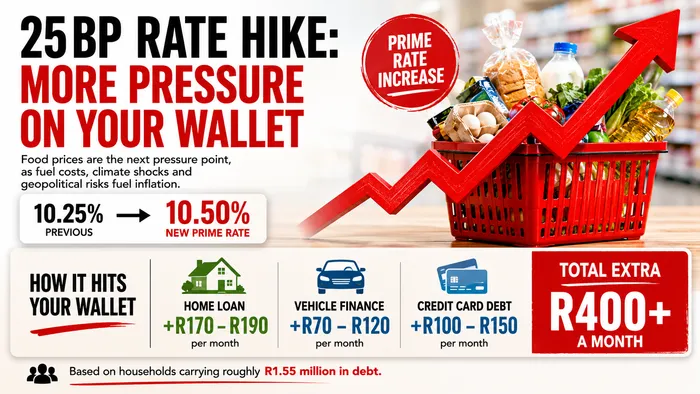
Approximately how the 25bps interest rate hike will hit your wallet.
Image: ChatGPT
The risk is not just higher rates, Naik notes, but the combination of cost pressures hitting at once. “The affordability challenge becomes immediate and more difficult to manage,” he says.
Consumers are not only facing slightly higher borrowing costs, but also contending with rising fuel and food prices, the municipal rates and utility tariff increases to be implemented in July and broader inflationary pressures affecting almost every other area of household expenditure, says Berry Everitt, CEO of the Chas Everitt International property group.
“Against that backdrop, the South African Reserve Bank had little choice but to increase rates today, and to make it clear that further increases are to be expected until it can bring inflation back in line with its 3% target,” says Everitt.
PSG group chief economist Johann Els says hiking early would likely mean fewer hikes in total would be needed. “The Governor also said that it’s difficult to judge when second round inflationary impacts would start. Once you see it, it’s too late,” he adds.
Els sees the increase in the inflation forecast as marginal, with the end result depending on how quickly oil prices reverse from around $100 a barrel.
Samuel Seeff, chairman of the Seeff Property Group, slammed the increase, saying the hike will unnecessarily penalise consumers and hamper economic recovery for what is clearly a temporary spike in inflation driven by external factors rather than domestic overspending.
“Consumers and the economy are already struggling under the weight of high interest rates and the burden of fuel price hikes and other cost increases. Further pressure on disposable incomes only exacerbates the current economic challenges while impeding recovery,” he says.
PERSONAL FINANCE