

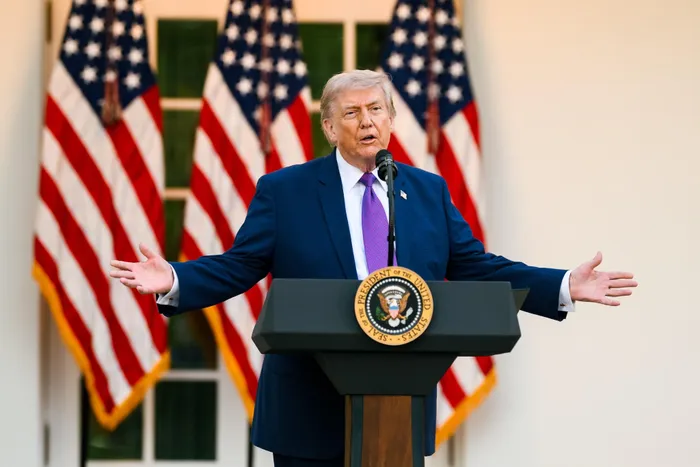
Us President Donald Trump has received unexpected criticism of the Iran peace deal from his Republican allies, as tensions rise and the implications for global stability unfold, writes Armstrong Williams.
Image: Facebook / The White House
One of the most revealing aspects of the emerging Iran peace agreement is not the criticism coming from Democrats. It is the criticism coming from President Trump’s own Republican allies.
For months, Americans watched tensions escalate into a dangerous confrontation that threatened to engulf the Middle East, disrupt global energy markets, and pull the United States into yet another costly regional conflict. Now, as diplomacy begins to replace military confrontation, many expected Republicans to rally behind what could become one of the most consequential foreign-policy achievements of Trump’s presidency.
Instead, some of the sharpest criticism is coming from within his own party.
Why?
The answer lies in a fundamental disagreement over what victory should have looked like.
Many Republican critics believe Iran arrived at the negotiating table from a position of weakness. Years of sanctions, economic pressure, military setbacks, and international isolation left Tehran with fewer options than it had possessed in decades. From their perspective, the United States and its allies held a rare strategic advantage.
Their argument is straightforward: if Iran was weakened, why not demand more?
They wanted stronger guarantees regarding Iran’s nuclear ambitions, tighter restrictions on missile development, more severe limitations on regional proxy networks, and sanctions relief conditioned upon years of demonstrated compliance.
Their concern is rooted in a principle as old as diplomacy itself: leverage surrendered is rarely recovered.
Supporters of the agreement view the situation differently.
They argue that the purpose of military and economic pressure is not endless confrontation. The purpose is to create conditions where diplomacy becomes possible. If negotiations can reduce the likelihood of war, lower regional tensions, stabilise energy markets, and establish meaningful verification mechanisms, then the pressure campaign has achieved its purpose.
At the centre of the disagreement lies a question that has divided policymakers throughout history:
When is enough enough?
History provides examples supporting both positions. Nations have sometimes failed to press an advantage and later paid the price. Others have pursued absolute victory only to become trapped in conflicts that consumed lives, resources, and political capital far beyond what anyone anticipated.
Unfortunately, those lessons usually become obvious only after history has rendered its verdict.
Yet there is another dimension to this debate that receives far less attention in Washington.
The world is watching.
Earlier this year, during my travels in South Africa, I encountered a perspective that differs markedly from the debate taking place inside American political circles. Across much of Africa, Asia, and the developing world, there is growing fatigue with great-power confrontations that threaten global economic stability.
For many nations, the question is not whether Iran deserves pressure or punishment. The question is whether another regional conflict will drive up fuel prices, disrupt trade routes, increase food costs, and place additional burdens on already fragile economies.
In Johannesburg, Cape Town, Nairobi, Lagos, and elsewhere, citizens often experience geopolitical conflict not through military briefings or congressional hearings but through rising prices at the grocery store, higher transportation costs, and declining economic opportunity.
What Washington sees as a strategic confrontation, much of the world experiences as economic disruption.
That reality helps explain why many nations have become increasingly supportive of diplomatic solutions even when they remain skeptical of the parties involved.
This broader international perspective matters because the geopolitical landscape is changing.
The emergence of BRICS, the growing influence of China, and the increasing assertiveness of middle powers have created a world less willing to automatically align with American foreign policy objectives. Countries throughout Africa are increasingly seeking strategic autonomy rather than choosing sides in every dispute involving major powers.
For the United States, this creates both a challenge and an opportunity.
America’s strength has never rested solely upon military power. It has also rested upon its ability to build coalitions, inspire confidence, and persuade other nations that stability, prosperity, and freedom are best served through partnership with the United States.
How the Iran agreement is perceived internationally may ultimately prove almost as important as how it is perceived domestically.
And then there is Israel.
Regardless of what is signed in Washington or Tehran, Israeli leaders have maintained one principle across generations: the survival of the Jewish state will never depend solely upon diplomatic agreements.
Israeli governments of every political persuasion have consistently reserved the right to act independently when they believe existential threats are emerging. If Israeli intelligence concludes that Iran is violating commitments or rebuilding capabilities that threaten Israel’s security, history suggests Jerusalem will not remain passive simply because a diplomatic framework exists.
That reality cannot be ignored.
Peace agreements may alter political calculations, but they do not eliminate national interests. Nations ultimately act according to what they believe is necessary for their survival.
The agreement may mark the beginning of a new chapter, but it does not end the story.
Indeed, the debate may only be beginning.
The fog of war is slowly lifting. Yet as Americans debate whether enough was gained or too much was conceded, much of the world is asking a different question altogether:
Can diplomacy prevent another conflict before its consequences spread far beyond the Middle East?
The answer will not be measured merely in Washington, Tehran, or Jerusalem. It will also be measured in places like Johannesburg, Nairobi, Mumbai, São Paulo, and countless other cities where ordinary people bear the economic consequences of decisions made by powerful nations.
The fog of war is lifting.
Whether the fog of peace proves any easier to navigate remains an open question.

Us President Donald Trump has received unexpected criticism of the Iran peace deal from his Republican allies, as tensions rise and the implications for global stability unfold, writes Armstrong Williams.
Image: IOL
* Armstrong Williams is the manager and Sole Owner of Howard Stirk Holdings I & II Broadcast Television Stations and the 2016 Multicultural Media Broadcast Owner of the year.
** The views expressed do not necessarily reflect the views of IOL.