

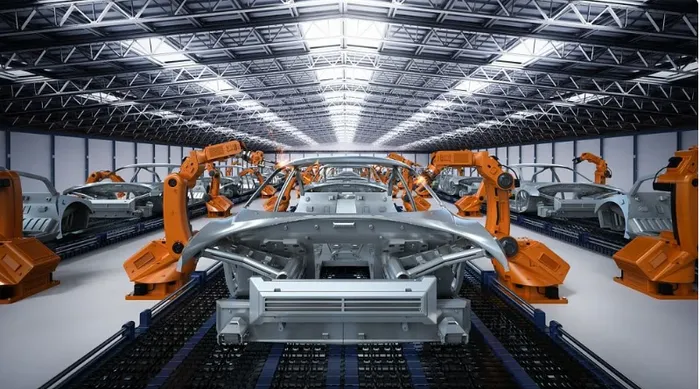
If South Africa is serious about building an indigenous EV industry, the effort must be treated as a long-term national project rather than a short-term political initiative, writes the author.
Image: TV BRICS
As electric vehicles (EVs) reshape the global automotive industry, South Africa faces a strategic question that extends far beyond transportation: can the country design, engineer, manufacture and commercialise its own electric vehicle?
At first glance, the answer appears straightforward. South Africa already manufactures vehicles for some of the world's most respected automotive brands. It possesses a mature automotive sector, a strong engineering tradition, significant mineral resources and a well-established export infrastructure. Yet despite these advantages, South Africa has not produced a globally competitive indigenous vehicle brand in modern times, let alone an electric one.
Meanwhile, Chinese manufacturers are flooding international markets with increasingly sophisticated and affordable electric vehicles. Brands that were virtually unknown outside China a decade ago now compete directly with established European, Japanese and American manufacturers. In South Africa, Chinese vehicles are rapidly gaining market share, offering consumers advanced technology at prices local manufacturers would struggle to match. A Chinese-manufactured vehicle has just won the COTY award in South Africa. Such is the dominance. The challenge, therefore, is not whether South Africa can build an electric vehicle. Technically, it can. The real challenge is whether it can build the ecosystem, supply chains, skills base, and industrial discipline necessary to sustain a competitive EV industry.
A Strong Automotive Foundation
South Africa's automotive industry remains one of the country's industrial success stories. For decades, global manufacturers such as Toyota, BMW, Ford, Mercedes-Benz, Volkswagen, Nissan and Isuzu have operated local manufacturing facilities. These plants produce vehicles that meet international quality standards and are exported to markets worldwide.
The sector contributes significantly to GDP, manufacturing output and export earnings. Thousands of jobs, both directly and indirectly, depend on automotive production, while hundreds of component suppliers support the industry.
This existing foundation provides South Africa with a significant advantage over many developing economies that are attempting to enter the EV market from scratch.
However, there is a crucial distinction between manufacturing vehicles and owning the intellectual property behind them. South Africa is highly capable of assembling and manufacturing vehicles designed elsewhere. It has far less experience developing complete vehicle platforms, battery systems, software architectures and proprietary technologies. The future automotive industry increasingly revolves around these high-value intellectual assets rather than simply assembling components.
The Chinese Benchmark
Any discussion about South Africa's EV ambitions must acknowledge the scale of China's achievement. China's rise as an electric vehicle powerhouse was not accidental. It was the result of more than two decades of strategic planning, state support, industrial investment, and relentless execution. Chinese manufacturers benefit from vertically integrated supply chains, enormous domestic demand, large-scale battery production, advanced manufacturing capabilities, and strong government support. Companies such as BYD, Geely, SAIC, and NIO have achieved production volumes that dramatically reduce unit costs.
Battery manufacturing is particularly important. In an electric vehicle, the battery can account for up to half the vehicle's value. China dominates much of the global battery supply chain, giving its manufacturers a structural advantage that competitors struggle to overcome. South Africa, by comparison, imports most of the technologies that would form the heart of a locally designed EV. The consequence is visible in showrooms across the country. Chinese vehicles often arrive fully assembled and priced competitively against locally manufactured alternatives. Replicating those economics domestically would be extraordinarily difficult.
The Missing Pieces
To build a viable South African electric vehicle industry, several critical gaps must be addressed.
The first is battery manufacturing.
South Africa possesses significant mineral wealth, including resources relevant to battery production. Yet the country largely exports raw materials and imports higher-value products. This long-standing pattern of exporting commodities while importing technology limits industrial growth. A sustainable EV sector would require local battery assembly and, ideally, some level of battery cell production. Without domestic battery capability, local manufacturers will remain dependent on imported technology and vulnerable to global supply chain disruptions.
The second challenge is electronics and software.
Modern electric vehicles are no longer purely mechanical machines. They are increasingly software-defined products. Vehicle performance, battery management, energy efficiency, safety systems, connectivity and autonomous driving capabilities are all controlled by sophisticated software. South Africa has pockets of excellence in software engineering and technology development, but it lacks the scale of ecosystems found in China, Germany, South Korea, or the United States. Building a competitive EV requires thousands of specialists in fields such as embedded systems, power electronics, artificial intelligence, cybersecurity and systems integration.
The third challenge involves supplier localisation.
A truly South African EV would require a domestic network capable of producing electric motors, power electronics, charging systems, battery packs, sensors, wiring harnesses and numerous other specialised components. Much of this ecosystem does not yet exist. Without local suppliers, manufacturing costs remain high and economic benefits are limited.
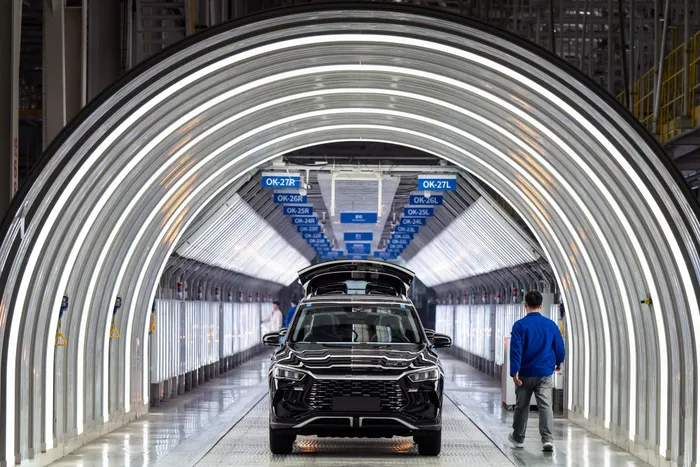
Electric vehicles on the assembly line at the BYD factory.
Image: Qilai Shen/Bloomberg
The Skills Crisis
Perhaps the greatest obstacle to a South African EV industry is not technological but human. The country continues to produce talented engineers, scientists, and technicians. Universities graduate capable professionals every year, many of whom perform exceptionally well on the international stage. Yet South Africa simultaneously faces a persistent skills shortage. Demand for electrical engineers, electronics specialists, software developers, mechatronics engineers, industrial engineers, automation experts and data scientists consistently exceeds supply. These are precisely the skills required to build an advanced electric vehicle industry.
Compounding the problem is the ongoing emigration of skilled professionals.
Over the past decade, large numbers of engineers, IT specialists, healthcare professionals, and scientists have relocated to countries such as Australia, New Zealand, Canada, the United Kingdom, Germany and the United Arab Emirates. While precise occupation-specific statistics remain difficult to obtain, professional associations and migration studies consistently identify engineering as one of the most mobile professions.
The result is a troubling cycle. South Africa invests in educating highly skilled individuals, only to lose many of them during their most productive years. In the age of remote work, the challenge has become even more complex. Engineers may remain physically in South Africa while effectively exporting their expertise to foreign employers.
The Discipline Factor
Industrial success is often discussed in terms of technology and investment, but culture plays an equally important role. Countries that dominate advanced manufacturing share certain characteristics. They emphasise precision, quality control, continuous improvement, technical excellence and long-term planning. Manufacturing discipline is embedded in their institutions, companies, and workforce. Germany's reputation for engineering excellence, Japan's obsession with quality and South Korea's manufacturing efficiency were not created overnight. They emerged through decades of investment in education, vocational training, industrial policy, and workplace culture. South Africa's challenge is not a lack of talent. Rather, it is inconsistency.
Infrastructure instability, policy uncertainty, logistics bottlenecks, skills mismatches, and uneven project execution create barriers that discourage long-term investment. Advanced manufacturing depends on reliability. A production line cannot operate efficiently if power interruptions, transport delays, or supplier disruptions become routine risks. Creating a globally competitive EV industry would therefore require more than factories and funding. It would require a national commitment to operational excellence.
Finding a Niche
Attempting to compete head-to-head with Chinese giants may be unrealistic. South Africa's greatest opportunity may lie in identifying market segments where it possesses unique advantages.
One possibility is commercial vehicles designed for African conditions. Electric delivery vans, municipal fleets, utility vehicles and public transport solutions could address growing urbanisation across the continent.
Another opportunity lies in mining and industrial applications. South Africa possesses deep expertise in mining operations and could potentially develop specialised electric vehicles for underground and industrial environments.
Agricultural utility vehicles represent another niche. Much of Africa's economy remains dependent on agriculture, creating demand for robust, affordable, and easily maintained electric platforms. Rather than trying to build the next Tesla, South Africa may achieve greater success by solving uniquely African mobility challenges.
What a Turnaround Would Require
If South Africa is serious about building an indigenous EV industry, the effort must be treated as a long-term national project rather than a short-term political initiative.
First, policymakers must provide regulatory certainty. Investors require confidence that industrial policies will remain stable over decades, not election cycles.
Second, the country must move further up the value chain. Beneficiating mineral resources, producing battery components, and expanding local manufacturing capacity would create greater economic value than simply exporting raw materials.
Third, technical education must evolve. Universities, colleges and vocational institutions should align programmes with future industrial needs, including battery technology, robotics, automation, software engineering and advanced manufacturing.
Fourth, greater emphasis must be placed on apprenticeships and technical trades. Engineers alone cannot build an industry. Electricians, toolmakers, machinists, technicians, and automation specialists are equally essential.
Fifth, South Africa must develop strategies to retain and attract talent. Competitive salaries, world-class research facilities, career opportunities and a stable operating environment will be critical if the country hopes to reverse the brain drain.
Finally, government procurement could play a catalytic role. Public-sector fleets, municipalities, and state-owned enterprises could provide the initial demand needed to help local manufacturers achieve scale.
Beyond Electric Vehicles
The electric vehicle debate is ultimately about much more than cars.
An indigenous EV industry would require South Africa to solve many of the challenges affecting manufacturing more broadly. It would require better educational outcomes, stronger research capabilities, improved infrastructure, greater policy consistency, and more effective collaboration among government, industry, and academia.
In that sense, the electric vehicle serves as a useful test case for industrial renewal.
The country already possesses many of the ingredients necessary for success: engineering talent, mineral resources, manufacturing experience, and access to growing African markets. What remains uncertain is whether these strengths can be aligned into a coherent national strategy. South Africa can build an electric vehicle. There is little doubt about that. Whether it can build a globally competitive electric vehicle industry is a far more demanding challenge. The answer will depend not on a breakthrough technology or a single flagship project, but on the country's ability to develop skills, retain talent, foster innovation, and sustain industrial discipline over the next generation. If South Africa can achieve that, the rewards will extend far beyond the automotive sector. It will have created a blueprint for industrial growth that could be replicated across multiple sectors of the economy. And that may ultimately prove more valuable than the vehicle itself.
The India Factor
The comparison between South Africa and India is particularly revealing because both countries started from broadly similar positions as developing economies with colonial legacies, large populations living below middle-income levels, and ambitions to industrialise. Yet India has become one of the world's largest automotive manufacturing hubs, while South Africa remains primarily an assembly and export platform for foreign brands. The fact that an estimated 35–40% of passenger vehicles sold in South Africa originate from Indian factories is not accidental. It reflects decades of industrial policy, skills development, supplier localisation, and relentless focus on manufacturing competitiveness.
It is worth casting an eye over the Indian Ocean towards India. Let’s consider and compare the dynamics of the two nations
South Africa vs India: Automotive and EV Industry Dynamics
| Factor | South Africa | India |
| Population (2026) | ~63 million | ~1.45 billion |
| Domestic Vehicle Market | Relatively small (~500,000–600,000 new vehicles annually) | One of the world's largest (>4 million passenger vehicles annually) |
| Manufacturing Model | Primarily assembly and export of foreign-designed vehicles | Full-spectrum manufacturing from design to export |
| Vehicle Brands Owned Locally | Virtually none of global significance | Tata Motors, Mahindra, Ashok Leyland and others |
| Automotive Supply Chain | Limited localization in high-tech components | Deep local supplier ecosystem with thousands of manufacturers |
| Battery Manufacturing | Emerging and fragmented | Rapidly expanding through government incentives |
| Labour Costs | Higher than many Asian competitors | Significantly lower at scale |
| Engineering Graduate Output | ~15,000–20,000 annually across disciplines | Hundreds of thousands annually |
| Technical Colleges & Vocational Training | Uneven quality and industry alignment | Extensive technical training network |
| Research & Development Investment | Limited private-sector R&D | Significant investment by both government and industry |
| Vehicle Exports | Strong exporter of specific vehicle models | Major exporter of complete vehicles and components |
| Energy Reliability | Historically constrained by power shortages | Generally more stable industrial power supply |
| Local Market Scale | Too small to achieve major economies of scale | Massive domestic demand drives production volumes |
| EV Ecosystem | Nascent | Growing rapidly with government support |
| Talent Retention | Significant brain drain | Increasingly attracts global engineering investment |
| Manufacturing Culture | Strong in pockets, inconsistent nationally | Highly competitive and process-driven |
India's automotive success did not emerge because it had better engineers than South Africa. It succeeded because it systematically built an industrial ecosystem.
1. Scale Created Competitive Advantage
India's enormous domestic market allowed manufacturers to produce vehicles in large volumes. A factory producing 300,000 vehicles annually enjoys significantly lower unit costs than one producing 50,000. South Africa's market is simply too small to provide similar economies of scale.
2. India Focused on Supplier Development
One of India's greatest achievements was the development of thousands of local suppliers.
Today, Indian companies manufacture: engines, gearboxes, electronics, wiring harnesses, seats, software systems and other relevant components. South Africa imports many of these components. As a result, much of the value creation occurs offshore.
3. India Invested in Technical Skills
India produces enormous numbers of mechanical engineers, electrical engineers, software developers, and manufacturing specialists. Companies such as Tata, Mahindra, Infosys, Wipro, and others helped create a culture in which engineering became a respected career path. South Africa produces excellent engineers but in much smaller numbers.
4. India Developed Indigenous Brands
Perhaps the biggest difference is ownership. India owns automotive intellectual property. Examples include: Tata Motors, Mahindra & Mahindra and Ashok Leyland.
South Africa manufactures vehicles for foreign brands but owns very little automotive IP.
The profit margins, patents, software and vehicle platforms typically reside overseas.
Why Indian Vehicles Are Dominating South Africa
Many South Africans are surprised to learn how many vehicles originate from India.
Models from brands such as Suzuki, Hyundai, Kia, Toyota, Renault, and Nissan are increasingly sourced from Indian production facilities. Indian plants have become global export hubs because they offer:
Advantage | Impact |
Lower labour costs | Cheaper vehicles |
Massive production volumes | Better economies of scale |
Local supplier base | Reduced import costs |
Strong logistics networks | Faster export capability |
Mature quality systems | Consistent product quality |
Government incentive | Increased investment |
The Bigger Reality
India's automotive success is not fundamentally about cars. It is about the national industrial strategy. Over several decades, India deliberately built capabilities in engineering, manufacturing, software development, supplier networks, and entrepreneurship. South Africa possesses many of the same raw ingredients: capable engineers, strong universities, mineral wealth, and established manufacturing facilities.
What India demonstrates is that industrial success requires patient execution over decades, not years. The uncomfortable comparison is that South Africa currently competes not only against imported vehicles, but against the accumulated industrial discipline, skills development, and policy consistency that India has been building since the early 1990s.
The encouraging conclusion is that the gap is not primarily technological. It is institutional. And institutional weaknesses, unlike geography or natural resources, can be changed through deliberate policy, investment, and leadership.
* Shabodien Roomanay is the board Chairman of Muslim Views Publication, a founding member of the Salt River Heritage Society, and a trustee of the SA Foundation for Islamic Art.
** The views expressed do not necessarily reflect the views of IOL.
A truly South African EV would require a domestic network capable of producing electric motors, power electronics, charging systems, battery packs, sensors, wiring harnesses and numerous other specialised components.
Image: Supplied