


Johannesburg is set to host the LIV Golf tournament this weekend, marking a pivotal moment for South Africa. This event is not just about golf; it represents a strategic opportunity for economic growth and national branding.
Image: File Picture
This weekend, Johannesburg hosts a defining moment: the arrival of the LIV Golf Johannesburg tournament on African soil for the first time.
It is tempting to view this as just another sporting event.
That would be a mistake.
What we are witnessing is not an event. It is a strategic lever—one that sits at the intersection of nation branding, economic growth, and long-term value creation. At a time when South Africa is searching for new growth pathways, global events are not optional. They are essential.
Yes, the immediate economic impact matters. International events drive tourism, fill hotels, stimulate local businesses, and generate employment across multiple sectors.
They inject much-needed revenue into the economy at a time when growth is under pressure.
But the real value lies beyond the balance sheet. Global events are brand accelerators. When South Africa hosts a world-class event, it is not merely accommodating visitors—it is broadcasting a message to the world. Millions of viewers are not just watching golf; they are experiencing South Africa. They are forming perceptions about our capability, our infrastructure, our hospitality, and our potential.
In a competitive global economy, perception shapes reality. Countries, like companies, compete for investment, talent, and tourism. And in that competition, brand matters. Events like LIV Golf compress years of marketing into a single weekend.
This is not theoretical. It is a model that has already been proven at scale. The 1984 Summer Olympics fundamentally changed how the world thinks about hosting global events. Prior to 1984, the Olympics had become synonymous with financial overreach and post-event debt. Cities built expensive infrastructure with little long-term use, often leaving taxpayers to carry the burden.
Los Angeles rewrote the playbook. Instead of overbuilding, the city leveraged existing infrastructure. Instead of relying on public funding, it mobilised private capital. It pioneered modern sponsorship models and maximised broadcast revenues.
The result was historic: a surplus of approximately $200 million—the first profitable Olympic Games of the modern era. But the real legacy was not just financial. It was philosophical. Los Angeles proved that global events can be commercially viable, strategically aligned, and legacy-driven. It shifted the narrative from cost to investment. That lesson is profoundly relevant for South Africa. The opportunity is not simply to host events—but to design platforms.
South African Tourism has already positioned LIV Golf as more than a tournament. It is a gateway to showcase the country’s broader offering—from world-class golf courses to safari experiences, cultural richness, and natural beauty. Importantly, it targets a high-value segment: golf tourists, who typically spend significantly more than the average traveller. This is ecosystem thinking.
A visitor who arrives for a global event does not just attend and leave. They explore. They spend. They return. And, perhaps most importantly, they tell the story. This is how momentum is built. The impact extends across the entire value chain: airlines, hospitality, transport, retail, and small businesses all benefit. For a country grappling with unemployment, particularly among the youth, this is not insignificant. It is a practical pathway to inclusive economic participation.
Yet the most powerful return on investment remains intangible. Belief. When a nation successfully hosts a global event, it demonstrates competence at scale. It builds trust in its ability to deliver. It creates a sense of pride among its citizens. It shifts the internal narrative from limitation to possibility. This is not soft value. It is strategic capital.
South Africa experienced this during the 2010 FIFA World Cup. Beyond the infrastructure and tourism boost, the tournament redefined how South Africans—and the world—saw the country. It was a moment of unity, confidence, and global relevance.
As a result, not only did South Africa earn the highest Net Promoter Score of all World Cups, a resounding 92% NPS from the visitors (which still stands as the best ever to date), but Major Infrastructure Upgrades showcased South Africa’s engineering prowess, visitors experienced Zero Major Crime in 31 Days, Leisure Tourism went up 31% year-on-year (and Business Tourism by 47% for the City of Cape Town), Business Confidence was rated highest since 1995, and we co-created 500,000 New Jobs Every Year from 2004 to 2010, a total of 3 million plus as all stakeholders were working towards the common goal – and the Exchange Rate strengthened to R7/$.
That is the power of a well-executed event.
The LIV Golf tournament represents the next chapter. Crucially, it is not a once-off moment, but part of a multi-year commitment. This creates the foundation for sustained impact rather than a fleeting spike.
And this is where strategic intent becomes critical. If South Africa approaches global events as isolated opportunities, the returns will remain limited. But if it treats them as part of a coordinated national strategy—aligned with tourism, investment promotion, skills development, and enterprise growth—the upside becomes exponential.
This is how leading nations think. They do not bid for events. They build ecosystems around them. Johannesburg this weekend is more than a host city. It is a signal to the world that South Africa is open, capable, and ready to compete on a global stage.
But it is also a signal to ourselves. Because ultimately, the true value of global events lies not only in how they shape global perception—but in how they shape national belief. And belief, when properly designed, becomes a country’s most powerful asset.
Dr Nik Eberl is the founder and executive chair: The Future of Jobs Summit™ (Official T20 Side Event). He is also the author of Nation of Champions: How South Africa won the World Cup of Destination Branding.
*** The views expressed here do not necessarily represent those of Independent Media or IOL.
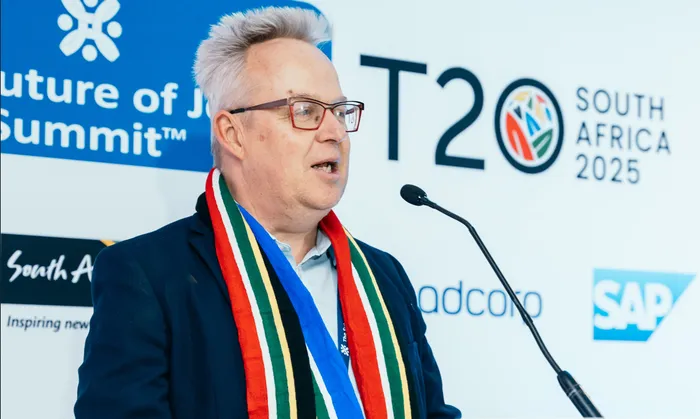
Dr Nik Eberl is the Founder & Executive Chair: The Future of Jobs Summit™ (Official T20 Side Event).
Image: Supplied
Follow Business Report on Facebook, X and on LinkedIn for the latest Business and tech news.