

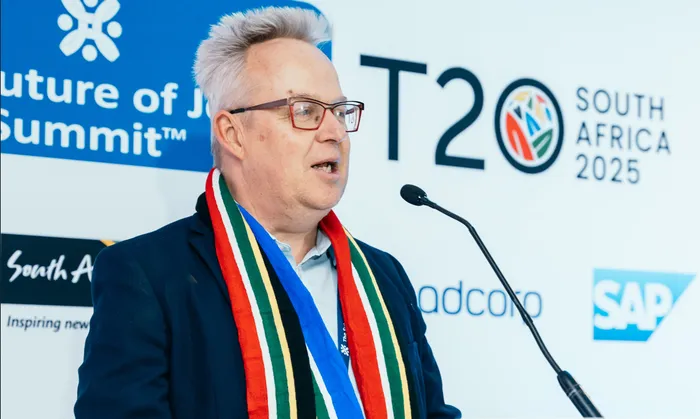
Dr Nik Eberl is the Founder & Executive Chair: The Future of Jobs Summit™ (Official T20 Side Event).
Image: Supplied
South Africa faces a literacy crisis that threatens the very foundation of its future economy. According to the latest national assessments, 81% of Grade 4 learners cannot read for meaning.
That statistic has been quoted in conferences, policy documents and strategy papers for years. It has been debated in boardrooms and parliamentary committees. It has been analysed by academics and development economists.
But last Friday, in a classroom in Soweto, we were reminded that solving the problem may begin with something far simpler. Miss South Africa, Qhawekazi Mazaleni, walked into Nkone Maruping Primary School in Braamfischer and read an isiXhosa children’s book to a group of learners. Not for a photo opportunity. For a reading session.
Mazaleni read from her children’s book Amasela Amdaka, encouraging pupils to embrace reading in their mother tongue as the foundation for learning, confidence and cultural identity. As a speech therapist who specialises in autism, she understands something many education debates overlook: language is the first building block of comprehension.
Before mathematics. Before science. Before history. Children must first learn to process language. This insight lies at the heart of one of the most important yet underappreciated debates in South African education: the role of mother-tongue literacy.
For decades, international research has consistently shown that children learn to read and understand concepts more effectively when they start in the language they speak at home. Once comprehension is established, transitioning into additional languages becomes easier.
Yet South Africa’s education system often pushes learners into English-dominant instruction before they have mastered the basics of reading in their own languages. The result is predictable.
Children memorise words but struggle to interpret meaning. They can pronounce sentences but cannot explain them. They move through grades without building the cognitive scaffolding required for higher learning. By the time they reach Grade 4, the gap has widened into a crisis.
Mazaleni’s visit offered a powerful reminder that literacy is not simply about textbooks and syllabi. It is about how children experience language. The visit also coincided with the school’s Diversity Celebration Day. Mazaleni used the moment to encourage learners to view diversity “not as a difference to be feared, but as a strength that enriches their school, communities and the nation as a whole”.
That message carries lessons far beyond the classroom. Having coached leaders across five continents, I have learned that the best leaders do not merely tolerate diversity. They leverage it. In business, diversity drives innovation. In teams, it strengthens decision-making. In societies, it builds resilience.
Mazaleni was teaching that lesson to Grade 4 learners long before the workplace will demand it from them. But what made the moment particularly compelling was how it reflected systems thinking in action.
In South Africa we often attempt to fix complex problems by addressing symptoms rather than causes. We debate declining education outcomes, rising unemployment and poor productivity as if they exist in isolation.
In reality, they are deeply connected. Low literacy leads to weak educational outcomes. Weak education feeds into youth unemployment. Youth unemployment erodes social cohesion and economic growth. The chain begins with how children learn to read.
Consider the example of Springbok coach Rassie Erasmus. When he rebuilt the national rugby team, he did not simply focus on selecting better players. He redesigned the entire system that develops and supports them.
From scouting structures to team culture, from preparation to performance analysis, he built a machine capable of producing sustained excellence. The results are well documented.
Mazaleni’s classroom visit may appear modest by comparison, but the underlying philosophy is remarkably similar. She was not merely encouraging children to read. She was reinforcing the cognitive and cultural foundations that make reading meaningful.
Literacy combined with values-driven leadership. Language linked to identity. Education connected to social cohesion and mutual respect. These are the ingredients of long-term transformation. The scene in Braamfischer captured what that transformation can look like at a human level.
Learners gathered around Miss South Africa, eager to participate in a reading experience that celebrated both language and diversity. High fives, laughter, autographed books. For many of those children, it may have been the first time a national figure read to them in their own language.
Moments like that matter more than we often realise. They shape how young people see themselves. They influence how they relate to learning. They remind them that their language, their identity and their future belong in the same story.
Which raises an uncomfortable but necessary question for the rest of us. What would change in South Africa if every leader with a public platform spent just one Friday a year in a classroom?
What if CEOs, entrepreneurs, athletes and public officials regularly showed up to read to children in their mother tongue? What if we moved beyond debating literacy statistics and started engaging directly with the learners behind them?
The 81% literacy crisis is often presented as a policy problem. In reality, it is also a leadership challenge. Because transformation rarely begins with legislation alone. It begins when individuals decide to act where they can make a difference.
Last Friday in Braamfischer, Qhawekazi Mazaleni offered a simple demonstration of that principle. Fixing South Africa’s literacy crisis does not always start with policy papers. Sometimes it starts with a book, a classroom, and the willingness to show up.
Dr Nik Eberl is the founder and executive chair: The Future of Jobs Summit™ (Official T20 Side Event). He is also the author of Nation of Champions: How South Africa won the World Cup of Destination Branding.
*** The views expressed here do not necessarily represent those of Independent Media or IOL.
BUSINESS REPORT