

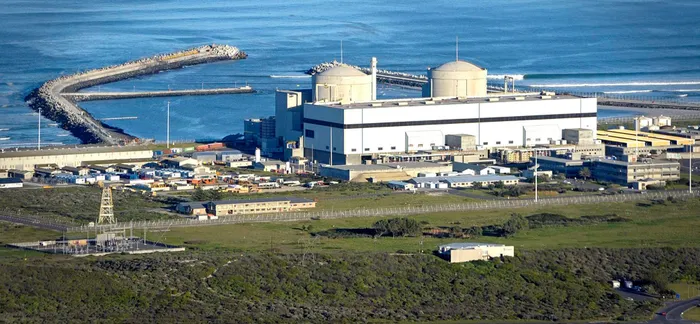
Nuclear power currently contributes roughly 4% of national electricity generation, primarily through the Koeberg Nuclear Power Station, says the author.
Image: Supplied
South Africa cannot industrialise without reliable electricity. Yet for decades the country has struggled with energy shortages that have constrained economic growth and undermined investor confidence. It is time that we face the facts. If we are serious about rebuilding our economy, nuclear energy must form part of the cure.
The government’s Integrated Resource Plan (IRP) already proposes adding 5.2 gigawatts (GW) of nuclear capacity by 2039. I believe this goal is not only achievable but essential if the nation is to secure long-term energy stability and industrial growth.
South Africa stands at an energy crossroads. When we look back one day, we must be able to say we chose the right route. That is why we have a joint responsibility to support the IRP.
Before we continue, I want to put the figure of 5.2 GW in real terms. What does it mean? The country has about 18 million households, and 5.2 GW is enough to power more than four million homes, or a city the size of Johannesburg. This is a critical need. Let us get working on it.
What I propose is a twin-track nuclear development strategy designed not only to stabilise the country’s electricity supply but also to drive industrialisation, skills development and long-term energy sovereignty.
Nuclear power currently contributes roughly 4% of national electricity generation, primarily through the Koeberg Nuclear Power Station.
A twin-track nuclear strategy
The first track focuses on large Generation III+ pressurised water reactors located along the country’s coastline. More than 85% of the proposed capacity would be built at two established nuclear sites: Duynefontein, near Koeberg in the Western Cape, and Thyspunt in the Eastern Cape.
Developing these coastal sites offers several advantages. Duynefontein can leverage existing nuclear infrastructure and regulatory experience, while Thyspunt could stimulate a new industrial corridor in the Eastern Cape, a province that has long sought large-scale economic anchors.
The second track focuses on small modular reactors (SMRs) deployed inland. These reactors would account for roughly 15% of the new capacity and would primarily be located at retiring coal power stations in Mpumalanga.
The concept is known as “coal-to-nuclear” repurposing. Sites such as Camden and Hendrina already have transmission infrastructure and skilled workforces. By installing SMRs at these locations, the country could save up to 30% on grid infrastructure costs while protecting jobs in communities historically dependent on coal.
In a water-scarce country, the technology choice is also strategic. The proposal emphasises non-water-cooled high-temperature gas reactors, similar to the technology previously explored under South Africa’s Pebble Bed Modular Reactor (PBMR) programme. These reactors would require significantly less water than traditional designs.
A five-year launch roadmap
I propose a five-year rollout plan to move the programme from concept to construction.
In the first year, government would launch a request for proposals from international vendors, revive the PBMR programme from its current “care and maintenance” status, and begin rebuilding the national nuclear skills pipeline.
The revival of South Africa’s Pebble Bed Modular Reactor (PBMR) programme should also be understood in the correct context. Lifting the PBMR out of “care and maintenance” and transferring it to the Nuclear Energy Corporation of South Africa (NEXA) would allow local scientists and engineers to resume research and development on this uniquely South African technology. However, the PBMR will not form part of the proposed 5.2 GW nuclear deployment, as the technology would first need to progress through a demonstration phase before it can be commercialised.
For the inland component of the nuclear expansion programme, preference would instead be given to high-temperature gas-cooled reactor designs that are already operating or are close to commercial maturity. Examples include China’s HTR-PM reactor, which is already producing electricity in Shandong Province, and the X-energy design in the United States. The long-term objective of reviving the PBMR programme is to eventually develop a locally owned reactor technology that South Africa could deploy and potentially export, particularly for applications such as desalination, hydrogen production and industrial process heat in Africa and the Middle East. If successfully demonstrated, this technology could position South Africa as a developer and exporter of advanced nuclear solutions tailored to the needs of emerging economies.
Year two would focus on vendor selection, licensing processes and environmental impact assessments, particularly for the Thyspunt site.
By year three, the programme aims to reach contract negotiations and financial close, followed by the first concrete pour at Duynefontein in year four.
The fifth year would see the commissioning of local fuel production at Pelindaba, alongside the start of heavy manufacturing for long-lead nuclear components.
After the first five years, construction would continue at Duynefontein, taking into account a typical 60-month reactor build period. This would allow the first unit to be completed and begin producing electricity around 2036, in line with the Integrated Resource Plan. In parallel, development at Thyspunt in the Eastern Cape would have gathered momentum, with licensing and construction progressing so that both units there could come online by around 2039. By sequencing the programme in this way, electricity generated from the first reactors at Duynefontein could begin generating revenue 18 to 24 months before the Thyspunt units are completed, helping to support financing for the later stages of the programme.
Strategic global partnerships
Another cornerstone of the plan is a multi-vendor international partnership model.
Large coastal reactors could involve collaboration with global nuclear suppliers such as France’s EDF, Russia’s Rosatom, South Korea’s KEPCO or Chinese nuclear firms, each offering different strengths in financing, speed of construction and technological maturity.
SMR development could involve partnerships with the United States or China, particularly for advanced gas-cooled reactor technologies suitable for inland coal sites.
The strategy positions the nation as a “middle power” capable of cooperating with both BRICS and G7 partners, avoiding geopolitical alignment with any single bloc while securing the best technology and financing options.
Financing the programme
Given the scale of nuclear infrastructure investment, the proposal emphasises hybrid financing models rather than relying solely on government borrowing. Potential mechanisms include export credit agency loans from vendor nations, financing through the BRICS New Development Bank, and the use of green taxonomy frameworks to attract private institutional investors seeking low-carbon infrastructure projects.
Building a domestic nuclear industry
Beyond electricity generation, we must aim to rebuild a complete nuclear industrial ecosystem.
This includes restoring elements of the nuclear fuel cycle, expanding domestic manufacturing capacity for reactor components, and developing a long-term human capital pipeline for engineers, welders and specialised technicians.
I propose an 85% localisation target for civil works, maintenance and related supply chain activities, ensuring that nuclear investment drives significant domestic economic activity and builds a strong local industrial base.
It is also essential that we position nuclear technology as a catalyst for broader industrial applications. These include the continued production of medical radioisotopes, the use of high-temperature reactors for industrial heat in sectors such as steel and cement, and the generation of clean hydrogen for the emerging hydrogen economy.
A nuclear programme rooted in peaceful development
The country’s nuclear ambitions are framed within its longstanding commitment to peaceful nuclear use. It remains the only state to have voluntarily dismantled its nuclear weapons programme and is a key signatory to the Pelindaba Treaty, which establishes Africa as a nuclear-weapon-free zone. My proposed expansion, therefore, is positioned as a model of civilian nuclear development aimed at economic growth, energy security and technological advancement.
We can win the war against poverty, and we can win it using the peaceful atom.

Professor Bismark Tyobeka is the principal and vice-chancellor of the North-West University.
Image: Supplied
Professor Bismark Tyobeka is the principal and vice-chancellor of the North-West University (NWU), former CEO of the National Nuclear Regulator, and has recently been appointed both a member and chairperson of the Ministerial Expert Panel on Nuclear.
*** The views expressed here do not necessarily represent those of Independent Media or IOL
BUSINESS REPORT