

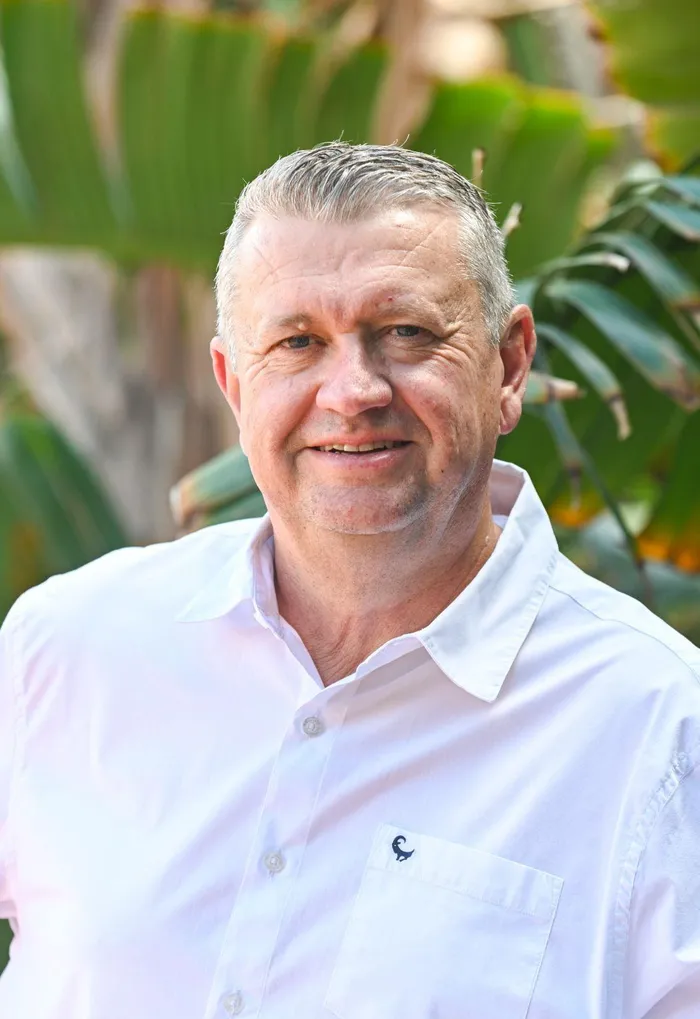
Thomas Garner holds a Mechanical Engineering degree from the University of Pretoria and an MBA from the University of Stellenbosch Business School.
Image: Supplied
South Africa’s economic debate often treats structural reform and energy transition as separate policy tracks. One sits within discussions about the business environment and growth policy, the other within electricity reform and climate commitments.
In practice the two are closely linked. A modern energy system requires sustained investment, and investment depends on a business environment where companies can operate, expand and compete.
Two recent reports illustrate this connection. The International Monetary Fund’s report “Structural Reforms to Bolster South Africa’s Business Environment” examines regulatory barriers constraining growth. The Barclays paper “Transition Realism: Financing Energy Systems That Work” examines the economic realities shaping global energy transitions. Read together, they suggest that economic reform and energy reform depend on the same institutional foundations.
South Africa’s growth slowdown over the past decade is well documented. Economic growth has averaged below 1 percent since the global financial crisis. Real income per person has fallen back to levels seen nearly two decades ago, while unemployment remains among the highest globally. The IMF study focuses on the regulatory environment facing businesses. South Africa’s product- market regulations rank among the most restrictive across comparable emerging economies and OECD countries. Administrative complexity, licensing procedures and fragmented authority create barriers to investment and expansion.
Company level data illustrates the effect. The World Bank Enterprise Survey shows that South African businesses spend a large share of senior management time dealing with permits and licences. This administrative burden has increased significantly since the late 2000s and now ranks among the highest in the global data set. Companies whose management teams devote more time to regulatory compliance tend to grow more slowly, create fewer jobs and exhibit lower productivity. Smaller businesses carry the heaviest cost.
In companies with fewer than twenty employees the productivity penalty associated with regulatory complexity is roughly double that observed in larger companies. South Africa’s licensing framework explains part of this burden. Authority is divided across national, provincial and municipal spheres of government, each with its own capability challenges, separate procedures and approval systems.
Entrepreneurs often require multiple approvals from different institutions before they can begin operating.The result is a fragmented regulatory landscape. Licensing rules differ between municipalities, administrative capacity varies and businesses frequently submit the same information to different authorities because no unified system exists for permit tracking. These conditions discourage formal business creation and limit expansion.
Competition barriers reinforce the problem. Several sectors remain highly concentrated, allowing established companies to maintain strong positions while entry for new competitors remains difficult. Network industries such as electricity and logistics illustrate this pattern clearly. The IMF estimates that reducing half of South Africa’s regulatory gap relative to emerging-market peers could increase real output by around 2 percent over the medium term.
Measures such as a national licensing framework, digital permitting systems and clearer regulatory coordination would reduce duplication and improve investment conditions. These institutional reforms matter directly for energy policy because the energy transition depends on the same conditions.
The Barclays Transition Realism report examines the practical realities shaping global energy systems. Much of the international debate has focused on climate targets and timelines. The operational challenge lies in financing and building energy systems capable of delivering reliable and affordable power during the transition. Historical evidence shows that energy transitions occur through accumulation rather than replacement. New energy sources enter the system while existing ones continue operating for decades.
Renewable energy is expanding rapidly, yet it is largely being added to the global energy mix rather than replacing fossil fuels in the short to medium term. Infrastructure now plays a decisive role. Renewable generation costs have fallen sharply, yet transmission networks, grid integration and system balancing increasingly determine how quickly new capacity can be deployed. Investment is shifting toward enabling infrastructure such as transmission networks and storage systems.
Energy transitions also differ across regions. Countries follow distinct pathways shaped by resources, industrial structures and geopolitical priorities. Renewable energy will expand further, yet fossil fuels, nuclear energy and existing molecule based fuels remain part of the global energy system.
For South Africa the link between structural reform and transition realism is clear. Expanding electricity infrastructure, attracting private capital and developing new supply chains require institutions capable of supporting large-scale investment. Structural reform and energy transition therefore converge around a practical question: whether SouthAfrica can create a business environment where companies invest, infrastructure expands and energy systems evolve with the scale and speed the economy requires.
The structural obstructions that make it difficult to do business in South Africa combined with competition barriers, allow established companies to maintain strong positions while entry for new competitors remains challenging. South Africa needs to combine structural reforms and transition realism to enable a pragmatic energy future. Combining these two would also go a long way to close the trust deficit between government and business by assisting with institutional behaviour that holds steady under pressure.
Thomas Garner holds a Mechanical Engineering degree from the University of Pretoria and an MBA from the University of Stellenbosch Business School. Thomas is self-employed focusing on energy, energy related critical minerals, water and communities. He is a Fellow of the South African Academy of Engineering and a Management Committee member of the South African Independent Power Producers Association.
*** The views expressed here do not necessarily represent those of Independent Media or IOL.
BUSINESS REPORT