
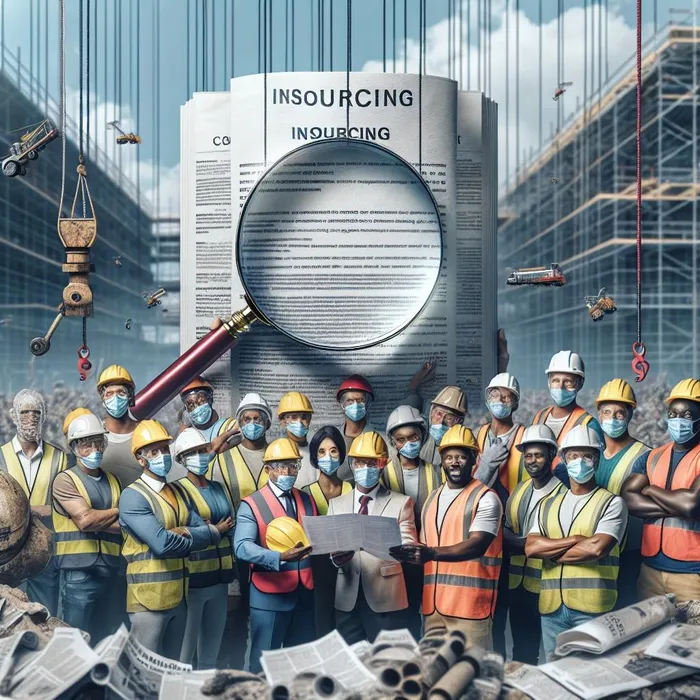
Parliament held an important hearing on the Insourcing Bill this past week.
Image: AI Lab
Parliament held an important hearing on the Insourcing Bill this past week. This Bill provides the nation with the unique opportunity to address a key ingredient that has fueled state capture and corruption, the hollowing out of the state and the suppression of vulnerable workers’ rights since the advent of democracy in 1994.
The Bill has been tabled against a background of a nation grappling with the dire challenges of a 41.1% unemployment rate, entrenched levels of poverty and inequality, endemic crime and corruption. It is being considered whilst the state experiences severe financial constraints.
The costs and damage of the decade of state capture and corruption are well known. What is not appreciated by many is the role of public procurement in fueling it. The state with an annual public procurement budget of R1 trillion is tempting, low hanging fruit to be feasted upon by a growing class of tenderpreneurs built solely to profit at the public’s expense.
Lax public procurement practices, particularly in local government and state-owned enterprises (SOEs), have seen the development of an incestuous relationship between corrupt and criminal elements in the public and private sectors. At times individuals within supply chain management in the state create companies in their relatives’ names and ensure that they receive lucrative state tenders.
These tenders all too often are rigged at prices far above their market value. Media headlines are rife with tenderpreneurs failing to provide the goods they were paid for, often requiring the state to pay twice.
The victims of this bonanza of state capture and corruption are the nurses and patients when the state does not have enough money to fund quality public healthcare. The victims are women and children in a society where criminals believe there are few consequences for breaking the law. The victims are the 41.1% of South Africans who cannot find work when investors are reluctant to put their money in a society seen to be riddled with crime and corruption. The victims are workers whose meagre wages cannot last till the next paycheck as they battle to take care of unemployed relatives.
Cosatu unashamedly champions the Insourcing Bill as a critical intervention that seeks to rebuild the capacity of the state to provide routine services, to save an overstretched fiscus of scarce resources, to defend and uphold the rights of vulnerable workers, to remove the cancer of corruption from the state.
The Bill speaks to insourcing routine functions that any organ of the state has to provide on a daily basis, in particular: security, cleaning, gardening, catering, transport, administrative, healthcare, maintenance, information technology, auditing, amongst others. These are duties that government must provide.
The Bill provides an important opening step towards to rebuilding state capacity by focusing upon public service departments and requiring government to develop an insourcing plan and to regularly report back to Parliament on its implementation. This needs to be accompanied by the necessary training of public sector staff to perform these functions.
It will be important that this then be expanded to other organs of the state where outsourcing is rampant, e.g. universities, local government and SOEs.
As with most legislation, the Bill seeks to strike a fair and pragmatic balance by acknowledging that in certain instances, insourcing may not be practical or possible. It provides reasonable exemptions within clear criteria and reporting requirements. This is fair and a welcome shift away from the current wild west of public procurement where anything goes.
One of the greatest tragedies and affronts of the outsourcing addiction has been the motivation to undermine workers’ hard-won constitutional and labour rights. Labour brokers and tenderpreneurs are notorious for violating labour laws and undermining workers’ rights. Whilst we have many progressive rights enshrined in our labour laws, for all too many of the workers employed by tenderpreneurs these are as remote as a holiday to Sun City.
Outsourcing workers fragments their ability to unionise and mobilise the strength of numbers in collective bargaining to support workers’ struggles to improve their working conditions.
The champions of outsourcing falsely claim that it saves the fiscus badly needed funds. It doesn’t. It introduces profiteering into the state budget at the expense of workers’ legitimate expectations for their wages to be protected from inflation and to a living wage. Inevitably, these are the most vulnerable and poorly paid workers, the cleaners, security guards and maintenance workers. Monies that could have been better utilised to boost their wages now go to satisfying the extravagant lifestyle of a tenderpreneur and the kickback of a supply chain manager in the state.
Linked to the progressive objectives of the Insourcing Bill, is the equally progressive Public Procurement Act passed by Parliament in 2024 and one of the most important legislative reforms by the African National Congress led government. It provides a powerful boost to tackling the cancers of state capture and corruption and local procurement. Together, they would help spur the cleansing and rebuilding of the state.
The Insourcing Bill has been tabled by the Honourable Omphile Maotwe, a Member of Parliament from an opposition party, the Economic Freedom Fighters. This is testament to the maturing of our democracy. Cosatu is unashamedly a member of the Tripartite Alliance with the ANC and the South African Communist Party. We welcome and will support any MP who tables progressive legislation which seeks to fix the state, grow the economy and improve the lives of the working class. This Bill does exactly that.
The task now for Parliament is to consider, process and adopt this long overdue, timely and progressive Bill. The task for the ANC led government is to support this Bill and once Parliament passes it, to ensure its speedy and effective implementation across the state.
Cosatu will continue to provide its full support to ensure that this Bill becomes a reality and that the pains of thousands of outsourced workers are relieved.

Solly Phetoe is the general secretary of Cosatu.
Image: Doctor Ngcobo / Independent Newspapers.
Cosatu General Secretary Solly Phetoe
*** The views expressed here do not necessarily represent those of Independent Media or IOL.
BUSINESS REPORT