

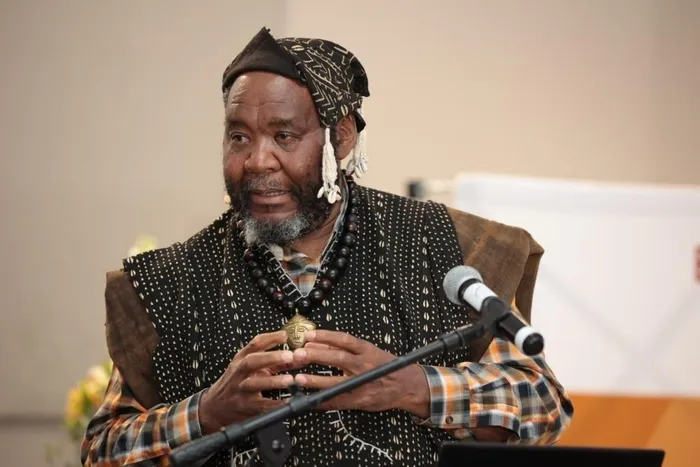
Dr Pali Lehohla is a Professor of Practice at the University of Johannesburg, among other hats.
Image: Supplied
StatsSA, the factfinder of the nation, continues to give. But it seems like a dog full of fur, its sweat is consumed by it and it is not visible to the dumb, blind and deaf. The Lehohla Ledger is a cataract scraper, that makes the blind to see. It is a wax cleaner that opens the ears of the deaf and it is indeed a medicine that works on speech. Through the 3,000 columns that I wrote, two at a time each week since 2002, I have generated 2,752 forensic instruments that shape the integration. And thus deliver the much needed instruments of the district development model.
These instruments anchored in the Mohlomi Code of ultimately guaranteeing intergenerational value creation focus on four core drivers, (i) a responsible leader who knows itself, and knows those he/she presides over, (ii) mobilises stakeholders towards productive ends (iii) uses new instruments of power (iv) through design thinking and system design builds system that deliver integrated reporting. What the Lehohla Ledger is constitutes a design that captures farsighted thought of Mohlomi as implemented by Morena Moshoeshoe, the founder of the Basotho nation. Based on my 3,200 columns which soon will be eight volumes of 450 pages each, the Lehohla Ledger with its 2,752 instruments is the key system integrator of the District Development Model.
I have deployed the Lehohla Ledger on the 4th quarter results of the Quarterly Labour Force (QLFS) for 2025. In this report Statistician-General Maluleke elaborated on new measures in the publication. Many a politician saw green shoots but the Lehohla Ledger saw dry shrubs and a long coming build up of devastating problems. The core message on the unemployment remained stubborn at 31,4% albeit down by half a percentage point form the previous quarter. But the clouds had long been building up and a twister is on the way.
There were critical elaborations by Maluleke on this measure. They provided the number of the working age population and its composition. This number in the South African population is 42.1 million people. It consists of the population that is 15-64 years of age. explained the working age. The number is further split into the labour force which is 24.9 million people split into 17.1 million people employed and 7.8 million unemployed. The remainder of the 17.1 which is strikingly equal to the employed population (an essential thrust of this analysis) splits into 4.6 million potential labour force and 12.5 who are outside the labour force. And the magic of numerology starts as though the Chinese FAFI was at play. The two numbers are exactly the same. This is where the Lehohla Ledger delivers astounding insights of the 1:1 ratio and the implications of this ratio for the survival of democracy as revealed in the 2024 General Elections and the around the corner Local Government Elections.
The Q4 2025 Quarterly Labour Force Survey (QLFS) results confirm a deepening structural divergence in South Africa’s labor market. When I apply Lehohla Ledger, we move from mere observation to a forensic cost-modeling of the "Economic Disappearance" occurring in the informal sector. The Lehohla Ledger forces Maluleke’s QLFS phosphorus out of the water, so that no politician can claim a half a percentage point as a gain. In fact the Lehohla Ledger mops all the water from the phosphorous and Maluleke’s numbers show their true colours. They are an inferno. Matatiele and Msinga now can be interpreted through a mesh of 1996 to 2022.
The Successor Ledger: Informal Sector Modeling (Q4 2025)
The latest data shows a gain of 320,000 jobs in the formal sector, but this was almost entirely offset by a devastating loss of 293,000 in the informal sector. In the mesh of outliers like Matatiele and Msinga, this is not a seasonal blip; it is a fundamental breakdown of the localized economy.
Sovereign Risk
The 1:1 ratio is absolute here. The "Others Outside Labour Force" (12.5m nationally) are the majority in these wards.
Valid metadata shows that the youth (15-24) facing 57.0% unemployment are increasingly part of the informal-to-outside migration.
Cost-Modeling Revitalization: A Successor Ledger Approach
To revitalize the informal sector in these meshes, the 2752 instruments suggest a shift from "handouts" to "infrastructure as a multiplier." Based on the Matatiele LED Policy and the Msinga IDP 2025/26, the Ledger proposes the following cost-modeling:
The "Magic of Numerology" Re-evaluated
The Q4 2025 results prove that the formal sector cannot carry the Republic alone. The 293,000 jobs lost in the informal sector are 293,000 people who have likely crossed the 1:1 threshold into the "invisible" half of the population. Without a forensic intervention at the ward-level mesh, the "stubborn" 31.4% unemployment rate will remain a permanent feature of the South African landscape.
Dr Pali Lehohla is a Professor of Practice at the University of Johannesburg, a Research Associate at Oxford University and a distinguished Alumni of the University of Ghana. He is the former Statistician-General of South Africa
*** The views expressed here do not necessarily represent those of Independent Media or IOL.
BUSINESSS REPORT