

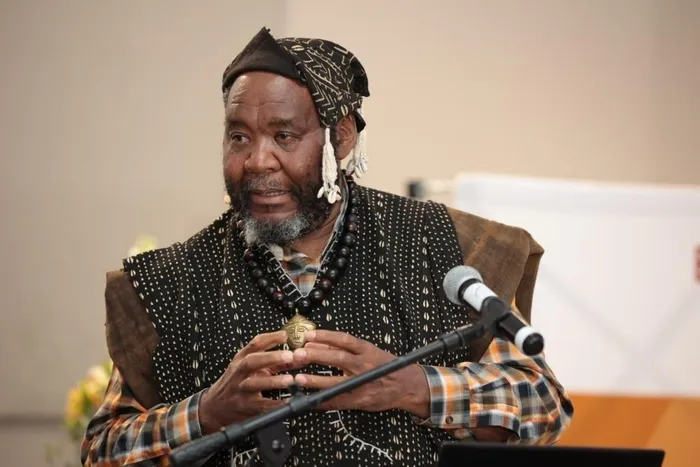
Dr Pali Lehohla is a Professor of Practice at the University of Johannesburg, among other hats.
Image: Supplied
Soccer and former soccer stars have a great deal to offer in a country marked by extreme social disenfranchisement. Drawing from a conversation with Malombo Leshaba — in which Johnny Masegela and Vuma Mfeka also featured — revealed just how powerful that contribution can be.
Last week, my session with Malombo Leshaba, the erstwhile soccer star and former Kaizer Chiefs player, was an engaging encounter focused on the current challenges facing South Africa and the question of how we solve them. We covered a wide range of subjects, with soccer at the centre of the discussion.
Little did I know that among the people I greeted at the Southern Sun Hotel was someone I would meet again a week later. He reminded me of that earlier encounter, when I took a metered taxi home after attending an Ethics Seminar hosted by the Companies and Intellectual Property Commission (CIPC) at the Southern Sun Hotel in Pretoria at the beginning of February. When he mentioned it, I replayed the moment in my mind and realised that the maestro I would later have a late-afternoon lunch with had been among the three people I had casually greeted that day. At the time, it was simply an innocent greeting.
Our discussion turned to the evolution of soccer in South Africa, particularly the establishment and rise of Kaizer Chiefs as a living illustration of leadership. In my reading of South African history, few ventures match the conception of Kaizer Chiefs as a social, business and economic idea. While the club has struggled recently — including a heavy defeat to Stellenbosch and a 3–0 loss in the Soweto derby over the weekend — one cannot diminish the legacy built by the octogenarian Kaizer Motaung.
From his days as a player at Orlando Pirates to becoming the founder of a brand admired not only in South Africa but globally, Motaung’s achievement is extraordinary. Awed by this unparalleled accomplishment and struggling to fully comprehend it, I listened as Malombo unlocked what may be the most potent explanation behind Motaung’s success.
As a social scientist and researcher, I have come to appreciate the concept of a self-liquidating catalytic role — a force that enables generational value creation long after its initial spark. This, to me, is what Malombo revealed about Motaung: a clear path toward creating lasting value for generations to come. What is fascinating is that such leadership costs nothing but the courage to ask the right questions.
Malombo recounted how Kaizer Motaung and the late Chippa Moloi once visited his school in Mamelodi. The presence of these soccer maestros filled the school with excitement; learners beamed at the mere sight of them, let alone the opportunity to hear them speak. For Malombo, the visit was life-changing.
After brief greetings, Motaung invited questions. When Malombo raised his hand, a classmate pulled it down and asked skeptically, “What are you going to ask?” The class watched the minor scuffle with curiosity and disbelief. Then came the defining moment.
Malombo asked: “Ntate Kaizer, what makes you play soccer so well?” The class erupted in laughter. Motaung calmed them, but he did not make things easier for Malombo — he responded with a question: “Why do you ask me that?”
Malombo replied, “Because I want to be like you.”
The laughter intensified. “You, Malombo, be like Kaizer? You must be out of your mind,” came the teasing remarks. Again, Motaung restored order and offered his answer.
“There are three Ds that I practise,” he said: “Dedication, Determination and Discipline. These have worked for me. But there is an ultimate letter you must pursue — the letter R, which stands for Respect. Nothing works without respect.”
For many in the room, the verdict on Malombo was already sealed. They could not see in him the makings of another Kaizer Motaung. The three Ds and the R did not seem to align with their perception of him. Even at home, his mother echoed the scepticism of his classmates. But his father, after listening carefully, concluded that perhaps — just perhaps — his son could indeed follow in Motaung’s footsteps.
Three years later, Malombo did not merely dream of becoming like Motaung — he donned the gold and black of Kaizer Chiefs and mesmerised audiences.
As I listened to Malombo, I shared our “Soccer for Stats” initiative at Statistics South Africa, led by Johnny “Black Sunday” Masegela, the former Orlando Pirates player. I also recounted a story about Vuma Mfeka, former goalkeeper of Zulu Royals.
Mfeka was once a borrowed goalkeeper from Ngoye who played for Rovers, a National University of Lesotho league club. As treasurer of both the SRC and Rovers, I would arrange flights for him to Bloemfontein on Fridays and fetch him for the journey to Roma, only for him to fly back on Sundays — all for the love of soccer.
Today, Vuma Mfeka is a life coach to boys growing up without fathers. Malombo has embraced a similar mission. I shared their contact details, and Malombo reached out to both of them.
These soccer players understand, in practical terms, what it takes to help fix South Africa. Motaung’s words continue to loom large in the mission Malombo has carved out for himself.
Dr Pali Lehohla is a Professor of Practice at the University of Johannesburg, a Research Associate at Oxford University, and a distinguished alumnus of the University of Ghana. He is the former Statistician-General of South Africa.
*** The views expressed here do not necessarily represent those of Independent Media or IOL.
BUSINESS REPORT