

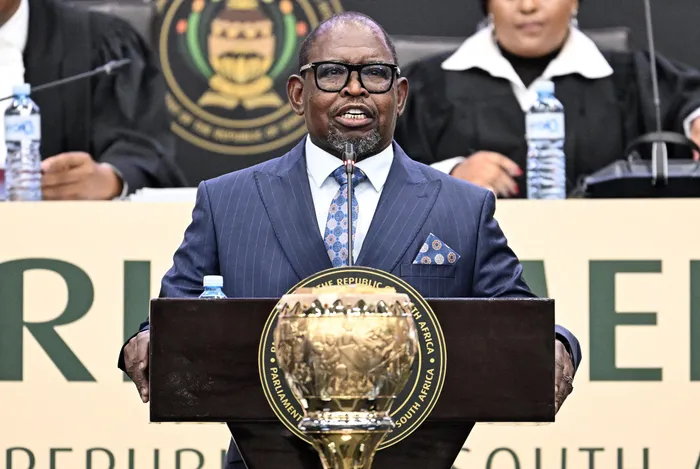
Finance Minister Enoch Godongwana's delivers the Budget Speech.
Image: GCIS
The 2026/27 Budget has now been tabled for Parliament’s consideration and adoption.
The Congress of South African Trade Unions (Cosatu) like millions of workers had been keenly awaiting it, more so given the many dire challenges facing the working class and the economy.
Workers had been hopeful given the many progressive commitments made by President Cyril Ramaphosa during the State of the Nation Address (SONA) two weeks earlier.
To say workers are disappointed with a Budget that walks back many of SONA’s progressive commitments would be an understatement.
Cosatu had hoped to see a Budget anchored upon society’s deep seated socio-economic challenges, in particular a 41.1% unemployment rate and an economy languishing at 1% over the past decade. Instead, the Budget forecasts 1.8% growth over the next three years, nowhere near the 3% plus needed to see unemployment substantially fall.
The fundamental flaw with Treasury’s approach is that it assumes the economy will somehow recover from its decade-long slump and grow on its own. This is a dangerous path to take when four out of ten South Africans cannot find work. One need look no further than the July 2021 violence in Gauteng and KwaZulu-Natal for the dangers and much larger costs for ignoring our deep underlying socioeconomic faultlines.
The second flaw is that Treasury continues to believe that cutting budgets will enable frontline public and municipal services to deliver the quality services that the working class and the economy depend upon.
Both of these approaches have been pursued dogmatically by Treasury with little to show for it, unless one thinks a 41.1% unemployment rate is something to celebrate.
Politically it is extremely concerning that government does not speak with one voice. SONA gives a raft of important commitments only to see them watered down or abandoned in the Budget weeks later.
To be fair there are important aspects of the Budget that Cosatu fought for, these include rolling out Grade R to 300 000 learners, the building of 7 provincial hospitals and R1.07 trillion allocated to investments in electricity, rail, ports, roads, water and airports’ infrastructure over the next three years. The latter will create thousands of jobs in the construction phase, and more in the economy. However given the many challenges facing society and the economy, these are not enough.
The government has previously stated to Parliament that the days of austerity and budget cuts are over, and investments will be made to rebuild frontline public and municipal services. Yet no Department sees above inflation real boosts in allocation. With the exception of the Border Management Authority, Home Affairs as well as doctors for Health, no allocations have been provided to hire additional staff and help ease the pressures on frontline services overwhelmed by high vacancy rates.
The Budget correctly highlighted the dire state of more than 60% of our municipalities. It provides important interventions to stablise and rebuild local government, including R57 billion to improve the ability of metros to deliver basic services and collect payments due, amending the Municipal Finance Management Act to enable timely interventions when municipalities struggle, and the enlisting of Eskom and Sanral to help capacitate municipalities to provide electricity and maintain roads. Whilst these are badly needed, they will take time. Something that many municipalities no longer have.
The recovery of Eskom, Transnet, Metro Rail and the South African Airways have provided invaluable relief to workers and the economy. Over R577 billion has been allocated to investments in state-owned enterprises’ infrastructure over the next three years.
Yet two important interventions are missing. First is support for Eskom to plug its still massive financial losses with R20 billion lost annually to municipal debt (soon to pass R100 billion), and wasteful expenditure, corruption, cable theft and vandalism. These are urgently needed to end Eskom’s dependence upon above inflation tariff hikes suffocating industrial sectors and costing thousands of jobs.
Turnaround plans are needed for Denel, the SABC, Post Office and Postbank. The Budget offered nothing new for them.
One of the most disappointing aspects of the Budget is the absence of any new allocations to boost the fight against the cancer of crime and corruption, despite SONA’s commitments. Without additional police in communities, detectives pursuing dockets, prosecutors securing convictions and judges presiding over trials; then what exactly will government do differently to produce different results? Speeches will not win this war.
The need to stimulate growth, in particular making capital available for SMMEs, industrial and export sectors are accepted by everyone, yet the Budget provides for a 10% cut in funding for the Department of Trade, Industry and Competition and a meagre R3 billion for small business development as compared to R4 billion for politicians’ bodyguards!
The SRD Grant has provided a lifeline for 8 million destitute recipients. Yet once again Treasury refused to provide an increase to protect their R370 from being eroded by inflation. In fact, Treasury has refused to provide it any inflationary adjustment for five out of the six years it’s been in existence. But the very same Members of Parliament were militant in demanding that their R1 million and in the case of Ministers, R2.5 million plus salaries receive an inflationary increase over December! Hypocrisy?
To add salt to the wound, the 10,000 permanent labour inspectors highlighted in SONA and further confirmed by the Department of Employment and Labour are not provided for in the Budget! These would provide a massive boost to protecting workers from some of the most abusive labour practices.
The government needs to speak with one voice and to honour the commitments it makes to society.
It needs to grasp that the economy requires the state to provide certain services if it is to grow at the pace needed to tackle unemployment, poverty and inequality. Similarly, society should no longer be expected to tolerate high levels of crime.
It is time politicians appreciate that society expects and deserves better and that its patience is not limitless.
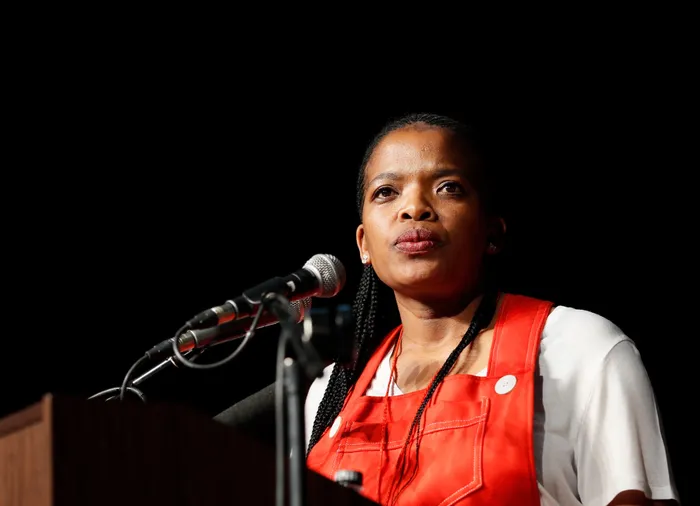
Zingiswa Losi is the president of Cosatu.
Image: Independent Newspapers
Cosatu President Zingiswa Losi
*** The views expressed here do not necessarily represent those of Independent Media or IOL.
BUSINESS REPORT