

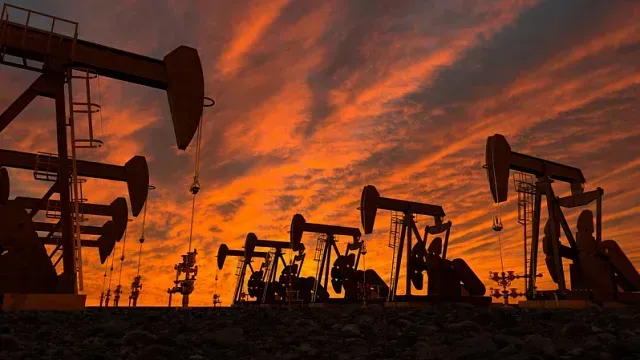
Offshore oil and gas development could materially strengthen South Africa’s economy and energy security, says the author.
Image: TV BRICS
Debate has been ongoing for years on South Africa’s offshore oil and gas potential. And during this time, South Africa has missed out on billions of rand per year in potential Gross Domestic Product (GDP) from offshore oil and gas projects. This is not for a lack of opportunity. Complex regulatory processes extending decision-making timelines and misconceptions amongst civil society come at an immense opportunity cost. Exploration capital is highly mobile and countries’ competitivity will impact companies’ decisions and direct where global investment will flow. Effective and timely coordination is in the national interest and 2026 is a make-or-break year.
The opportunity cost of uncertainty
An economic analysis performed in 2025 by FTI Consulting and commissioned by the EnerGeo Alliance shows that offshore oil and gas development could materially strengthen South Africa’s economy and energy security.
The Orange Basin is a perfect example of the significance of the opportunity because it straddles the maritime border between Namibia and South Africa. Namibia’s approach illustrates how regulatory certainty and clear timelines can accelerate investment decisions. Around 25 exploration and appraisal wells were drilled since 2022. Namibia’s successful exploration operations resulting into commercial discoveries validate the potential for South Africa.
Drilling operations require engineering, fabrication, maintenance and repair services. With Saldanha Bay strategically located, South Africa stands to benefit immensely from providing these support services to operations in both countries. But to do so requires policy certainty, permitting ensured within reasonable timelines and coordinated execution. South Africa has yet to fully realise the scale of this opportunity.
The offshore petroleum industry is ready to invest in both the Orange and Outeniqua Basins. So far, the potential reward has outweighed the opportunity cost of uninvested capital. But as new exploration opportunities are found in other parts of the world, the window to participate meaningfully in this opportunity is narrowing.
Government faces the important task of balancing economic development, environmental protection and social cohesion. With collaboration and clarity, these objectives can be achieved.
Energy uncertainty remains a national concern
Economic growth isn’t the only factor at play: energy security is another consideration. According to FTI Consulting analysis of Department of Mineral and Petroleum Resources and SA Revenue Service import data, more than 80% of South Africa’s oil and gas is imported. Due to domestic refinery closures, South Africa’s refined fuel imports more than doubled since 2019.
Governments prioritise their domestic fuel supply during times of political uncertainty, leading to export restrictions. Refinery-to-market shipping routes like the Suez Canal and Red Sea are also prone to disruption by geopolitical shocks. Domestic offshore oil and gas production could reduce import dependence and this risk significantly.
The solution requires coordinated policy execution.
The 2025 Energeo Alliance commissioned report states the Luiperd and Brulpadda operations in the Outeniqua Basin could improve South Africa’s energy security and contribute up to R25 billion per year to the balance of payments by replacing imported oil and refined products. This is a balanced and pragmatic energy transition that maintains reliability today while building toward lower-carbon solutions tomorrow.
FTI Consulting estimates that Luiperd alone could contribute R8.6bn annually in direct and indirect taxes and royalties. Based on employment modelling, these projects will create up to 20,000 direct, indirect and induced job opportunities, acting as a critical enabler to the South African economy.
Offshore oil and gas projects typically trigger long-life infrastructure developments. These stand to benefit a host of other industries, partly because they require permanent logistics bases. South Africa will benefit from investments in port and marine infrastructure, gas and oil pipelines, gas processing and treatment facilities, power generation and grid integration, refining, fuels and petrochemical infrastructure and industrial manufacturing facilities. These are just the investments that will directly support operations.
Successful development of these assets depends on clear, predictable and well-coordinated regulatory processes. Oil and gas exploration is a project of national interest that requires coordinated decision-making and greater certainty around timelines.
2026 is the moment of truth
Job creation, infrastructure development, energy security, renewables and the resulting GDP growth is within our grasp. With political government coordination, these projects can become a source of growth, hope and dignity for countless South Africans.

Niall Kramer, spokesperson for the Offshore Petroleum Association of South Africa.
Image: Supplied
Niall Kramer, spokesperson for the Offshore Petroleum Association of South Africa (OPASA.)
*** The views expressed here do not necessarily represent those of Independent Media or IOL.
BUSINESS REPORT