
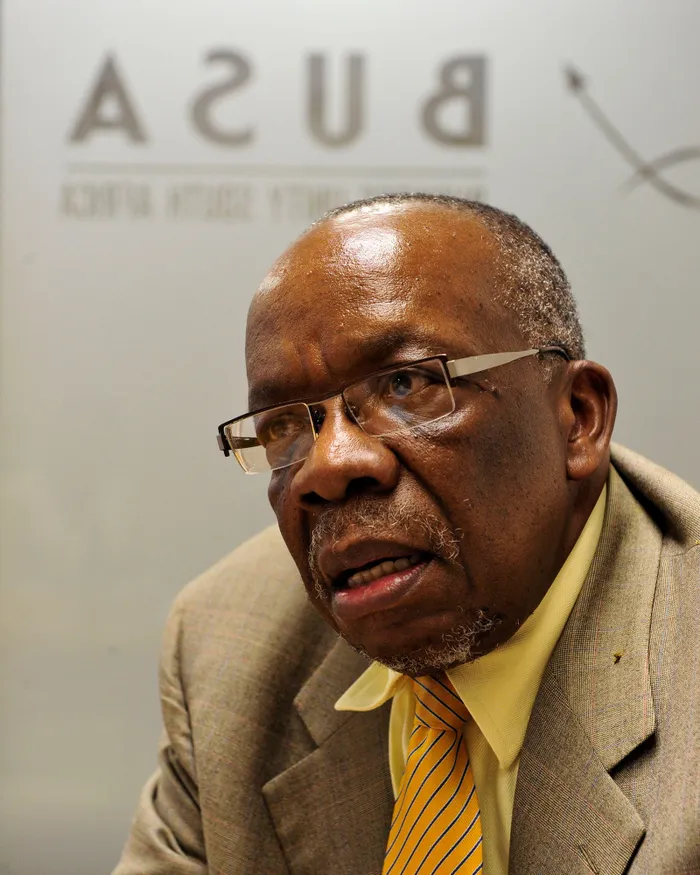
Dr Thami Mazwai.
Image: File Image
One shudders in disbelief at efforts to scrap black economic empowerment (BEE). If truth be told, BEE never started the full journey but they now say it must be scrapped. This begs the question: Are blacks the children of a lesser God”.
In May 1998 the Black Business Council (BBC) urgently appointed then former ANC secretary general and now president, Cyril Ramaphosa, to chair a BEE Commission as acceptance and implementation of BEE were erratic. From this BBC intervention, and further toing and froing, the Department of Trade and Industry, now Department of Trade, Industry and Competition (dtic) ultimately came with Broad-Based Black Economic Empowerment legislation in 2003.
There is no doubt that there has been some action and major achievements but the ultimate barometer is poverty, unemployment and inequality (PUI). To add to this is the sustainability of black firms, more so small one. Here are the facts.
According to Stats SA 23.2 million live below R1,415 per person per month. Talk in the townships, villages and informal settlements is that in some families adults take turns eating so that the children have something. Ai, and to add to this, in some instances take their school feeding packs home so the family eats.
Inequality continues to be a huge problem and ours is the highest in the world with the gini-coefficient at .63 to .67 and with 10% of population owning 80% of total wealth. Worse still, inequality within the black community, estimated at close to .6, is on the gallop. The latest unemployment figures, released last Monday, show that unemployment is at a staggering 31.4%. Over 12 million South Africans are jobless.
Finally, in terms of black small business survival; more than 80% collapse in their first five years. To add to this 1,3 million of black small businesses have turnovers, not profits, of R18000 per annum. The Black Industrialists Programme, ostensibly the BEE flagship, is running aground as officials in government and the development finance institutions have difficulty funding businesses with no track record. This results in companies owned by the non-indigenous, virtual fronts, getting support. Fancy, this from people who themselves had no profiles when appointed to these positions.
The PUI miseries and small business unsustainability above show that not only is economic growth urgent, but it must be mainly driven by the enterprise and supplier development (ESD) leg of BEE. Integrity also has to be a crucial and compulsory element. It is hoped an expected announcement by Trade, Industry and Competition (dtic) Minister Parks Tau on BEE will address the above.
For the record, the reconstruction of the economy and its activities to serve the common good is not new. Hence, a study by academics Guerrero, Liñán and Cáceres-Carrasco in developed and developing economies and released in 2021 gives examples of how countries have come with specific interventions to stimulate economic activity in specific localities or population groups. Thus, BEE is not something unusual and in our case it deals with a specific problem that must be corrected for the benefit and betterment of the whole country, not blacks only.
What is also problematic is focus on two issues; corruption and so-called “enrichment of the few”. Let us first deal with one, corruption. The focus on corruption is justifiable and it must thus be outrightly condemned. It has reached preposterous levels and the perpetrators simply close their eyes to the suffering and, instead, revel in their latest vehicles, big houses and whiskies. What happened to Ubuntu?
But, let us not restrict it to blacks only as it is a cancer involving black and white and is eating the soul of our country. Unfortunately, the government is not dealing with it with the warranted determination, ruthlessness and urgency.
On the broader scene and also to bring in the aspect of enrichment; with the wisdom of hindsight it is clear that our approach to BEE was not premised on long term economic growth with the betterment of the black community and society in general at the centre. It was a quick fix approach and did not factor in realities such as the embeddedness of capital and human frailties and desires. Ours was a university student mass meeting attitude, which unfortunately still persists.
On the “enrichment of the few” narrative, companies are going to empower in way that will further their interests and those of shareholders. It is natural; the Catholic Church does not appoint a protestant to edit its newspaper. For effective implementation of BEE the ball is in government’s court, that is Tau and his colleagues.
Numerous reports on BEE show that implementation is, at best, a by the way and at times apologetic. Since 1995 the development of implementation of BEE was a small section in the then dti and not the foundational pillar of the department as the driver of South Africa’s economy. After all, it was the black majority that was elbowed out of the economy. The Land Acts (1913 and 1936) and Apartheid legislation elbowing blacks out of economic participation are not a figment of the imagination.
As an example of lacklustre implementation, nobody can justify why the departments of agriculture nationally and provincially rightly create the emerging farmers programme but do not link it to the school feeding scheme in which the providers of food to schools must source from these emerging farmers, and it is a condition of the contract.
Furthermore, the ESD leg which should be compulsory across the economy is the least or worst implemented. Yet, as the Sanlam Gauge reports, it is the most important. China wiped out 95% of its poverty through mass entrepreneurship as a World Bank report shows. The report lauds the Chinese Government’s singleness of purpose to wipe out poverty.
Our country’s future hinges on the aggressive implementation of BEE with the sole purposes of wiping out poverty and unemployment and integrating blacks into the economy. Greater focus must be at the lower levels but without abandoning the commanding heights. It is painful to see thousands of our youth clean cars at parking lots for a livelihood. Are these black youths indeed children of a lesser God.
Dr Thami Mazwai is chairman of Mtiya Dynamics, an ESD company.
*** The views expressed here do not necessarily represent those of Independent Media or IOL.
BUSINESS REPORT