

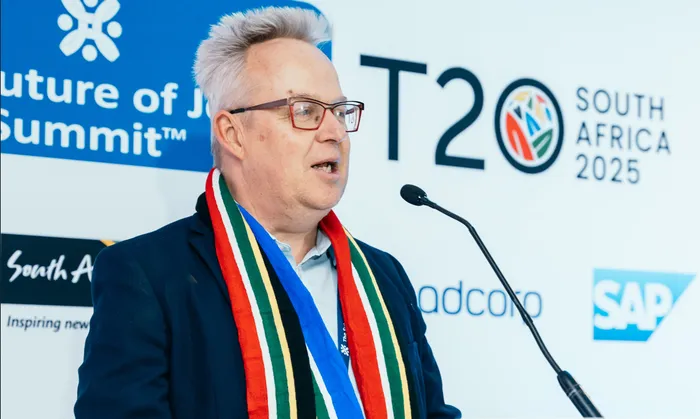
Dr Nik Eberl is the Founder & Executive Chair: The Future of Jobs Summit™ (Official T20 Side Event).
Image: Supplied
In 1996, Nelson Mandela issued a warning that now reads less like history and more like a message sent forward in time: “We are spending more on yesterday than tomorrow.” He was responding to finance minister Trevor Manuel’s projection that debt-servicing costs would soon exceed education spending. Mandela recognised the danger immediately. When a country prioritises consumption over investment, decline does not arrive overnight — it compounds quietly until the bill can no longer be deferred.
Nearly three decades later, South Africa faces another hinge moment. The topline indicators are encouraging. Inflation has eased. Growth has returned across four consecutive quarters. The country has exited the FATF grey list. Business confidence is tentatively improving.
Yet beneath this recovery lies a structural vulnerability that should concern investors far more than short-term growth figures: South Africa is still underinvesting in its future. Economic turning points rarely begin with spreadsheets. They begin with leadership choices.
When Trevor Manuel was appointed finance minister in 1996, South Africa was navigating recessionary pressure, currency volatility, fragile public finances and the immense uncertainty of a young democracy. Markets were searching for a signal of fiscal credibility. They found it.
Under Manuel, economic growth averaged above 3%, peaking near 5%. Hundreds of thousands of jobs were created annually. Debt-to-GDP declined to roughly 26%. South Africa recorded its first budget surplus in 2006/07, and Moody’s awarded the country an A credit rating.
This was not luck. It was disciplined leadership anchored in pragmatism rather than ideology. Manuel later acknowledged that he was not a technical economist when he entered office. Instead, he built institutional capability — surrounding himself with strong expertise while focusing on the strategic questions that linked fiscal policy to national priorities.
It is an underappreciated leadership truth: effective leaders do not need every answer, but they must build systems capable of producing the right ones. More importantly, Manuel demonstrated a quality modern democracies increasingly struggle to sustain — the willingness to accept short-term political discomfort in exchange for long-term national stability.
Expenditure restraint, wage discipline and tariff reductions provoked fierce resistance. Yet when commodity revenues swelled the fiscus, he resisted the easiest decision in politics: spending money you did not have yesterday but suddenly do today.
Debt was reduced. Fiscal buffers were strengthened. When the 2008 global financial crisis struck, South Africa entered it with resilience rather than fragility. Prosperity, it turns out, is rarely built on popularity. It is built on foresight.
Today, Mandela’s warning returns with uncomfortable clarity: are we investing in tomorrow, or quietly financing yesterday? Recent macroeconomic improvements risk obscuring a deeper concern. Total investment remains roughly 14% below 2019 levels in real terms, with private-sector investment lagging even further. Economist Peter Attard Montalto has described the scale of this shortfall as underappreciated — a crisis hiding in plain sight.
Investment is not an accessory to growth. It is the engine of durable prosperity. Without it, momentum becomes cyclical rather than structural — the economic equivalent of running faster on a treadmill. The consequences of prolonged underinvestment are already visible. Johannesburg — once Africa’s undisputed commercial heartbeat — increasingly reflects the compound effects of deferred capital spending: deteriorating infrastructure, unreliable services and rising operational friction.
Urban decline is seldom dramatic. It is what happens when postponement becomes policy. This is not merely a municipal story. It is a national signal. The government’s commitment of roughly R1 trillion to infrastructure over the next three years is, therefore, economically rational. Strategic public investment lowers risk, crowds in private capital and expands productive capacity.
But markets do not invest in announcements. They invest in execution. The global environment heightens the urgency. Trade tensions persist, geopolitical instability has become structural, and growth across major economies is uneven. President Cyril Ramaphosa’s emphasis on stronger institutions and deeper African trade reflects a pragmatic recognition that resilience must be built at home.
The opportunity is real — but so is the danger. Economic momentum should never be mistaken for permanence. It is a window. And windows close. The Manuel era leaves three lessons South Africa cannot afford to forget.
First, leadership appointments are themselves economic policy decisions. Nations rise or stall based on who occupies the critical chairs. Second, discipline during recovery matters more than austerity during crisis. It is easy to be prudent when resources are scarce; the real test is whether leaders resist excess when revenues improve. Third — and perhaps most important — investment is fundamentally an act of belief. It signals confidence in institutions, policy continuity and the country’s long-term trajectory.
South Africa has executed this playbook before. The blueprint exists because the country wrote it. What remains uncertain is whether we still possess the strategic patience to follow it. Mandela’s warning endures because it captures a timeless economic truth: every budget is ultimately a moral document — a statement about whether a nation values the future enough to prepare for it.
South Africa does not lack potential. What it cannot afford is hesitation. Momentum is not destiny. Investment is the decision that converts recovery into durability — and hope into trajectory. The question now is no longer whether South Africa knows what to do. It is whether we have the courage to do it again.
Dr Nik Eberl is the founder and executive chair: The Future of Jobs Summit™ (Official T20 Side Event). He is also the author of Nation of Champions: How South Africa won the World Cup of Destination Branding.
*** The views expressed here do not necessarily represent those of Independent Media or IOL.
BUSINESS REPORT