

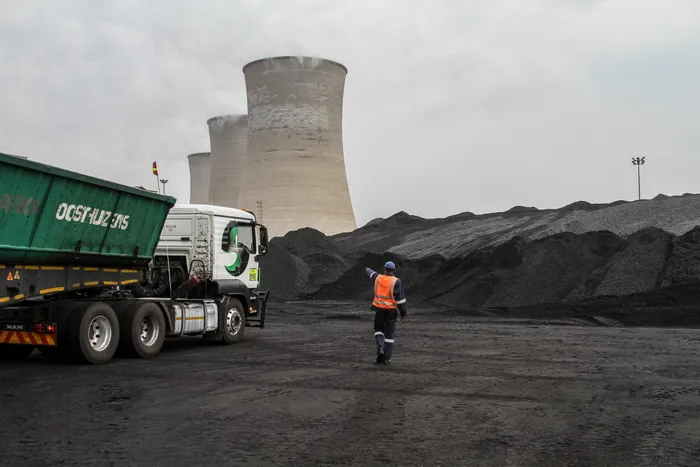
A worker supervises as a truck delivers coal supplies to the coal yard at the Grootvlei power station, operated by Eskom.
Image: File
The debate about electricity affordability in South Africa cannot be separated from decisions about which generation assets remain on the system. Eskom’s recent operational improvements have reduced emergency costs and created space for reform.
That space now risks being misused if it is channelled into extending the life of ageing, high-cost coal stations rather than accelerating structural change. Internal Eskom analysis and Just Energy Transition Partnership documentation identify three stations proposed for life extension beyond their scheduled retirement dates: Camden, Grootvlei, and Hendrina.These plants are among the oldest in the fleet, with average ages exceeding 55 years, low energy availability factors, high water intensity, and levelised generation costs far above those of new renewable capacity. They sit at the back of the merit order, meaning they add substantial fixed cost to the system while contributing relatively little energy.
On cost alone, they produce electricity at prices significantly higher than wind and solar procured in recent bid windows. Camden and Hendrina were scheduled for shutdown between 2023 and 2025, while Grootvlei is scheduled for retirement in 2026 and 2027. Extending the life of these stations would require capital expenditure estimated at between R80 billion and R90 billion for approximately 3.1 GW of capacity, delivering at most five additional years of operation.
On a per-gigawatt basis, this represents capital intensity several times higher than transmission expansion or new generation alternatives, with no long-term infrastructure benefit once shutdowns eventually occur.
From a system economics perspective, these investments are value-destructive, carrying negative net present value for an already over-indebted utility.This matters directly for electricity prices. Life extension does not reduce system costs. It locks inexpensive generation, increases maintenance risk, and diverts scarce capital away from grid expansion, which is now the binding constraint on adding cheaper capacity.
Transmission investment, by contrast, unlocks private generation at a fraction of the cost per gigawatt and delivers infrastructure with multi-decade life. Every rand allocated to prolonging old coal capacity is a rand not invested in lowering future electricity prices.
There is also a timing mismatch that undermines reform credibility. Eskom’s own analysis shows that since 2023, additional capacity from Kusile, Medupi, Koeberg, and more than 5 GW of renewables has materially reduced the risk of load-shedding, to the point where generation has been curtailed during periods of low demand. The system constraint has shifted.
Energy security arguments for life extension no longer align with operational reality. Persisting with life extension under these conditions creates a structural contradiction. Eskom seeks higher tariffs on the basis of financial strain while simultaneously proposing investments that raise the average cost of supply. Consumers are asked to absorb higher prices to fund assets that make electricity more expensive, not cheaper. This undermines the legitimacy of tariff increases and weakens public confidence in reform.
The life extension proposal also conflicts with South Africa’s Just Energy Transition commitments. Extending coal generation increases emissions, water consumption in stressed catchments, and exposure to health costs associated with air pollution. It creates reputational and legal risk through required derogations from minimum emission standards and weakens the credibility of shutdown commitments underpinning international climate finance.
More importantly, it delays the reallocation of capital and skills toward industries that can deliver durable employment and competitive energy costs. None of this diminishes the significance of Eskom’s recent operational recovery. On the contrary, it sharpens the choice now facing policymakers.
Improved performance has reduced crisis pressure and diesel dependence. That improvement should be used to complete reform, retire uneconomic assets on schedule, and accelerate investment in transmission and competitive markets.
Using the same space to justify life extension reverses the logic of recovery. Cheaper electricity will not be delivered by preserving legacy assets beyond their economic life. It will be delivered by allowing the cost curve to fall, by expanding the grid, by introducing competitive wholesale markets, and by ensuring that capital flows to the lowest-cost sources of supply.
Ending the operating life of Camden, Grootvlei, and Hendrina during 2026 and 2027 is therefore not an environmental gesture. It is a pricing decision. The electricity system has reached a point where affordability, credibility, and reform alignment converge. Extending the life of high-cost coal plants postpones difficult decisions but raises costs for everyone. Letting them go creates the conditions under which Eskom’s operational gains can translate into cheaper electricity for South Africans.
Eskom CEO Dan Marokane has stated that Eskom will now focus on bringing electricity costs down. Announcing the retirement of these three long-serving stations would be a clear signal that lower-cost electricity is being prioritised to support growth, job creation, and new economic opportunity.
Thomas Garner holds a Mechanical Engineering degree from the University of Pretoria and an MBA from the University of Stellenbosch Business School.
Image: Supplied
Thomas Garner holds a Mechanical Engineering degree from the University of Pretoria and an MBA from the University of Stellenbosch Business School. Thomas is self-employed focusing on energy, energy related critical minerals, water and communities. He is a Fellow of the South African Academy of Engineering and a Management Committee member of the South African Independent Power Producers Association.
*** The views expressed here do not necessarily represent those of Independent Media or IOL.
BUSINESS REPORT