

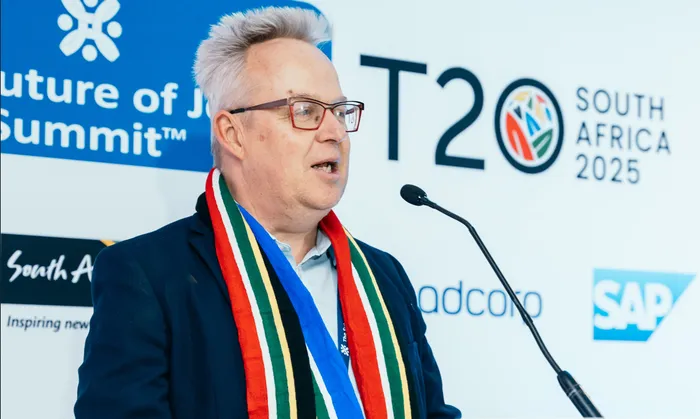
Dr Nik Eberl is the Founder & Executive Chair: The Future of Jobs Summit™ (Official T20 Side Event) .He will be writing a regular column in Business Report.
Image: Supplied
Soweto to Harvard. Nine distinctions. A 94% aggregate. And a two-week health crisis that could have derailed everything. Siza Gule has just secured a scholarship to Harvard University, one of the most prestigious institutions in the world, where he plans to study law and politics. His achievement is extraordinary not only because of the academic excellence it represents, but because of where it comes from. Not from Sandton. Not from leafy suburbs with legacy pipelines into elite universities. From Soweto.
In a country that regularly laments a “skills crisis” and a “talent shortage,” Gule’s story should force a more uncomfortable conversation. Perhaps talent is not our problem at all. Perhaps the real deficit lies elsewhere.
The Support System Truth
Having coached leaders across five continents, I have seen an uncomfortable pattern repeat itself: talented people fail quietly and alone. Not because they lack intelligence or ambition, but because the system around them does not catch them when life intervenes.
Gule understands this instinctively. Reflecting on his achievement, he did not credit genius or grit alone. Instead, he pointed to the people around him. “Had it not been for the support of my family and school, I don’t think I would have managed,” he said.
That statement should give us pause. Here is an 18-year-old on his way to Harvard acknowledging something many senior leaders only learn late in their careers: success is rarely an individual act. It is a collective outcome.
Midway through the year, Gule’s momentum was disrupted by anxiety and illness. Headaches, flu-like symptoms, and exhaustion forced him out of the classroom for two weeks. In an already demanding academic year, that kind of interruption can be devastating. It is often the moment when even high performers fall behind and never quite recover.
But his family and St John’s College did not let him fall. The system around him adjusted, supported, and stabilised him until he could regain his footing. The result speaks for itself.
The Resilience Pattern
Gule’s story is not an isolated miracle. It is part of a broader pattern emerging quietly across South Africa - one that contradicts the prevailing narrative of decline.
His classmate, Ruhan Gosai, achieved ten distinctions with a 94% aggregate. His explanation was neither romantic nor abstract. It was practical and disciplined: time management and the conscious sacrifice of a social life from Grade 11 onwards.
At Dainfern College, Mandisa Phakane secured six distinctions, including accounting and physical science - subjects she admits she had struggled with since Grade 10. “I had kind of given up,” she said candidly. What changed was not her intelligence, but her response to difficulty. She recommitted, sought support, leaned into faith, and worked consistently.
Three students. Three different schools. Different backgrounds, challenges, and trajectories. Yet one common thread runs through all of them: they did not do it alone. Resilience, in these cases, was not an innate personality trait. It was enabled. It was reinforced. It was supported by families, teachers, and institutions that refused to let momentary setbacks define long-term outcomes.
The South African Excellence Pipeline
This is what South African excellence actually looks like. First, talent exists everywhere. Soweto. Dainfern. Johannesburg. Geography does not determine potential. Exposure does. Expectation does. Support does.
Second, support systems multiply talent. A committed teacher who gives feedback. A family that notices when anxiety replaces confidence. A school that intervenes rather than penalises. These are not “soft” factors. They are performance multipliers.
Third, setbacks do not define outcomes. Two weeks of illness. Years of struggling with accounting. Temporary loss of confidence. The path to excellence is rarely linear, yet our systems are often designed as if it should be.
Consider the trajectories. Gule achieved 100% in dramatic arts and is heading to Harvard. Gosai is pursuing chemical engineering at Wits. Phakane is studying actuarial science at the University of the Western Cape. These are scarce skills. These are future leaders. This is a pipeline that is already producing.
The uncomfortable question is not whether South Africa has talent. It is whether we are building enough support structures to identify it early, protect it during moments of vulnerability, and sustain it through inevitable challenges.
A Leadership Question We Can No Longer Avoid
This is not only an education question. It is a leadership question. Right now, whose talent are you multiplying? In your organisation, your community, your family - who has potential but lacks support? Who is one setback away from being written off? Who is quietly carrying anxiety, illness, or self-doubt while still expected to perform?
Too often, we celebrate excellence at the finish line but ignore the scaffolding that made it possible. We reward outcomes and neglect systems. We applaud resilience without asking who made resilience possible.
Siza Gule’s journey from Soweto to Harvard proves something profoundly important: world-class potential exists in places we too often overlook. It does not require rescue. It requires reinforcement.
The future of South Africa will not be determined by whether talent exists. It already does. It will be determined by whether leaders - in schools, families, organisations, and communities - choose to build the support systems that allow that talent to flourish. Because Harvard-level potential does not begin at Harvard. It begins wherever belief, discipline, and support intersect.
Dr Nik Eberl is the founder and executive chair: The Future of Jobs Summit™ (Official T20 Side Event). He is the author of Nation of Champions: How South Africa won the World Cup of Destination Branding.
*** The views expressed here do not necessarily represent those of Independent Media or IOL.
BUSINESS REPORT