

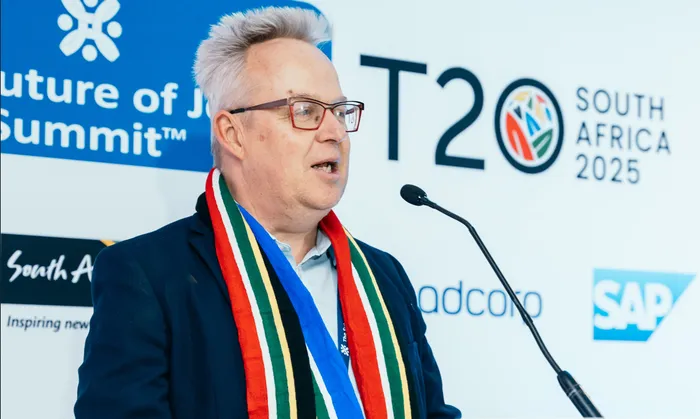
Dr Nik Eberl is the Founder & Executive Chair: The Future of Jobs Summit™ (Official T20 Side Event) .He will be writing a regular column in Business Report.
Image: Supplied
South Africa stood at two remarkable crossroads last month. A continent-first G20 summit in Johannesburg put our nation — its people, institutions and hospitality — in the global spotlight. At almost the same time, I was in Barcelona at Workday Rising, where enterprise leaders explored the near-term reality of AI-driven, people-centred workplaces. The two experiences together crystallised a single, urgent point: South Africa can not only adapt to the future of work — it can lead it.
First, the context. Global leaders arriving on our soil exposed us to the highest expectations in security, logistics, digital capability and service delivery. Coverage from international and local outlets praised South Africa’s delivery — our media centre, our event management and the warmth shown to delegates were singled out repeatedly. That goodwill is a strategic asset: hospitality isn’t just a soft power nicety, it is a credibility deposit we can spend when pitching investment, partnerships and talent to the world.
Meanwhile in Barcelona, Workday and its customers framed the future of work as “AI-powered, human-centric, future-ready.” The product and strategy conversations weren’t about replacing people; they were about augmenting teams with AI agents that automate administrative friction, surface learning opportunities and allow leaders to focus on strategy, culture and creativity. Those same tools — when implemented with a firm ethical and skills framework — can accelerate productivity across South African firms, from large corporates to fast-growing SMMEs.
Putting these two trajectories together suggests a practical playbook for South Africa to become a global leader rather than a passive adopter.
There is a final, cultural point. Leading the future of work requires reframing success: from merely filling jobs to creating careers and citizenship. South Africa’s greatest asset is the relational capital of its people — their hospitality, ingenuity and resilience. If we pair that relational capital with rigorous tech adoption, clear skills frameworks and pro-competitive public policy, we create a model that other emerging markets will want to copy.
The world is watching. Delegates left Johannesburg impressed; technologists in Barcelona are building tools that can reshape opportunity at scale. That confluence gives us a window to act. We can choose to be implementers of other people’s tech and models, or we can become designers of a version of the future of work that fits our context — equitable, competitive and proudly South African.
It’s time to convert the applause into policy, capital and programmes. Lead with hospitality, design with people at the centre, and scale with a national skills passport and clear data rules. Do that, and the future of work will not simply arrive in South Africa — South Africa will shape it.
Dr Nik Eberl is the founder and executive chair: The Future of Jobs Summit™ (Official T20 Side Event). He is also the author of Nation of Champions: How South Africa won the World Cup of Destination Branding.
*** The views expressed here do not necessarily represent those of Independent Media or IOL.
BUSINESS REPORT