

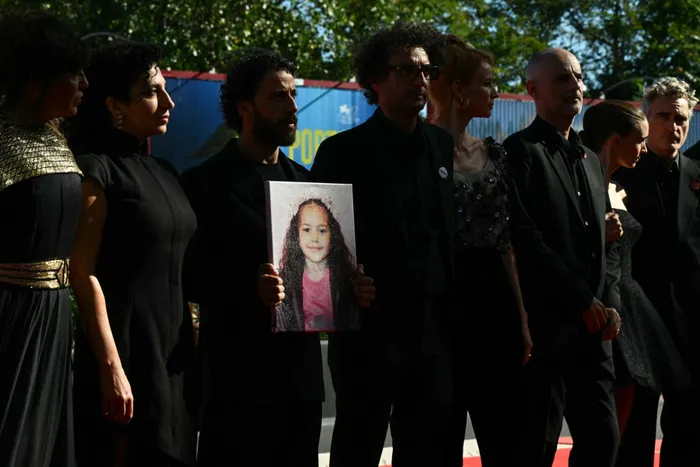
From left : Tunisian director Kaouther Ben Hania, actress Clara Khoury attend, actor Motaz Malhees, and producers Nadim Cheikhrouha, Odessa Rae, Jim Wilson, Rooney Mara, Joaquin Phoenix, hold a portrait of late Palestinian girl Hind Rajab, during the red carpet for the movie "The Voice of Hind Rajab" presented in competition at the 82nd International Venice Film Festival, at Venice Lido.
Image: STEFANO RELLANDINI / AFP
20,000 children.
That is how many children have been killed by relentless attacks on Palestine by Israel. To put into perspective, that is approximately how many children there would be in 400 public schools.
The Voice of Hind Rajab left viewers feeling nothing but anger, heartbreak and a drive - a drive to do more and to do better.
In recent weeks, Social Intifada has brought the Oscar-nominated Gaza film to South African screens, reigniting a spark of activism and calls for an end to occupation and genocide.
But we need to remember that 6-year-old Hind Rajab was one of thousands whose lives were taken away far too early. And we also need to remember the thousands killed in the genocide in Palestine are not just numbers and headlines.
Let's draw our attention to the international response and accountability.
The United Nations has repeatedly called for ceasefires, increased humanitarian access and investigations into alleged violations of international law. All of which have seemingly fell on deaf ears.
The UN Human Rights Council established an independent Commission of Inquiry to investigate abuses committed by both Israeli authorities and Palestinian armed groups since October 7, 2023.
The Commission concluded in 2024 said Israeli actions included attacks on civilians, starvation tactics and collective punishment. In 2025, the UN Commission went further, stating that Israeli forces had committed genocidal acts in Gaza, citing widespread killings, destruction of civilian infrastructure and restrictions on humanitarian aid.
Several world governments have also increased diplomatic pressure.
South Africa brought a genocide case against Israel before the International Court of Justice and a number of countries have suspended or reviewed arms exports to Israel. There have also been an increase in calls for ceasefire and condemnations of Israel's attacks.
Meanwhile, others, including the United States and European allies, have continued backing Israel while also urging humanitarian protections and ceasefire negotiations.
The International Criminal Court is investigating alleged war crimes and crimes against humanity linked to the war. The ICC has rejected Israeli attempts to halt the investigation, allowing prosecutors to continue examining events in Gaza and Israel following the October 2023 attacks.
In 2024, ICC prosecutors sought arrest warrants for Israeli Prime Minister Benjamin Netanyahu and former defence minister Yoav Gallant, over alleged war crimes and crimes against humanity. However, Israel has rejected the ICC’s jurisdiction and denies committing war crimes.
Alongside the ICC process, the ICJ case brought by South Africa accuses Israel of violating the Genocide Convention. The ICJ has issued provisional measures ordering Israel to help prevent genocidal acts and allow humanitarian aid.
According to aid agencies, humanitarian operations continue to face major obstacles despite international pressure.
According to Human Rights Watch and UN agencies, aid deliveries have been repeatedly disrupted by border closures, damaged infrastructure, insecurity, fuel shortages and restrictions on goods entering Gaza.
Human Rights Watch reported in May 2026 that aid levels remained well below what humanitarian organisations say is necessary to sustain Gaza’s population. It also cited ongoing Israeli restrictions on crossings, medical supplies, generators and essential equipment.
The destruction of hospitals, roads, water systems and sanitation infrastructure has further complicated relief efforts. UN agencies have warned of worsening hunger, disease outbreaks and the risk of famine in parts of Gaza.
Ceasefires have repeatedly broken down or faced allegations of violations.
Recent UN briefings warned that Gaza’s division and instability could become permanent if ceasefire agreements are not upheld.
Continued airstrikes, military operations and restrictions on aid have undermined ceasefire agreements.
Although international mediators, including Qatar, Egypt and the United States, have brokered temporary truces, enforcement mechanisms remain weak, and there is no permanent political settlement in place.
IOL