

A powerful El Niño climate pattern is rapidly developing in the Pacific Ocean and is expected to influence South Africa's weather over the coming months. The World Meteorological Organization says there is more than a 90% chance the event will persist until at least November, increasing the risk of extreme heat, drought and veld fires across the country's summer rainfall regions.
Image: ChatGPT
Before a single raindrop falls, the Pacific Ocean is already helping to shape South Africa's weather.
Thousands of kilometres away, a natural climate pattern known as El Nino can influence everything from soaring temperatures and shrinking dams to the risk of devastating veld fires. have said that it will be the strongest on record.
The United Nations' World Meteorological Organization (WMO) has confirmed the rapid onset of a strong El Nino event.
Forecasts indicate that sea surface temperatures are expected to rise by more than 2°C above average, contributing to record-breaking global temperatures and increasing the likelihood of extreme weather events, including intense heatwaves, severe droughts and heavy rainfall around the world.
While many South Africans only hear the term when drought warnings are issued, meteorologists said understanding the phenomenon can help communities prepare for what may lie ahead.
Additionally, how will this affect the country's food production?
SA Weather Service (Saws) forecaster Lelo Kleinbooi said El Nino is part of the El Nino Southern Oscillation (ENSO), a naturally occurring climate cycle.
"El Nino is an ENSO (El Nino Southern Oscillation) state or phase, which occurs when the sea surface temperatures (SST’s) over the equatorial Pacific are warmer than normal," Kleinbooi said.
Although it begins in the tropical Pacific Ocean, its effects are felt across continents, including southern Africa.
In SA, El Nino typically results in warmer and drier than normal conditions across the country's summer rainfall areas, including the Free State, North West, Gauteng, Mpumalanga, Limpopo, KwaZulu-Natal and the eastern parts of the Eastern Cape.
The impact on the winter rainfall areas, which include parts of the Western Cape and Eastern Cape, varies considerably.
Kleinbooi said that during this climate phase, rain-bearing systems are blocked from dominating the country's weather.
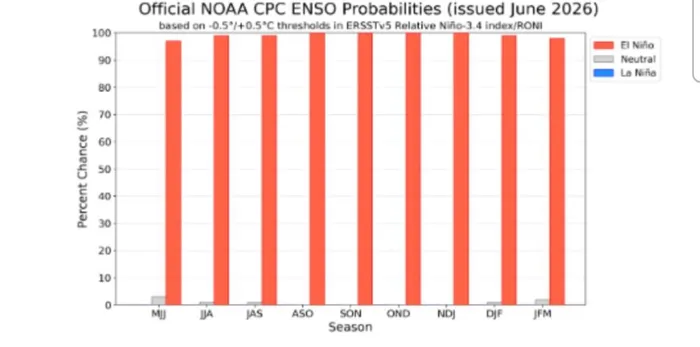
Powerful El Nino developing with 90% chance of persisting, WMO warns.
Image: COLUMBIA CLIMATE SCHOOL
This usually results in less cloud cover and higher than normal daytime temperatures for prolonged periods, increasing the frequency of heatwaves, the possibility of temperatures exceeding 40°C and the risk of runaway fires.
She said the prolonged heat and dry conditions also have serious consequences for water security and agriculture, as increased evaporation raises the likelihood of drought.
"The higher-than-normal daytime temperatures accompanied by drier than normal conditions, results in increased evaporation and therefore an increased risk of droughts. The stronger and long lasting this ENSO phase is, the more drastic the impacts are," she said.
While concerns have grown over the potential impact of the weather phenomenon on farming and food prices in 2027, Wandile Sihlobo, chief economist at the Agricultural Business Chamber of South Africa (Agbiz), said several factors could help cushion the country's agricultural sector against the effects of the severe phenomenon.
He said much of the public discussion had centred on the possibility of drought reducing crop production and driving up food inflation but argued that South Africa enters the new summer crop season in a stronger position than during previous droughts.
"One of the major points of discussion amongst other analysts and economists this past week was the likely impact of the expected El Nino on South Africa’s agriculture and consumer food price inflation in 2027."
According to Sihlobo, years of favourable La Nina rainfall have left farmers with a significant advantage ahead of the 2026/27 planting season.
He said the prolonged rainy seasons had improved soil moisture and groundwater levels across much of the country, creating conditions that could support crops even if rainfall during El Nino is below average.
"The longer rainfall season benefited the country by improving soil moisture and the water table ahead of the 2026-27 summer crop season."
Sihlobo said that when planting begins in October, many farmers are expected to start the season with healthier soil than is usually the case.
"When the planting period starts in October 2026, farmers across South Africa will have better-than-normal soil moisture to begin with."
He noted that while rainfall is still essential, the timing of showers will ultimately determine how well crops develop.
Irrigation farmers also stand to benefit from higher dam levels following successive wet seasons, while livestock producers are expected to have access to healthier grazing veld and improved water availability.
"For the livestock industry, the grazing veld across the country is in a fair condition, having benefited from the longer rainy periods in the 2025-26 season."
Sihlobo also pointed to South Africa's record grain production as another reason for cautious optimism.
The latest estimates from the Crop Estimates Committee place the country's 2025/26 summer grain and oilseed harvest at a record 21.49 million tonnes, driven by expanded planting areas and strong yields.
Maize production alone is expected to reach 17.25 million tonnes, comfortably exceeding annual domestic consumption of about 12 million tonnes and leaving substantial stocks available even after exports.
These supplies, he said, would provide an important buffer should production decline during the next growing season.
"The second key factor to keep in mind is that South Africa has its largest-ever summer grain and oilseed crop in the 2025-26 season."
Although Sihlobo acknowledged that drought conditions associated with El Nino would present challenges and increase production costs for farmers, he said the current situation differs markedly from previous drought cycles because of the country's improved starting position.
"Ultimately, while it is understandable that many people worry about the expected El Nino, forecasts of higher food price inflation may miss some of the fundamental issues that will shape the season ahead, such as improved soil moisture and available grain supplies."
The economist added that South Africa's crop estimates have continued to improve over the past month, with higher production linked to expanded cultivation and favourable La Nina rainfall.
"South Africa’s summer grain and oilseed production estimates have been consistently lifted. It is now at a fresh high due to the expansion of the area under cultivation and the high yields from favourable La Nina summer rains."
The World Meteorological Organization (WMO) has warned that El Nino conditions are developing, fuelled by unusually warm waters in the tropical Pacific Ocean.
The UN weather agency said the climate pattern is expected to influence global temperatures and rainfall over the coming months, increasing the risk of extreme weather.
It added that there is a more than 90% probability that El Nino conditions will persist until at least November.
"Warm ocean waters are fueling the development of El Nino."
The WMO said El Nino typically pushes global temperatures higher and contributes to more extreme weather and shifting rainfall patterns. Forecasts also indicate above-average temperatures across most parts of the world between June and August.
"Time for informed decision-making, planning and preparedness is now."
The WMO said its El Nino updates are based on a global consensus of climate models and experts, providing governments and climate-sensitive sectors such as agriculture, health, water management and energy with the latest scientific guidance to support preparedness.
UN Secretary-General António Guterres urged countries to act before the full effects of El Nino are felt.
"The science is clear: El Nino is arriving on our doorstep in the coming months with 90% certainty."
IOL