

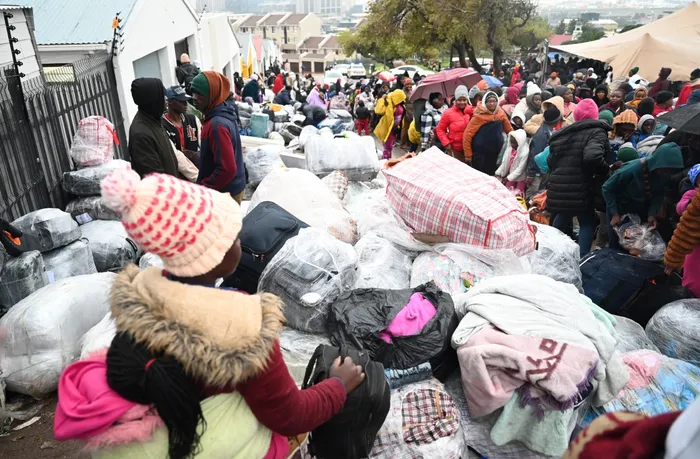
As heavy rain began pouring over Cape Town, the City of Cape Town, in collaboration with the Department of Home Affairs and the Zimbabwean Consulate, started relocating Zimbabwean nationals who had gathered in large numbers outside the Consulate in District Six.
Image: Ayanda Ndamane/ Independent Newspapers
While foreign nationals flock to the consulates across the country ahead of June 30th, concern and worry remain over whether an over-reliance on repatriation will address wider systemic governance issues.
The City of Cape Town, in collaboration with the Department of Home Affairs and the Zimbabwean Consulate, were relocating Zimbabwean residents who had gathered in large numbers outside the Consulate in District Six over the weekend.
The residents were then moved to the Home Affairs Repatriation Centre in Epping, which is the designated facility for processing voluntary repatriation and is properly equipped to manage this volume of residents safely and humanely.
The city had urged Zimbabwean residents wishing to be repatriated to instead go to the Epping Repatriation Centre, which will be the sole official site for processing before residents are transported to Beit Bridge.
The relocations came as South Africa braces for tense anti-illegal immigration protests on June 30 across the country, with police warning those planning to participate to behave and to adhere to the law.
Chairperson of Zimbabweans Cape Town, Weston Willie, said that Zimbabweans from across the province, in places like Bredasdorp, Hermanus, and Robertson, came to the consulate.
“The only place that they could find is the consulate because they know that it is the only place they could come for safety, so that's why you see there are a lot of people. There is immigration, which has its own way of processing. Also, our consulate has its own way of processing, so that they have as counterparts, they are working together.”
According to the civil group, Siyafana Sonke Campaign, the Western Cape is not only the place that has seen such mobilisation from foreign nationals amid growing concerns over Tuesday. They said that African citizens are not voluntarily requesting repatriation, but are instead fleeing from intimidation and violence.
“Thousands of migrants and refugees from across South Africa are coming together for safety in urban centres, with their belongings, and entering involuntary repatriation processes. In each of these sites, basic needs and support are provided from communities, faith groups, and humanitarian organisations,” they said.
They said that the Zimbabwean nationals in the Western Cape have been arriving over the past 10 days.
“The majority are women and children seeking transport home. While the Zimbabwean Consulate has been arranging buses back to Zimbabwe, many families have had to wait for days before departure, with no access to shelter and limited ablution facilities.
Following sustained advocacy by activists and members of the public across South Africa, permission was granted late last night for a temporary tent to be erected to provide basic protection while people await transport to the Epping Repatriation Centre. An increased police presence has also helped to support the management of the site,” they said.
They added that throughout this humanitarian response, the wider Cape Town community has stepped forward with extraordinary generosity.
“Gift of the Givers, faith communities, activists and individual residents have donated sandwiches, cooked meals, water, baby formula, nappies, toiletries and other essential items, ensuring that families have been cared for during this impossible period.”
Volunteer Ayesha Bagus said: “The compassion shown by the Cape Town community has been extraordinary. People from all walks of life have responded with supplies and financial donations, reminding us what humanity looks like when people come together. We are relieved that families will now be moved to the Epping Repatriation Centre, where we hope they will have access to dignified shelter and be processed more quickly by Home Affairs before returning home.”
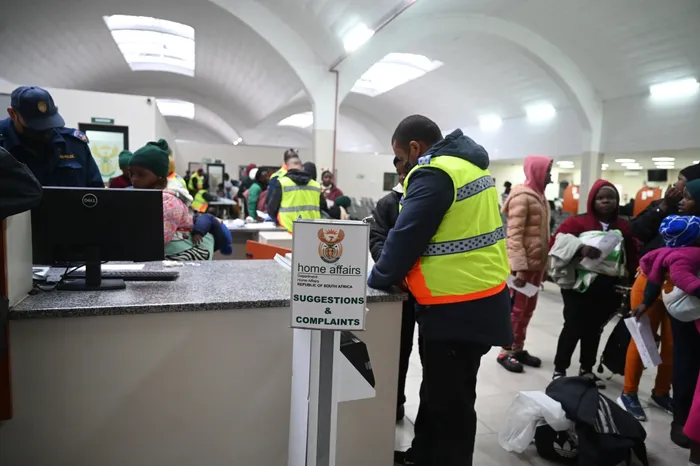
South African authorities are processing thousands of Zimbabwean nationals for voluntary repatriation and deportation following rising tensions and fears surrounding anti-immigrant demonstrations.
Image: Ayanda Ndamane/Independent Newspapers
Throughout KwaZulu-Natal, refugees and migrants are being displaced, either unlawfully evicted or fleeing threats, and are congregating in urban centres.
Volunteer Yesh Govender said, “We now have 2,000 people at a site that is able to support 300, and people are arriving every day, desperate. We are also aware that there are potentially hundreds of people afraid to travel and are in hiding, and this is another level of humanitarian assistance and security needed.”
On Friday night, 26 June 2026, about 400 people gathered outside the Malawian consulate in Woodmead, Sandton. The group includes a pregnant woman and a newborn baby. They were stranded outside in winter conditions. A decision was made to move the group to the Lindela Repatriation Centre, and transport was eventually arranged on Sunday morning.
Activist Tessa Dooms said: “People are arriving all the time. We are seeing violence emerging in some areas, and foreign nationals are being intimidated even in places they have fled to for shelter. There is a real risk of a humanitarian crisis emerging.”
International relations expert Siseko Maposa, who is the director of Surgetower Associates - Management Consultancy, said that it is naive to assume that deportation alone addresses the structural issues.
“We have porous borders, and that reality has undeniably fueled tensions. However, focusing solely on enforcement is a significant risk. I would caution that if we over-rely on repatriation without fixing systemic governance weaknesses, we are likely to create a scenario that exacerbates xenophobic tensions rather than solving the core issues.
“Enforcement must be matched with institutional integrity. The primary challenge is the lack of a cohesive regional approach. Success in this area depends entirely on how diligently we pursue a regional framework for border security.
"We require robust diplomatic engagements and increased coordination with neighbouring states, rather than the current trend of unilateral actions. Without that coordination, we create friction with our neighbours and undermine our own strategic position in the region,” Maposa said.