

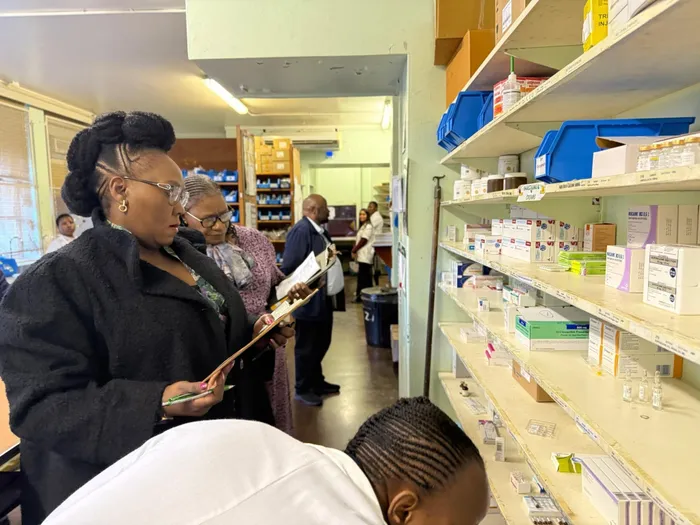
KZN Health officials have discussed strategies to manage medication shortages amid supply chain disruptions.
Image: Facebook/ KwaZulu-Natal Department of Health
The KwaZulu-Natal Department of Health says supply chain disruptions are behind occasional medicine shortages in the province.
According to officials, these shortages are primarily driven by external supply chain disruptions. To ensure continuity of care, the province is actively managing its stock through redistribution between hospitals and clinics and using therapeutic alternatives.
KZN Health MEC Nomagugu Simelane emphasised that when medicine unavailability occurs, it is not because they have not bought medicines, but because suppliers do not have them.
“Sometimes, some of the medicines we buy, during their manufacturing—because even a pill or a medicine doesn’t just have a single active ingredient. A medicine or a pill rarely contains just one ingredient. There are many different ingredients,” Simelane said.
She explained that while some medicines are manufactured in South Africa, not all ingredients are sourced from here. Some are ordered from overseas. Sometimes, it is a medicine or pill made overseas. They also source the ingredients from different places.
“Sometimes, when we want the medicine or pill, it turns out that the manufacturer doesn’t have it, or those who ordered it from overseas ran out of their order, or whatever happened. Sometimes, one of the ingredients required to make the medicine or pill is missing. Then the manufacturer can no longer make it, and we, in turn, cannot get it,” Simelane explained.
She highlighted that last year the province ran out of epilepsy medication, but doctors and nurses met and agreed that if this medicine is unavailable, some medicines or pills can be combined to achieve the same result.
Provincial Pharmaceutical Supply Depot manager Thandeka Njapha said the department had not run out of the affected medicines, but was receiving lower quantities than required.
She said they currently have a problem with epilepsy medication called Phenobarbital. A circular from the National Department of Health was issued.
“It’s not just us in KZN who don’t have it… We are trying every way possible so that when something is unavailable, it is truly because the problem is further back in the supply chain,” Njapha explained.
“The issues with transport and importing medicines from overseas, since there are wars in the world, affect us because there are delays. You find that they don’t arrive at the time we had planned, so we experience shortages.
“We redistribute; we borrow from each other, even across provinces. We can go to another province and share because we are all facing the same problem.”
Njapha further explained that if a patient cannot receive Phenobarbital, there are other therapeutic alternatives.
“We give you a therapeutic alternative so that even if the primary one isn’t there, this other one can treat the condition you presented with,” Njapha said.
She said another medicine facing challenges is Rifampicin for tuberculosis.
“There too, it’s not KZN alone, but again, we have another drug that can be used in its place. We won’t just let you go like that,” Njapha said.
Njapha added that contraceptive pills were also affected by the low supply.
“It’s not that they are completely out, and other types of pills are available, as well as other methods of preventing pregnancy. There are other options: there are injections, which have no issue; there are implants; and even among contraceptive pills, not all of them are out, just specific ones,” she said.
She shared that for all affected medicines, the suppliers have promised that stock will return.
“Some, we were able to source from alternate suppliers, meaning if this supplier doesn’t have it, we buy from another. But most suppliers have promised us that by July, the situation will be back to normal,” Njapha said.