

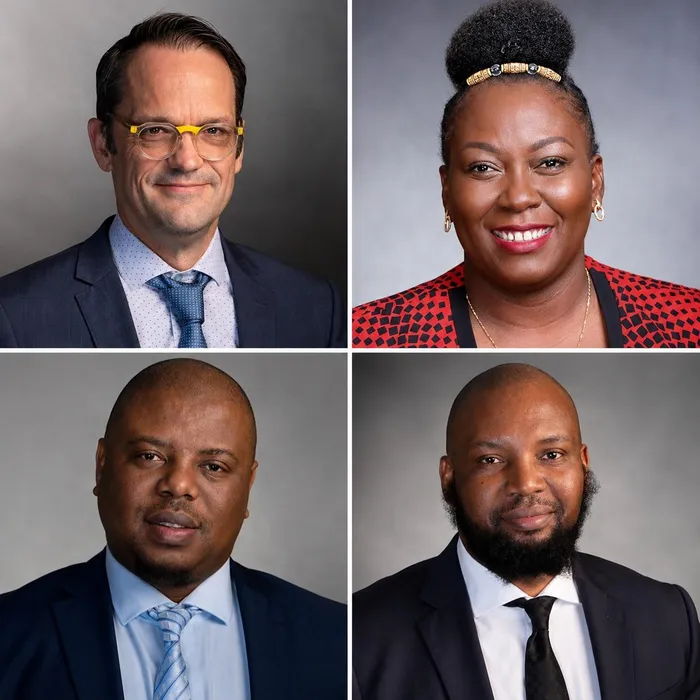
From left: clockwise, Martin Meyer, MEC for the Department of Public Works and Infrastructure, and Nomagugu Simelane, MEC for Health. Bottom left: Sipho Hlomuka, MEC for Education, and Siboniso Duma, MEC for Transport and Human Settlements.
Image: SA Gov
Members of the KwaZulu-Natal Legislature will continue to scrutinise, deliberate, and debate the budgets of each of the provincial government departments until Tuesday.
According to the legislature, passing the budget is a fundamental requirement carried out that grants the executive the legal authority to spend public funds and continue running the state. Additionally, the budget decides how around R168 billion is distributed locally.
HEALTH
The KZN Department of Health (DoH) has a R60.2 billion budget. Nomagugu Simelane, MEC for Health, spoke of ushering in a new era for Inkosi Albert Luthuli Central Hospital with R45 million in funding for critical posts to rebuild specialist services across several disciplines to reduce surgical waiting lists.
Simelane said the department will reduce the medico-legal burden by improving the medico-legal unit. In the 2025/26 financial year, the department's interventions saved R201 million through negotiated settlements and improved litigation management. The department also intends to improve ambulance services.
PUBLIC WORKS
MEC for the Department of Public Works and Infrastructure, Martin Meyer, has a R2.4 billion budget. His focus is on six key aspects which he has identified as material concerns for the people of KZN.
Budget allocations will focus on digitisation, jobs, and women's empowerment through existing initiatives such as "She Builds", a dedicated women-only advisory body.
Meyer will also focus on the construction mafia and more cranes/projects. His department has a plan that will see more cranes and active construction sites across the province.
“Rates have ballooned to R2 billion. Municipalities are taking the department to court for unpaid rates on properties across 54 municipalities. Hundreds of unused buildings are draining the department’s rate purse while schools continue to be subjected to paying rates,” he said.
HUMAN SETTLEMENTS
Siboniso Duma, MEC for Transport and Human Settlements, said his R3.2 billion budget will focus on housing delivery. His budget was reduced by 10% from R3.6 billion in the adjusted 2025/26 financial year.
One of his goals is to close all Transitional Emergency Accommodation (TEAs) by June 2027. The annual rental burden for TEAs currently stands at R128 million.
He said moving flood victims to Cornubia and Montclair Lodge is projected to save the state R66 million.
Duma explained that a Housing Indaba is scheduled for this year to establish a social compact on Innovative Building Technologies (IBTs) aimed at disaster-resistant housing.
“The implementation of alternative energy solutions, including solar systems, continues to be explored within Human Settlements projects.”
Duma said that after 18 years, a new organisational structure was implemented in April 2026. “A major milestone to improve organisational efficiency.”
EDUCATION
Sipho Hlomuka, MEC for Education, said the R71 billion budget will be used to expand Early Childhood Development (ECD) services, accelerate digital transformation, and continue the provision of school nutrition programmes.
Currently, the province caters to 181,459 children, from funded and unfunded ECD centres, who access quality learning in 5,761 registered ECD programmes.
Hlomuka allocated R463 million to the construction of ablution facilities at 125 schools in the 2026/27 financial year. He was also concerned about criminals targeting equipment that is meant to empower learners.
“Over the past three years, at least 84 laptops, 501 tablets, 127 data projectors, and seven smart screens have been stolen from schools. The estimated loss amounts to R14 million,” he said.
According to the Legislature, a government cannot legally collect most taxes or fund essential public services like healthcare, education, and policing.
The significance of this process ensures that the government is held accountable to the public since Members of the Provincial Legislatures are elected by the people; their vote acts as a check on executive power, ensuring that public money is spent in line with the priorities and interests of the people they represent.