

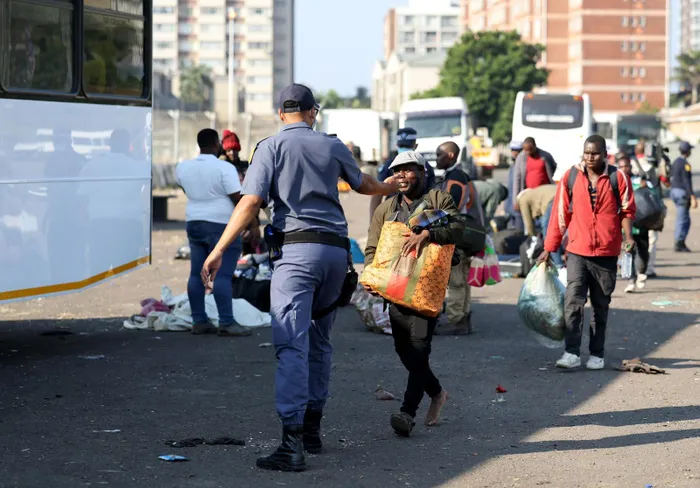
A group of foreign nationals preparing for repatriation as part of the eThekwini Municipality’s coordinated strategy.
Image: Thuli Dlamini
The eThekwini Municipality has effectively managed the large-scale repatriation of undocumented immigrants from sites in Sherwood and the Durban drive-in, overseeing the departure of over 20,000 individuals through a coordinated strategy.
Mayor Cyril Xaba confirmed on Wednesday that the Durban drive-in site was erected and dismantled within 14 days.
“We still see a few people around but have buses ready to collect them, and I think the buses will take them to the Beitbridge site,” Xaba said.
“I really appreciate and thank the Minister of Justice, who, after seeing our plan, decided to replicate this plan in Beitbridge, which then helped the city in terms of lessening the burden on our side.”
Xaba said that after the Beitbridge site was opened, Home Affairs invited them to help bus people to the site. The city assisted with over 150 buses on a cost-recovery basis.
“We entered into an agreement that the money will be spent, and the city will get reimbursed. That’s the agreement between ourselves and Home Affairs,” Xaba said.
“People who have left these two sites, Sherwood and this site (drive-in), are in excess of 20,000. That I know, the buses that were organised are close to about 300, and the city contributed in excess of 150 buses.”
Xaba said that close to 95% of the people at the site were Malawians; however, it did not mean that only Malawians left the country.
“Zimbabwe was a bit organised because they had representatives in various communities who were able to gather their own nationals and communicate with the office of the Consul General in Gauteng, which then provided them with transport. They didn’t have to come to us for transport. I’m also grateful to the Zimbabwean authorities for not coming to us with a begging hand, but for simply saying we are here, we’ll assist, we’ll repatriate our own people. Of course, they also had to follow the process,” Xaba said.
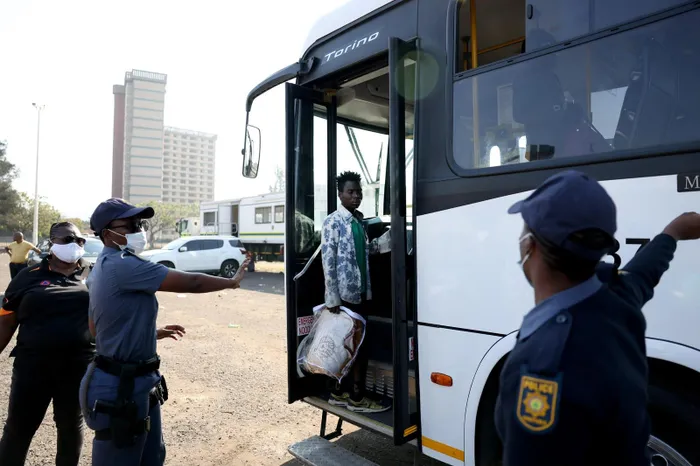
Immigrants boarding buses at the Durban drive-in site, part of a large-scale repatriation initiative.
Image: Thuli Dlamini
He said the Zimbabweans may be converging at the drive-in site to assemble because they organised their own buses.
“I got a call this morning (Wednesday) to say that they have plans to repatriate their own people,” Xaba said.
“But once again, repatriation means that they must also go through the processing facility in Gauteng. So, those are less of my concern.”
The mayor said he met some Zimbabweans in Pinetown, near the Department of Labour, and spoke to a man who said he was from the Consulate General’s office.
“He explained the process and the protocol; I was happy. Even though I did not know of their movements, they were in control of the situation. They were just loading their people into their bus and transporting them to the processing centre, as it were. So, I am happy with it,” Xaba said.
“I heard that there were Mozambicans. Mozambicans felt that going to Musina was too far. I think it is about 800km as opposed to travelling 500km to Mozambique. They also have their own plan to take people out of the country, but again, they must also go through the process. So, they have not come to me for buses. They are organising buses themselves. So, I’m excited about that.”
Xaba said processes had to be followed because immigrants cannot leave the country without being processed, so those with cases against them can be brought to book.
“A number of people who, through this process, were arrested because they have pending cases against them. Processing also facilitated that people don’t leave the country when they have cases pending against them. That fingerprinting process was meant to ensure that we are clinical in the repatriation process. That’s how far we have come,” Xaba said.