

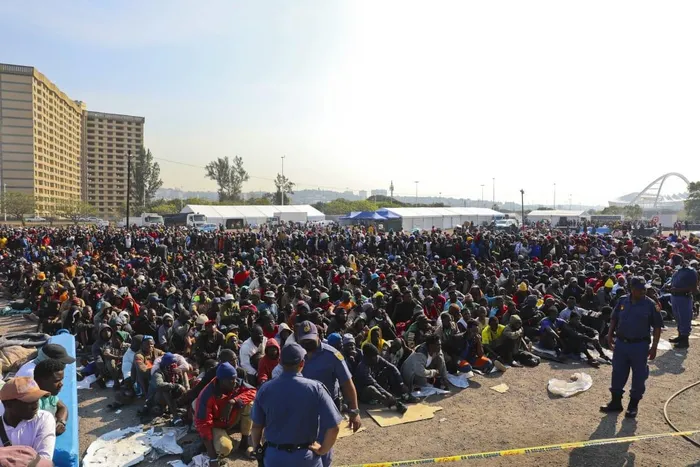
A view of the Durban drive-in site, where thousands of undocumented Malawian nationals await repatriation as part of a government initiative.
Image: Doctor Ngcobo/ANA Studio
Home Affairs Minister Dr Leon Schreiber has underscored the complexity and scale of the ongoing repatriation operation for undocumented Malawian nationals in Durban, calling it a balance between enforcing immigration laws and upholding human dignity.
Speaking at the Durban drive-in site on Monday morning, Schreiber said the drive-in site had better health and ablution facilities, people were being fed, and the numbers were ramping up.
“We were able to do over 2,200 on Saturday night, working into Sunday morning, another 1,600 yesterday (Sunday), and we think with a few more tweaks, we can actually speed that process up further,” Schreiber said.
“What we’d like to see is those numbers to continue to grow, but critically, we are doing this in a humane, lawful manner. This is not a matter of people being chased out. These are people who say ‘we want to be repatriated’.
“We’ve now done over 7,000 in total. There are probably about 8,000 more people here. One of our biggest challenges is that we can’t project how many more we’ll have to process.”
Schreiber said this is happening in Durban, but they have seen similar challenges in Pietermaritzburg and a few other spaces around the country.
Schreiber further emphasised that the operation, which involves rigorous screening to ensure wanted criminals do not use the repatriation process as an escape route, is a necessary measure to manage accumulated immigration challenges while working toward systemic, long-term solutions such as the electronic travel authorisation (ETA) system.
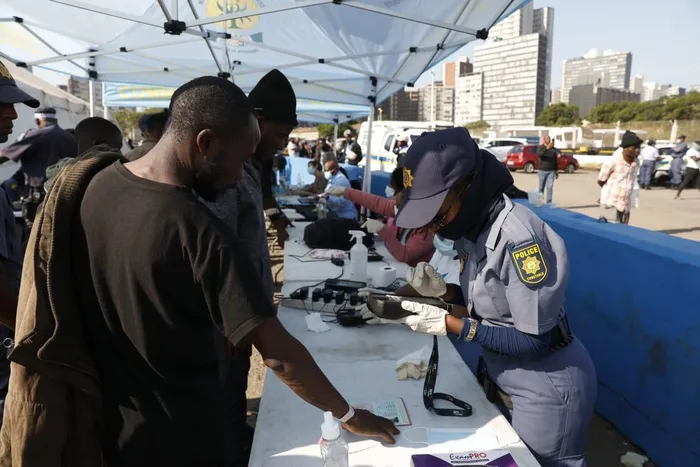
SAPS officials conduct verifications to ensure the safety and legality of the repatriation process.
Image: Doctor Ngcobo/ ANA Studio
“We will not tolerate our immigration laws being undermined. That is why it’s so critical that we have this balance where we say only the government can do this work. The government must do it in a responsible and lawful manner, but we must never do it in a way that actually harms the dignity of people who are already quite vulnerable,” Schreiber explained.
He said the government cannot have someone who may be wanted in South Africa for a crime to be repatriated and, in that sense, escape justice.
“We have SAPS here doing verifications along with Home Affairs, and we already have one case of an individual who was wanted for the rape of a child. We’ve identified who was arrested here,” Schreiber said.
“I emphasise it to the people of South Africa. There are unintended consequences that could harm all of us if we don’t do it this in an orderly process, because the parents of that child who was allegedly raped by this individual, they would have been effectively robbed of justice if that person was just in an unmanaged manner repatriated to their country.”
Schreiber said the work aims to ensure South Africa is not an escape route for people wanted for crimes. Immigrants are having their fingerprints checked and the system scanned for warrants.
The minister called the number of undocumented people “incredibly worrying”, saying it shows how big the problem has grown.
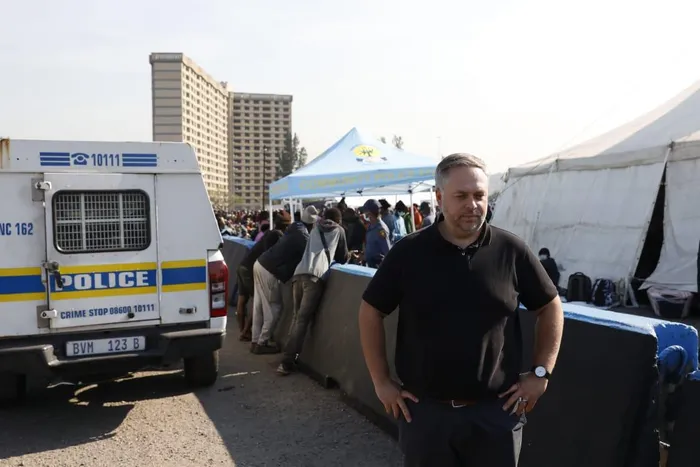
Minister Schreiber emphasises the importance of balancing immigration laws with human dignity during the repatriation process.
Image: Doctor Ngcobo/ ANA Studio
“What is important beyond the work that we’re doing here today and in the coming days is the systemic reforms we’re rolling out because we want to prevent this in the future. We can’t just have this happening again down the line, and certainly not at this scale,” Schreiber said.
“The electronic travel authorisation or the ETA system is very important for fixing this at the source. We rolled that out in October last year for four countries, and we’re going to be scaling it up soon. And this system is recording your face for the first time. It’s matching your face to your passport photo. It’s checking your face when you enter and leave the country. It’s verifying your passport. You have to upload. Take a picture of your passport, and we will verify that through this incredible machine learning technology we have available these days.”