

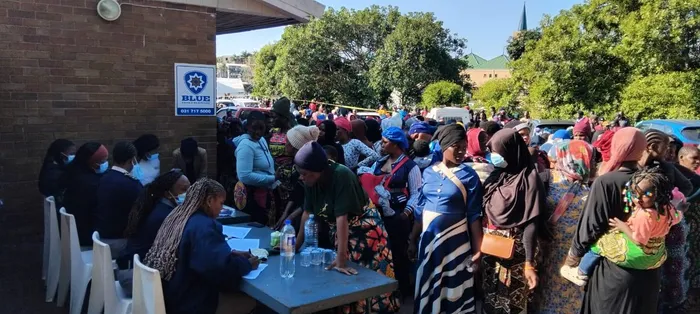
Officials from the Department of Home Affairs record the details of displaced Malawian residents that have gathered at the Sherwood Hall park in Durban.
Image: Zainul Dawood
“We are safer in Malawi,” was the common answer from Malawian residents who fled informal settlements and homes in Durban after anti-illegal immigration protests intensified.
Malawian nationals fled from wherever they were renting after receiving death threats and temporarily settled on the playground at Sherwood Hall on Sunday, with the numbers swelling to approximately 2,500 by Wednesday. Concern is mounting across South Africa over the deadline set by anti-illegal immigration groups, the Insizwa Ngobunsizwa Development Foundation and March for March, for undocumented migrants to leave the country by June 30, 2026.
On Wednesday, migration officers from the Department of Home Affairs (DHA) began processing the Malawian nationals outside the hall. Warren Burne, eThekwini ward 30 DA councillor, said DHA officials are manually recording each person's individual data, including their family in Malawi, personal details, health records and which clinics or doctors they used in Durban.
Other questions on the five-page sheet included how the person entered South Africa, the point of entry and the type of work they did.
“It is a database of the person's profile. There is a lot of data to analyse. It is useful because it will show the lifestyle and the impact each individual had in South Africa,” Burne explained.
He added that the situation changed dramatically: 75 people had arrived by midnight on Sunday, 275 by Monday, 500 by Tuesday, and approximately 2,500 by Wednesday. Malawians were still arriving from other parts of KwaZulu-Natal via mini-bus taxis and privately hired vehicles.
“It is well organised and food aid is pouring in by the hour from humanitarian organisations. I am impressed by how calm the Malawians are in this stressful situation. Tents have been provided by the Muslim community to protect the displaced community from the elements and give the women and children some privacy,” he said.
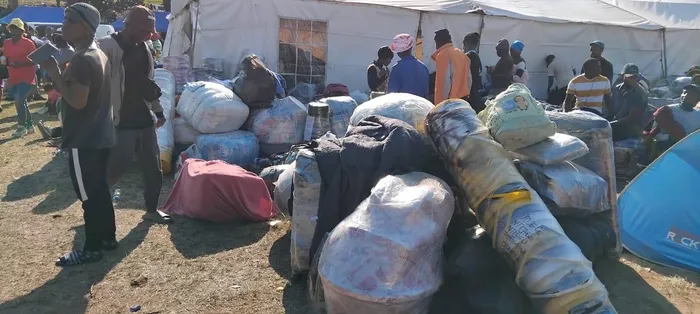
Displaced Malawian residents secure their belongings as they prepare to be transported back home following anti-immigration protests in Durban.
Image: Zainul Dawood
A woman holding triplets said she fled the shack they were renting in oThongathi, north of Durban. She had been queuing to give her details with the hope that she could go back to Malawi.
“We have lost hope here. We are safer at home. We had to leave our jobs and whatever business our husbands created to earn an income. Most people are here because they can never afford the plane ticket or bus fare home,” she said.
A man who identified himself as Bilal said criminal elements had been threatening them for several months where they lived in Clare Estate.
“These people are living among us but want to rob us of our possessions. They kept asking us for money so that we could stay here. I'd rather go back home before I am killed," he said.
Adam Ali, a representative of the Embassy of Malawi in South Africa, said processes are in place and they are working in phases to eventually transport the displaced Malawians home. Ali said safety was a priority and that the embassy was doing all it could to ensure processes are fast-tracked.
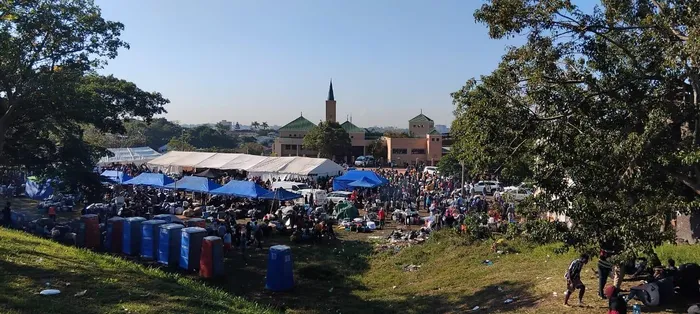
Sherwood Park in Durban where displaced Malawian residents have sought safety from anti-immigration protests in Durban.
Image: Zainul Dawood
On Tuesday, Osman Bhoola, an interim Malawian community leader, said people armed with an assortment of weapons arrived at their doors in informal settlements, threatened their lives and told them to leave the country before June 30. Bhoola said those renting houses and flats were also informed by their landlords to leave.
Burne said he was concerned that skip bins had not been provided while waste accumulated in heaps of discarded plastic and food. Burne said the SAPS's Public Order Policing Unit and Durban Metro Police will be based at Sherwood Park. Cassim Malani of the World Memon Organisation (WMO), said he was overwhelmed with the aid being provided.
Around the tents, heaps of bags and luggage wrapped in plastic are carefully watched. Meanwhile, a total of 150 Malawian nationals left South Africa under a coordinated voluntary repatriation exercise, with the first two buses departing the Western Cape on Saturday, June 6, 2026.