

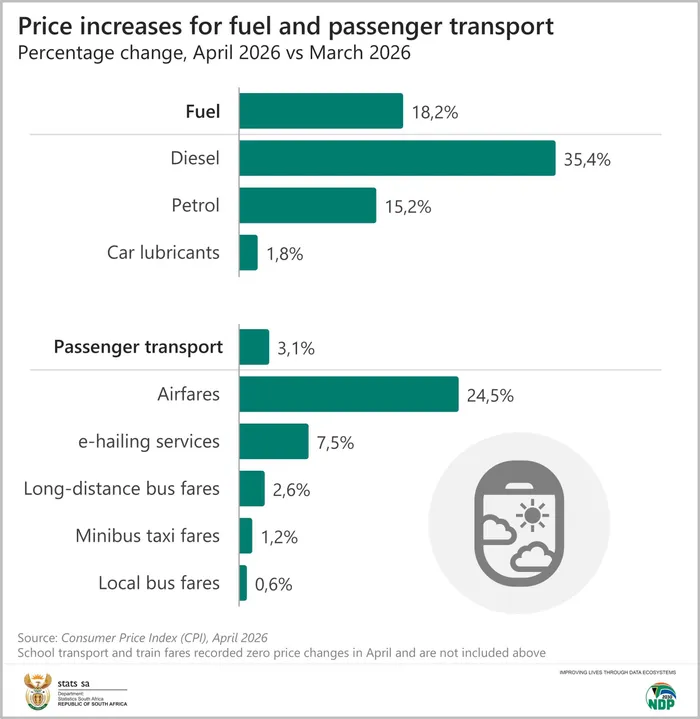
Fuel price increases have impacted on the eThekwini Municipality's fleet. The StatsSA infograph shows price increases for fuel and passenger transport.
Image: Consumer Price Index (CPI) 2026 / Statssa.gov.za
eThekwini Municipality’s fleet fuel consumption bill increased by approximately R12.8 million in April 2026 due to fuel price increases.
The municipality has a fleet of approximately 9,240 vehicles, including 450 Durban Transport buses and heavy construction plant equipment.
The municipality’s April 2026 fleet management and administration report to the Finance Committee provides an overview of fuel consumption, including total litres consumed, distance travelled, and fuel cost per month.
The fleet report also stated that vehicle availability was 92%, which is above the industry norm of 90%.
"This is an important indicator for the organisation that relies on vehicles to achieve its goals and objectives. In the municipal environment, it tells us the state of readiness we are in to deliver municipal services."
The report added that the vehicle monitoring centre actively monitors all municipal vehicles that travel outside of the eThekwini area. Notifications of usage are sent to the line managers daily, and monthly reports are thereafter escalated to the respective directors.
Also, the onboard vehicle monitoring equipment records overspeeding, which is linked to the speed limit on the route that the vehicle is travelling on. This information helps to monitor and improve driver behaviour, which helps to reduce operating costs and the risks of accidents. In February, 1,589 incidents of speeding were recorded, March 211, and April 67.
According to Statistics SA, consumer inflation jumped to 4.0% in April from 3.1% in March, driven mainly by sharp fuel price increases. This is the highest inflation print since August 2024, when the headline rate was 4.4%. The monthly change in the consumer price index (CPI) was 1.1% in April.
StatsSA stated that consumers were dealt a painful fuel price blow in April. The index for fuel rose by 18.2% from March, the steepest monthly increase since the current CPI series began in 2008.
Petrol prices were up by 15.2% and diesel by 35.4%. The price for inland 93 octane petrol rose from R20.19 per litre in March to R23.25 per litre in April. This is the fifth-largest increase for this grade in 50 years, and the biggest this century. Motorists using diesel felt the most pain. The average price for a litre of diesel jumped from R21.28 in March to R28.80 in April.
Gwede Mantashe, the Minister of Mineral and Petroleum Resources, stated that the adjustment of fuel prices was based on current local and international factors.
"South Africa’s fuel prices are adjusted monthly, informed by international and local factors. International factors include the fact that South Africa imports both crude oil and finished products at a price set at the international level, including importation costs," he said.
June's predicted adjustment could see 95 unleaded petrol reaching all-time highs of R27.42 at the coast, surpassing the previous July 2022 high of R26.90, while Gauteng residents will now pay in the region of R28.13. The wholesale price of 50ppm diesel is likely to fall to R29.66 at the coast and R30.42 inland.