

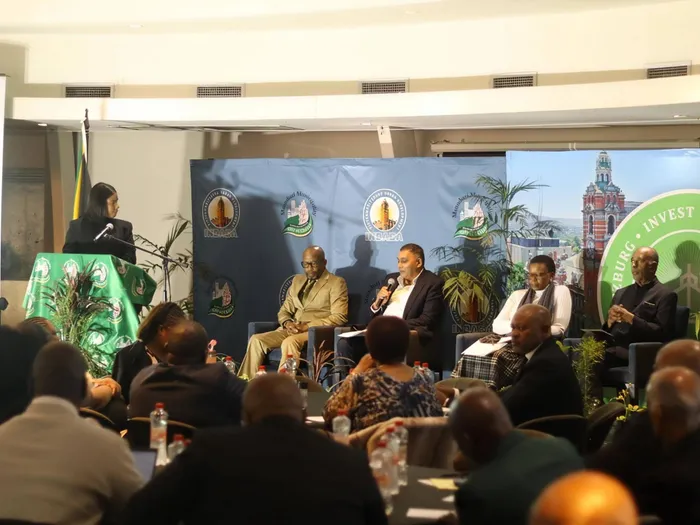
The Pietermaritzburg Urban Development Indaba focused on reversing urban decay and improving service delivery in the Msunduzi Municipality
Image: Msunduzi Municipality
Msunduzi Municipality ratepayers said there are many stumbling blocks to unlocking the potential and opportunities in the urban renewal of Pietermaritzburg.
Anthony Waldhausen, co-founder and chairperson of the Msunduzi Association of Residents, Ratepayers and Civics (MARRC), said there were creative and innovative proposals for urban renewal, which they look forward to being part of the solutions.
He was commenting after the conclusion of the Pietermaritzburg Urban Development Indaba held by the Msunduzi Municipality in partnership with Invest PMB and supported by the KwaZulu-Natal Department of Economic Development, Tourism and Environmental Affairs (EDTEA).
Anele Makhanya, the municipal spokesperson, said delegates from government, business, investors, professionals, and civil society attended with a clear focus on addressing urban decay and advancing a coordinated pathway towards urban restoration, regeneration, and economic revival of the city.
Makhanya said delegates engaged in focused discussions on reversing urban decay, improving service delivery, strengthening infrastructure, enhancing safety and law enforcement, and unlocking investment-led renewal.
“The strong participation reflected a shared commitment to restoring the city and repositioning it as functional, safe, and investment-ready,” she said.
The discussions also centred on establishing a one-stop shop for investment facilitation, strengthening the rates clearance system to improve efficiency, and operationalising a single municipal law enforcement unit to address by-law violations and urban decay.
Waldhausen suggested that the municipality address political interference, corruption, nepotism, and consequence management. Also, cadre deployment of inexperienced, unqualified staff, and the enforcement of bylaws, to ensure safety and security.
“They also need to engage all stakeholders to be involved in addressing urban renewal projects. For example, the CBD needs a major makeover, and they need to partner with formal and informal businesses and residents to address urban renewal,” he said.
Waldhausen added that a task team comprising all stakeholders needs to be established to address all the resolutions from the Indaba and provide regular updates on the progress of their implementation.
“There is great potential to make the capital city a modern African city that is safe, vibrant, and promotes all our heritage and culture. The potential of implementing many projects will provide much-needed employment opportunities for the youth and much more,” he said.
Makhanya said other discussions centered around land-use reform that aims to support inner-city regeneration and strengthen support for Small, Medium, and Micro Enterprises (SMMEs) as part of inclusive economic growth.
“The Indaba concluded with a stakeholder commitment to a joint implementation pact, ensuring that resolutions are translated into tangible action. The municipality is hopeful that the urban renewal programme will be a turning point,” she said.
Mzimkhulu Thebolla, the Mayor of Msunduzi Municipality, said their mission is not only to attract investors but to build confidence to show that this city is ready for business.
“The success of our city will not be measured by what we promise today, but by what we deliver tomorrow,” he said.
Jimmy Naidoo, the chairperson of the Northern Area Ratepayers and Residents Association (NARRA), said residents are tired of grand announcements and “indaba talk shops” with little implementation thereafter.
“Every election cycle, communities are presented with ambitious plans and promises — much like the tram train proposal that was heavily publicised years ago, yet more than a decade later nothing tangible has materialised,” he said.
Naidoo added that the municipality should prioritise addressing basic issues within its control before making further promises of regeneration and renewal. He said NARRA has lost confidence in the municipality’s ability to deliver on commitments made publicly.
“In 2024, residents were assured that both municipal crematoriums would be repaired by July 2024. That commitment was never fully honoured. To date, only one crematorium has reportedly been addressed. Residents no longer want speeches and presentations, they want accountability, implementation, and visible service delivery outcomes,” Naidoo added.
He hoped the 2026 local government elections would bring fresh leadership and renewed energy to address the challenges.