

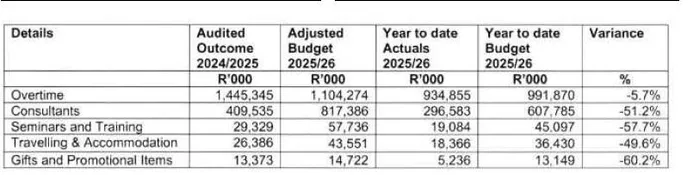
The eThekwini Municipality's cost containment measures from the budget statement report ending March 2026.
Image: Budget statement
The eThekwini Municipality’s cost containment measures have shown a 27% less spend on municipal budgets but water losses still remain a concern.
This was contained in the budget statement report for the quarter ending March 2026, presented to the municipality’s finance committee. The containment measures were approved by council in March 2020.
Detailed in the report was the year to date actual spend 2025/2026 which showed overtime R934 million (-5.7%), consultants R296 million (-51%), seminars and training R19 million (-57.7%), travelling and accommodation R18.3 million (-49.6%), gifts and promotional items R5.2 million (-60%). The total year to date actuals for 2025/2026 was R1.6 billion, a variance of -27%.
Alicia Kissoon, eThekwini ward 23 DA councillor, said the data from the report suggests that the measures implemented in March 2020 are indeed gaining traction, and if one looks at the year-to-date figures, the municipality has significant variances in discretionary spending, specifically in areas like consultants, travel, and promotional items, all of which are currently more than 40% under budget.
“However, as a public representative, I remain cautiously optimistic. While spending less is a positive indicator for the treasury, we must ensure these reductions do not come at the cost of service delivery. For instance, overtime spending shows only a marginal 5.7% reduction, and this is often where the real work of the municipality happens, from fixing water leaks to restoring electricity,” she said.
Kissoon said the municipality’s goal is not just to save money, but to ensure that every rand is used effectively and economically to serve the residents.
“We will continue to monitor these figures closely to ensure that cost containment leads to better efficiency and not a decline in municipal services,” she added.
The municipality has reported water losses of 53% of its purchases - this is above the norm of between 15 % to 30%. The newly established dedicated Non-Revenue Water branch structure has been approved, and currently, only the senior manager of the 27 posts has been filled. The remaining posts will be filled in the next financial quarter.
This branch will be implementing the NRW reduction strategy, which is linked to the Ethekwini Water and Sanitation turnaround strategy (TAS).
Speaking at a recent council meeting Bheka Ntuli, DA eThekwini councillor, said his biggest concern was water loss and the billions of rands in potential revenue it has cost the municipality. Ntuli said that ratepayers and businesses were concerned about this.
“We have a serious challenge built up from incompetence, maladministration and mismanagement in our city. In the 2006 and 2007 financial year, we recorded a 31% water loss. What went wrong, and how did we end up arriving at 53%? What message are we sending to potential investors?” Ntuli said.
Nkosenhle Madlala, an ANC councillor in eThekwini, said that the municipality was dealing with the NRW.
“Approximately 60% of people live in rural areas in KwaZulu-Natal where they rely on water tankers. We must meter every outlet of water so that we know how much we give to the area, the cost of it and how to bridge the gap for areas that lack coverage to bring about service delivery,” he said.
The budget statement also highlighted that total loans outstanding amounted to R9.8 billion with the municipality mindful that any borrowing of a long-term nature must be sustainable and affordable and in compliance with the municipality's borrowing policy and financial strategy.
The report also highlighted the challenges faced by the Energy Directorate, and the procurement of high mast streetlights that was deferred back to the Bid Evaluation Committee (BEC), resulting in the inability to spend the allocated budget of R26.8 million.
There was also R10 million delayed spend on the electricity substation security systems project due to procurement process, affecting the lead times for the equipment.