

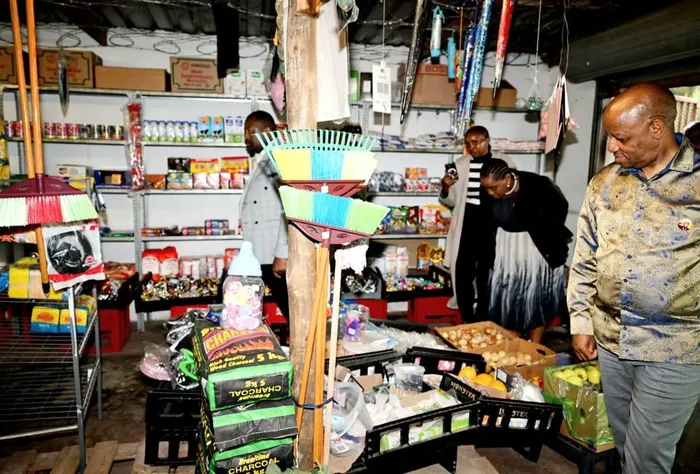
Recently, KwaZulu-Natal Premier Thamsanqa Ntuli and Department for Community Safety and Liaison head of department Nokuthula Khanyile conducted operation Engangeni Ngesango Iyafohla in the eThekwini Municipality. The objective of this operation is to ensure compliance with the Immigration Act.
Image: KwaZulu-Natal Provincial Government
KwaZulu-Natal Economic Council civil society convenor, Sizwe Cele, has addressed the challenging issue of foreign nationals out-competing locals, calling for a shift in focus from confrontation to empowerment.
While acknowledging the widespread concern over foreign-owned businesses like tuckshops, Cele’s central message is a call to action for local citizens to explore the skill sets necessary to compete effectively and reclaim lost economic ground.
Cele was speaking at the 2026 KZN Jobs and Skills Summit, where he said the presence of foreign nationals conducting businesses in townships and rural areas is 'the elephant in the room'.
He said that often, the term ‘foreign nationals’ is limited to African immigrants, overlooking those of European descent, likely due to their economic roles. Foreign investors are welcomed for their contributions to local development, while those who establish small businesses such as tuckshops are often resented as a threat to local livelihoods.
Cele noted that research revealed that a tuckshop could employ an average of four people and the closure of tens of thousands of tuckshops in KZN is damagingl.
“The question that we must ask ourselves should be how come our fellow Africans are able to come to our country and their business outcompete us in our own backyard,” Cele said.
He said ordinary South Africans are awarded government tenders with the hope that part of that award would be used to create jobs for locals. Instead, they hire foreigners at the expense of local job seekers.
“We need to explore the skill sets that our people should possess in order to be in a position to compete and win back the lost ground that is now occupied by foreign nationals. In other words, we are saying let us accept the competition positively and then begin to empower ourselves in order so that we are able to compete within our backyard,” Cele said.

Sizwe Cele, convenor of the KwaZulu-Natal Economic Council, addresses the pressing issue of competition between locals and foreign nationals.
Image: Tumi Pakkies/ Independent Newspapers
In an unrelated matter, Department of Employment and Labour Minister Nomakhosazana Meth said: “The department does not have direct jurisdiction regarding the monitoring of compliance with the policies that regulate the employment of foreign nationals. This is regulated through the Immigration Act, which is in the purview of the Department of Home Affairs.”
Meth was responding to parliamentary questions by member of parliament Joyce Basson, regarding how the DEL monitors or enforces foreign national employment compliance and SA worker protection, the steps taken to strengthen inspections and penalise non-compliant businesses, and departmental collaboration with other government bodies on foreign business adherence to SA labour and immigration laws.
Meth said that for the protection of workers, the department regulates compliance with the following Acts: Basic Conditions of Employment, National Minimum Wage, Occupational Health and Safety, Compensation for Occupational Injuries and Diseases, Unemployment Insurance and Employment Equity. The purpose of these laws is to safeguard the working environment and employment standards.
Meth said they have introduced high-impact blitz inspections targeting problematic and high-risk sectors.
“We have also strengthened collaboration with various entities, including government departments, to reinforce and maximise resources. We have also established strategic compliance-based inspections whose main aim is to drive voluntary and self-regulated inspections,” Meth said.
She added that DEL collaborates with various government departments, including Home Affairs, SAPS, and local municipal law enforcement. They conduct coordinated high-impact blitz inspections to target high-risk and problematic sectors.